
In Race for Speed, Massive Cargo Ships Are Outrun by Nimble Vessels

For years, container shipping was a rough business. Margins were minuscule, the risks were high and growth prospects bobbed with the unpredictable tides of global trade. That it's now generating record profits is one of the great economic surprises of the pandemic.
The transformation over the past year also debunks a premise expressed loudly by pundits and politicians in recent years that U.S.-China trade, the most vital route of international commerce, was heading inexorably down a path of steady decline. The world wants more from China Inc. today than ever, and — as illustrated by the containers piled high on a ship stuck in the Suez Canal this week — companies in the U.S. and Europe need it faster than before.
Accelerated by more online shopping, the demand is so strong that customers of ocean freight are increasingly willing to pay up for it, too. At Matson Inc., a Honolulu-based company with a fleet of smaller, nimbler vessels that charge a premium over the rates to transport on much larger ships, the need for a quick Shanghai-to-Los Angeles service became so great that executives decided to add a second weekly run last year and make it a permanent offering.
“I was getting calls at 2 in the morning from customers saying ‘Look, you’ve got to do something, you’ve got to help me,”’ Matthew Cox, Matson's CEO, said in an interview.
Matson’s main business is shuttling staple goods to Hawaii and Guam and it ranks outside the top 20 largest container lines. But its stock jumped almost 40% last year and the industry as a whole is healthier than ever, topping more than $200 billion in estimated revenue in 2020. It’s conceivable that the largest players including Denmark’s A.P. Moller-Maersk A/S and China’s Cosco Shipping Holdings Co. ended a tumultuous year with their most profitable quarter to date.
Another $1.9 trillion in U.S. fiscal stimulus may keep the good times going in 2021. Maersk CEO Soren Skou said on Tuesday that “we have to expect that some of that money will be used to buy goods that need to be transported.”
Still, running full steam has revealed how temperamental the backbone of the global trading system is when stretched: Crews are overworked, thousands of containers have tumbled overboard in high seas and the vessel blocking Suez threatens wider economic problems if it snarls traffic for more then a few days.
Beyond the setbacks, ocean freight companies have been propelled by a confluence of factors. First, governments from Australia to Belgium kept consumers flush with cash and their financial systems liquid. Then China’s factories and American consumers recovered quickly from last year’s initial shocks and emerged from three years of supply-and-demand turmoil — a U.S.-China trade war followed by the pandemic — still intertwined.
“China remains the manufacturing floor of the world,” Cox said in early March. “There are problems that are real and need to be dealt with, but it doesn’t change the fact that China has built a very capable network that in the short run people will find very difficult to replace.”
For six decades before Covid-19, U.S. household spending on goods declined proportionately as Americans spent more on services. That trend flipped in 2020, to the tune of a $523 billion increase in merchandise purchases, McKinsey & Co. calculates. “All the freighters and transport assets were more or less sucked up by the strong transpacific trade lane,” said Ludwig Hausmann, a partner in McKinsey’s Munich office. “China right now is unbeatable.”
In Washington and in European capitals, politicians vilified supply chains that extended to state-managed economies like China or Vietnam.
But talk to retailers and manufacturers dependent on Asia and it becomes clear the crisis reinforced those links, serving as a reminder to diversify suppliers and proving eulogies to globalization were premature. Shipping and inventory carrying costs have surged, but not enough to avoid new supply risks ranging from weather and tariffs to disease.
Trade’s Resilience
“Firms have basically decided that they can manage that and still pursue these efficiency gains,” said Robert Koopman, chief economist at the Geneva-based World Trade Organization. “That helps explain why trade has been resilient.”
Ask Heath Pittman about the crisis and he’ll tell you about three months he spent in Chicago ensuring freight kept moving so shelves stayed stocked at Rural King, an Illinois-based chain of about 125 general-merchandise stores in small-town America.
Rural King’s international logistics manager used 10 times as many 40-foot-long containers to import lawnmowers from Vietnam in 2020 than the year before. Pittman wasn’t going to be caught short in 2021 either, importing nearly triple last year’s number of containers of mowers. A consolidation facility in Vietnam will open in June, complementing five already in China, aiming to ensure enough products are always available.
“That’s a lot of costs for us and that’s a lot of risk,” Pittman said. “But the overwhelming positives that we get for our customers, we’ve determined that is worth more than being overbought.”
Demand and supply both were challenges last year for Polaris Inc., the maker of snowmobiles, motorcycles and all-terrain vehicles that had, in two strokes of pre-pandemic serendipity, already started reinforcing its supplier base a few years earlier before rebranding in 2019 to “Think Outside.”
Behind nearly 3,600 Polaris dealers is a production network feeding factories in Asia, North America and Europe. Making a single Polaris recreational vehicle involves as many as 2,000 parts, an achievement when about 10% of suppliers at any given time were under some sort of Covid-related duress, said Ken Pucel, executive vice president for global operations and engineering.
The Medina, Minnesota-based company adjusted assembly lines to make products based on what parts were available. It used more artificial intelligence and digital technology. It dispatched an employee to Los Angeles to run an operation usually left to logistics providers — the flow of container imports. “Port congestion is one of our largest supply-chain issues today,” Pucel said.
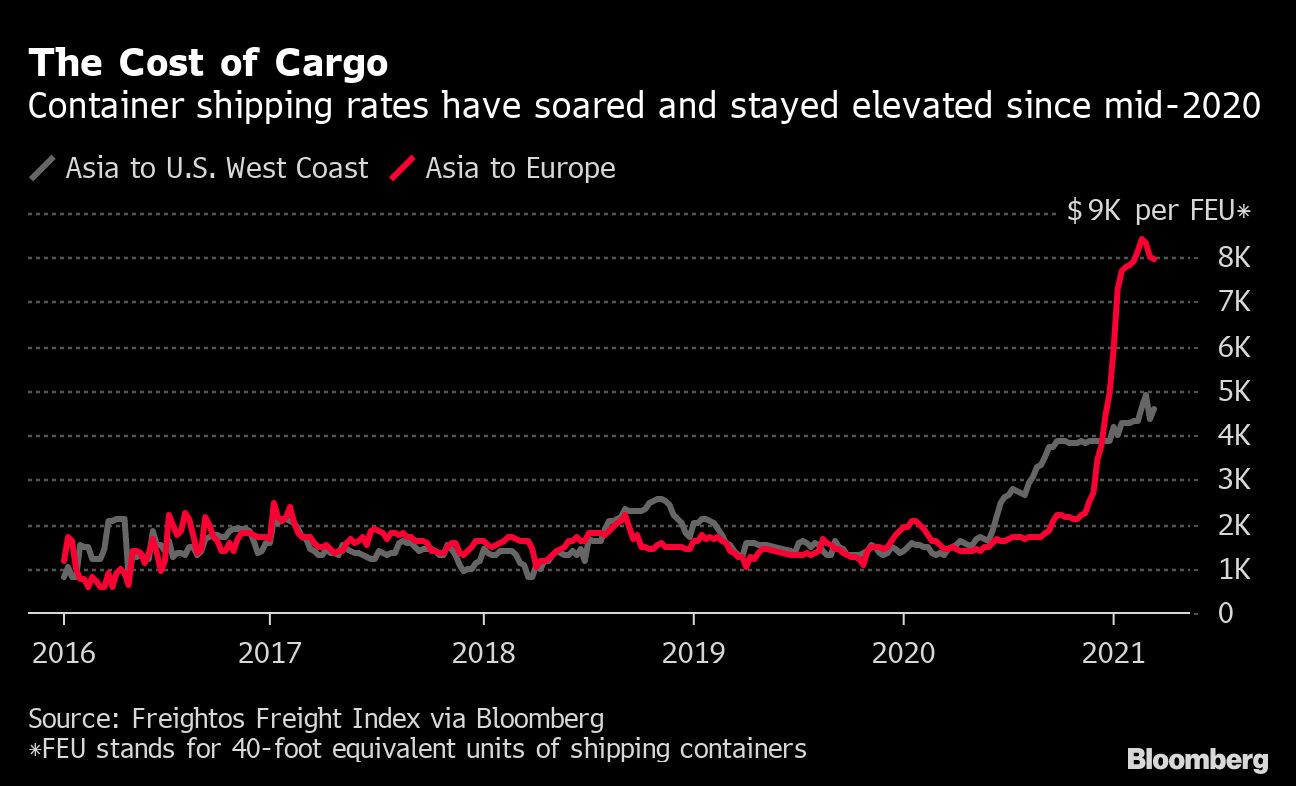
Transpacific snarls have also reached Europe, where Düsseldorf-based XSTAFF GmbH, a purchasing network for retailers and wholesalers, chartered its own cargo ship in February to help ensure members could import goods from Asia. Rates for a 40-foot container from China to Europe are hovering around $8,000, nearly quadruple the cost a year ago, and probably will stay above $5,000 at least through June, XSTAFF Chairman Bodo Knop said. “The demand side is much bigger than the supply side,” he said.
Such imbalances will eventually level out. While goods trade won’t likely return to its height in globalization’s heyday a few decades ago — expanding twice as fast as the world economy — the WTO’s Koopman expects a return to the long-term average of 1.4 times global growth.
E-commerce will keep fueling that. “A lot of people for the first time ever experienced the convenience of clicking a button and having a product show up at their door,” said Ryan Petersen, founder and CEO of Flexport, a San Francisco-based freight forwarder. “That’s an addictive thing.”
Petersen reckons better technology will help the shift to more speed and complexity, but doesn’t anticipate “big dramatic shifts” in supply chains or production locations.
John McCown, the founder of Blue Alpha Capital, has seen plenty of shipping booms and busts. His mentor was Malcom McLean, the North Carolina trucking executive who pioneered containerization in the 1950s. If a worldwide shock like a pandemic could pick its prey, an industry with high fixed costs like massive ships seemed to be among the slow buffalo. “A real bloodbath is what I was thinking,” McCown said.
Instead, container lines stuck together and didn’t repeat price wars that wrecked them in the past. McCown now estimates the carriers he tracks, both publicly held and private ones, will show record net income of $8.4 billion in the fourth quarter. Container services are cheap even at today’s elevated rates, he says, recounting how McLean was friends with Sam Walton, the founder of Walmart Inc. Both enjoyed quail hunting and one time McLean asked the key to the retailer’s success. According to McCown, Walton responded, “We’re just better at moving things around.”
Popular Stories


100 Great Supply Chain Partners 2026: The Secret to Supply Chain Success
VIEW THE LATEST ISSUECase Studies


Visit Our Sponsors |
|
|
|
|
|
|
|
|
|
|
|
|
|
|
|
|
|
|
|
|
|
|
|
|
|
|
|
|
|
|
|
|
|
|
|
|
|
|
|
|
|
|
|
|
|
|
|
|
|
|
|