
• Advertise
  • Contact Us
  • Supplier Directory
  • SCB YouTube
  • About Us
  • Login
  • Subscribe
  • Logout
  • My Profile
  • LOGISTICS
    • Air Cargo
    • All Logistics
    • Facility Location Planning
    • Freight Forwarding/Customs Brokerage
    • Global Gateways
    • Global Logistics
    • Last Mile Delivery
    • Logistics Outsourcing
    • LTL/Truckload Services
    • Ocean Transportation
    • Parcel & Express
    • Rail & Intermodal
    • Reverse Logistics
    • Service Parts Management
    • Transportation & Distribution
  • TECHNOLOGY
    • All Technology
    • Artificial Intelligence
    • Cloud & On-Demand Systems
    • Data Management (Big Data/IoT/Blockchain)
    • ERP & Enterprise Systems
    • Forecasting & Demand Planning
    • Global Trade Management
    • Inventory Planning/ Optimization
    • Product Lifecycle Management
    • Robotics
    • Sales & Operations Planning
    • SC Finance & Revenue Management
    • SC Planning & Optimization
    • Supply Chain Visibility
    • Transportation Management
  • GENERAL SCM
    • Business Strategy Alignment
    • Customer Relationship Management
    • Education & Professional Development
    • Global Supply Chain Management
    • Global Trade & Economics
    • Green Energy
    • HR & Labor Management
    • Quality & Metrics
    • Regulation & Compliance
    • Sourcing/Procurement/SRM
    • SC Security & Risk Mgmt
    • Supply Chains in Crisis
    • Sustainability & Corporate Social Responsibility
  • WAREHOUSING
    • All Warehouse Services
    • Conveyors & Sortation
    • Lift Trucks & AGVs
    • Order Management & Fulfillment
    • Packaging
    • RFID, Barcode, Mobility & Voice
    • Warehouse Automation
    • Warehouse Management Systems
  • INDUSTRIES
    • Aerospace & Defense
    • Apparel
    • Automotive
    • Chemicals & Energy
    • Consumer Packaged Goods
    • E-Commerce/Omni-Channel
    • Food & Beverage
    • Healthcare
    • High-Tech/Electronics
    • Industrial Manufacturing
    • Pharmaceutical/Biotech
    • Retail
  • THINK TANK
  • WEBINARS
    • On-Demand Webinars
    • Upcoming Webinars
    • Webinar Library
  • PODCASTS
  • WHITEPAPERS
  • VIDEOS
Home » Business Strategy Alignment » Workforce Turnover Can Be Improved With Detailed Analysis

Workforce Turnover Can Be Improved With Detailed Analysis
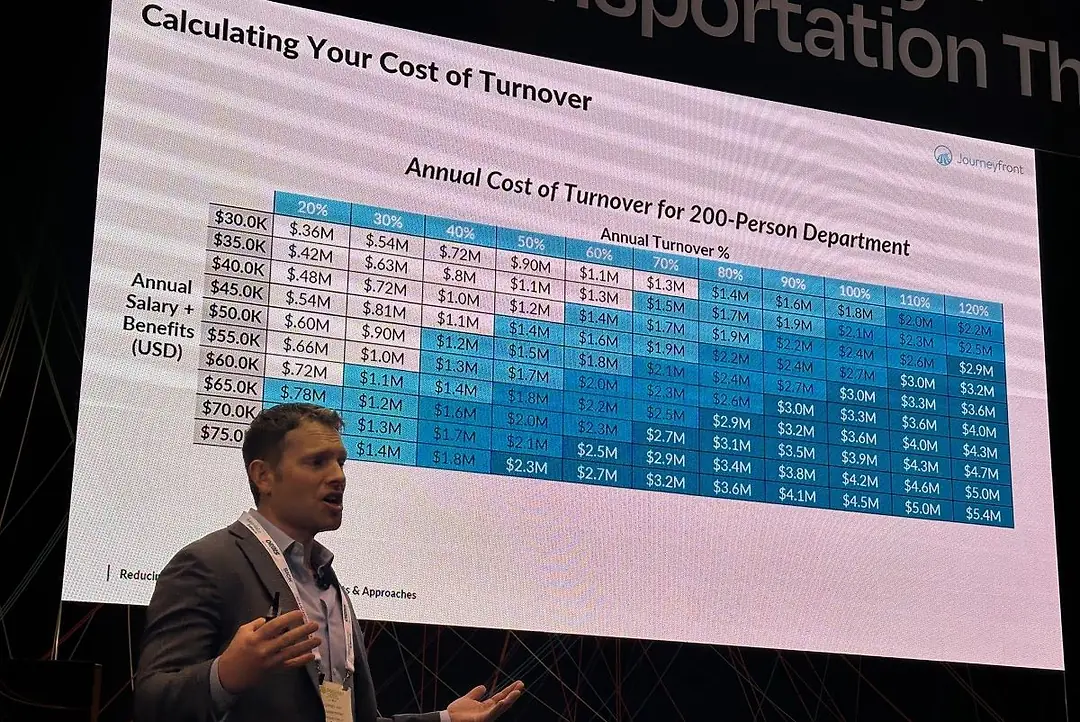
A MAN IN A JACKET HOLDING A MICROPHONE SPEAKS IN FRONT OF A LARGE SCREEN SHOWING A CHART

Daniel Ash, CEO of hiring platform Journeyfront, speaks at ProMat 2025. Photo: Helen Atkinson

March 19, 2025
Helen Atkinson, Managing Editor

Ever heard the adage: “People don’t leave jobs; they leave bosses”? That’s a vast over-simplification, says Daniel Ash, chief executive officer of Journeyfront, a hiring platform. He asked an audience at the ProMat 2025 supply chain conference in Chicago March 18 to consider a job where they might have liked the manager, but left the job anyway. Clearly, a bad boss can’t always be the main reason for workforce turnover. “That’s only a fraction of the problem,” he said.

The danger, Ash believes, is oversimplifying workforce turnover on the one hand — blaming it on a single factor such as hourly pay or shift flexibility — or else concluding that the issue is so complicated that it can’t be solved. 

The problem can be fixed, and it desperately needs to be fixed, according to Ash and his co-presenter, Zach Peluso, director of talent acquisition at KeHe, a food distributor. According to a comprehensive study by The Department of Labor, replacing a worker costs 30% of that worker’s annual salary, because of screening and hiring a new worker, plus paying other workers over-time to cover the departed worker, and then training a new worker to the point where they are productive. 

And those are just the tangible costs, said Ash. If you add in intangibles — such as the impact on customer service and sales, or the fact that other workers often decide they’ll join a co-worker in leaving, let alone the company’s reputation as an employer (the “employee brand,” as Ash terms it) — those costs can rise to 100-200% of a worker’s annual salary.

Worse, those costs tend to be spread out across multiple departments, so they can be hard to see; that is, before they hit the bottom line. And, in the meantime, faced with high worker turnover, companies can adopt strategies that fail to fix, or can even exacerbate the problem. At the ProMat session, entitled “Reducing Workforce Turnover: Proven Research and Approaches,” Peluso described the way KeHe lowered the bar for hiring during COVID, when there was intense competition for warehouse workers. “Turnover was terrible,” he said. “If you could mist a mirror, you got the job.” As a result, the company fell into a vicious cycle, where increased turnover led to being under-staffed, which in turn led to paying huge amounts of over-time. Adopting a more selective hiring process turned this into a virtuous cycle, and over the course of two years, the company reduced worker turnover by 50% — delivering an estimated saving of $15 million.

How did they do it? In part, by gathering more detailed data about who they were hiring, why they stayed and why they left, via exit surveys and interviews, management and employee group panels, and analytics that compared data gathered during the hiring process with the eventual stay-or-leave outcome. 

There are three main drivers of workforce turnover, according to a 2017 meta study of a wide number of studies on voluntary employee turnover, Ash explained: Market-related, such as there being other job options with the warehouse across town; job-related, such as job security, positive employee feedback, or workload; and person-related, which tends to be more about overall career satisfaction or work-life balance. “Not having a broad awareness of what’s going on, you can miss what you need to do to address this problem,” said Ash. “There’s a lot going on!”  

After deciding to fix its turnover problem, KeHe used the data it gathered to investigate whether their job descriptions were accurate, and whether they got the right information at interview, for example. Then they went after the range of employees who were likely to answer while employed at the company that they were “satisfied” enough to stay, instead of those who ended up reporting they were “very satisfied,” or by contrast those who were “very dissatisfied” and left. 

One particularly innovative change of strategy was to turn away from pursuing only workers with prior “relevant” experience, such as in warehouses or distribution centers. Instead, KeHe accepted and sought out applications from people who had worked in “non-aligned” but equally high-pressure businesses such as fast food or the construction industry. The results were surprising. “It turns out, bricklayers are our best palletizers,” Peluso said.

Of course, pay rates are a factor. But both Peluso and Ash agreed that it’s a mistake to assume that offering a higher hourly wage will automatically reduce worker turnover. And, if you’re going to determine if raising wages makes a difference, it’s best to do it in one location and conduct A/B testing to see if it actually works. 

In every case, there’s an extraordinary amount of insight into why workers stay and leave that can be mined from careful collection and analysis of data. 

“Turnover is expensive, but you can fix it,” said Ash. “It just has to be data-driven.”

    RELATED CONTENT

    RELATED VIDEOS

    Business Strategy Alignment Education & Professional Development HR & Labor Management All Warehouse Services Apparel Consumer Packaged Goods E-Commerce/Omni-Channel Food & Beverage Retail
    • Related Articles

      How Three Warehouse Problems Can Be Solved With Automation

      How Cloud Can Be Supplied to Human Resources Now

    • Related Directories

      Tecsys, Inc.

      ProcureAbility

    Helen Atkinson, Managing Editor

    Report: Effects of Tariff Turmoil Already Visible at Stores

    More from this author

    Subscribe to our Daily Newsletter!

    Timely, incisive articles delivered directly to your inbox.

    Featured Product

    Popular Stories

    • An overhead view of a port, with stacks of containers and vehicles moving through rows

      Podcast | AI in Supply Chain Planning: Impact, Promise and Limits

      Artificial Intelligence
    • A BLUE CROSSOVER AUTOMOBILE SITS ON A GREY SHOWROOM FLOOR

      Toyota Commits to Making Cars in Canada as U.S. Rivals Downsize

      Global Supply Chain Management
    • A cartoon illustration of a man sitting at a desk in front of a laptop, surrounded by five faceless humanoid robots

      The Productivity Story Everyone is Missing

      Technology
    • A row of semi-truck cabs, with a red truck in the foreground, parked next to four white trucks, two more red ones, and three blue ones

      USDOT Announces $200M in Funding for Commercial Truck Parking

      Logistics
    • A red and black container ship in open ocean

      Hormuz Attacks Against Commercial Shipping Reach Record Highs

      Global Gateways

    Digital Edition

    Scb q3 26 cover

    100 Great Supply Chain Partners 2026: The Secret to Supply Chain Success

    VIEW THE LATEST ISSUE

    Case Studies

    • Recycled Tagging Fasteners: Small Changes Make a Big Impact

    • A GRAPHIC SHOWING MULTIPLE FORMS OF SHIPPING, WITH A HUMAN STANDING AT THE CENTER, TOUCHING A SYMBOLIC MAP OF THE WORLD

      Enhancing High-Value Electronics Shipment Security with Tive's Real-Time Tracking

    • A GRAPHIC OF INTERLACING HONEYCOMBED ELEMENTS REPRESENTING GLOBAL BUSINESS TRANSACTIONS

      Moving Robots Site-to-Site

    • JLL Finds Perfect Warehouse Location, Leading to $15M Grant for Startup

    • Robots Speed Fulfillment to Help Apparel Company Scale for Growth

    Visit Our Sponsors

    4flow Amazon Freight Anaplan
    Arkieva AutoStore Blue Yonder
    Canadian National Railway Company Carton Cloud CoEnterprise
    Dassault Descartes Dexory
    Duravant E2Open EPG
    General Logistics Systems GEP Hy-Tek
    iGPS Knapp Korber
    Lyngsoe Odyssey Logistics OMP
    PeakAI Procurability Quinyx
    SAP Sikick Staples
    S&P Global Mobility Systech TADA
    Tive TransImpact US Bank
    Werner WSI
    • More From SCB
      • Featured Content
      • Video Library
      • Think Tank Blog
      • SupplyChainBrain Podcast
      • Whitepapers
      • On-Demand Webinars
      • Upcoming Webinars
    • Digital Offerings
      • Digital Issue
      • Subscribe
      • Manage Email Preferences
      • Newsletters
    • Resources
      • Events Calendar
      • 2026 Event Coverage
      • SCB's Great Supply Chain Partners
      • Supplier Directory
      • Case Study Showcase
      • Supply Chain Innovation Awards
      • 100 Great Partners Form
    • SCB Corporate
      • Advertise on SCB.COM
      • About Us
      • Privacy Policy
      • Contact Us
      • Data Sharing Opt-Out

    All content copyright ©2026 Keller International Publishing Corp All rights reserved. No reproduction, transmission or display is permitted without the written permissions of Keller International Publishing Corp

    Design, CMS, Hosting & Web Development :: ePublishing