
EXECUTIVE OPINION
Warehouse P2G Robotics: A Flexible and Affordable Solution
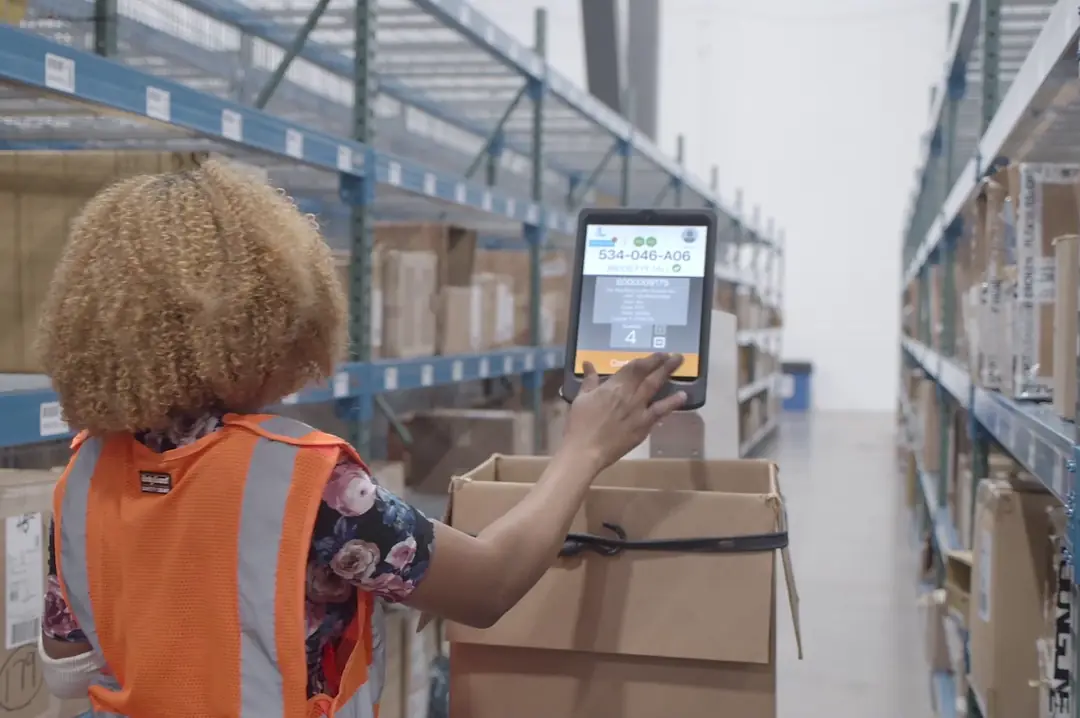
Photo: Locus Robotics
Shippers and 3PLs face an increasingly demanding and chaotic supply chain environment, with the warehouse a critical focal point. As operators struggle to build agility and scale while they manage costs, the use case for person-to-goods (P2G) robotics is more compelling than ever.
The message from markets is finally sinking in with shippers and 3PLs after nearly a decade of conflicting economic signals, demand volatility and heightened customer expectations: Uncertainty is the only certainty; risk, complexity and costs aren’t likely to ease, and no help is coming. Just be prepared for anything and keep going.
The warehouse, meanwhile, has been elevated from afterthought to a central player, as new demands and responsibilities are placed on supply chains — from small-batch wave picking and reverse logistics to deeper supplier collaboration, and tariff and sustainability compliance. Each requires specialized expertise, careful planning and targeted investment. Automation and artificial intelligence are a given, including in smaller, often older warehouses closer to customers but never configured for high-volume throughput.
As they evaluate warehouse automation solutions, chief financial officers are rightly focused on short-term versus long-term financial impact, flexibility and risk mitigation. While fixed automated storage and retrieval systems (AS/RS) and goods-to-person (G2P) systems have been the default option in warehouses for years, they are costly and mostly designed for an earlier B2B environment of larger orders, longer storage and less frequent throughput.
The good news for CFOs is that they have options. P2G automation offers a flexible, easily scalable alternative, deploying autonomous mobile robots (AMRs) under a subscription model. AMRs don’t require costly or disruptive fixed installation, and they navigate the warehouse with a mix of location-based software and radar to avoid obstacles. They provide optimized pick, putaway and replenishment functions, working with the human workforce to reduce travel time, errors and repetitive stress.
The robots-as-a-service (RaaS) subscription model allows the flexibility to scale up and down to align with a leaner permanent human workforce to meet seasonal or other variable demand. This plug-and-play flexibility offers distinct, compelling financial advantages that warrant a closer look from CFOs facing tough investment choices in an uncertain market.
Cost Structure, Cash Flow and ROI
Companies balance capital expenditures and operating expenses to optimize financial performance. P2G systems, particularly when provided with leased robots under an RaaS model, are generally treated as OpEx, which is more than offset by immediate operating savings.
Warehouses are then able to spread out automation costs over time rather than committing to a lump-sum investment upfront, which helps them maintain financial flexibility as they gain efficiency through robotics.
Return on investment (ROI) is a further consideration. While AS/RS and G2P payback periods are typically measured in years due to the significant capital outlay and lengthy implementation, P2G implementation can generate ROI in under 12 months, with significantly lower annual payments under the RaaS model, freeing up capital for other strategic initiatives.
Scalability and Flexibility
Warehouses experience fluctuations in demand due to seasonal peaks, new contracts or shifting customer needs. Owners and lessees benefit from automation capacity that can be dynamically aligned with warehouse demand.
Fixed conveyor, automated guided vehicle (AGV) and other systems require significant embedded infrastructure that cannot be easily modified once in place, let alone relocated, as warehouse networks are reconfigured.
P2G, by contrast, simplifies a business’s ability to continuously right-size its automation footprint as volumes shift, and it’s not just volumes, but also SKU profiles. In sectors where product assortments shift throughout the year, for example, AS/RS may require different bin sizes to accommodate new inventory, while P2G operates independently of bin structures, allowing for seamless transitions.
This agility is particularly valuable for third-party logistics (3PL) providers that operate predominantly in leased buildings and have end customer contracts that are typically seven years or less. Lighter, smaller robots can easily navigate narrow aisles, a pick tower or a mezzanine in either brownfield or greenfield facilities.
Risk Mitigation and Financial Stability
The same flexibility helps mitigate longer-term financial risk. 3PLs, for example, rely on contracts with customers that can change over time. If a major customer leaves, an AS/RS investment could become a stranded asset that sits on the balance sheet and drags down financial metrics such as return on asset (RoA) or other profitability measures. With P2G, warehouses avoid being locked into costly, underutilized infrastructure.
The risk to business continuity is a further concern. An AS/RS can experience significant downtime if a component fails; more resilient P2G systems continue operating without major disruption if one robot goes offline, and some can continue to function during temporary internet or power outages.
Business Growth and Customer Acquisition
Beyond just cost savings, automation drives new revenue generation. Many 3PLs increasingly use P2G automation as a competitive differentiator when bidding for new business. Demonstrating the use of robotics in fulfillment can provide confidence to prospective customers, reinforcing that the operation is designed for efficiency, scalability and cost control.
A final plus for warehouse operations has been the workforce impact of P2G solutions. In a typical warehouse, AMRs function as a force multiplier, enabling the same number of people to handle more freight easily. Operators benefit from faster, error-free workflow and save on new employee training and onboarding costs; workers benefit from reduced travel time, normal schedules, and less repetitive stress from pick and putaway activities.
Surveys also suggest greater worker satisfaction and engagement when aided by technology, translating into less churn and improved customer satisfaction with the company’s overall performance.
Making the Right Calculation
Multiple factors will play into the warehouse automation selection process; among them are a company’s long-term growth plans, expected warehouse volume, SKU fluctuations and the likely availability and cost of capital and labor.
P2G automation provides flexibility in uncertain market conditions, ensuring that warehouses can improve metrics in quality, delivery and outbound and inbound operational efficiency.
For CFOs focused on optimizing cash flow, managing risk and delivering measurable results, P2G provides a flexible, affordable option for implementing automation quickly, scaling as needed and aligning costs with business cycles.
Popular Stories




100 Great Supply Chain Partners 2026: The Secret to Supply Chain Success
VIEW THE LATEST ISSUECase Studies


Visit Our Sponsors |
|
|
|
|
|
|
|
|
|
|
|
|
|
|
|
|
|
|
|
|
|
|
|
|
|
|
|
|
|
|
|
|
|
|
|
|
|
|
|
|
|
|
|
|
|
|
|
|
|
|
|