
• Advertise
  • Contact Us
  • Supplier Directory
  • SCB YouTube
  • About Us
  • Login
  • Subscribe
  • Logout
  • My Profile
  • LOGISTICS
    • Air Cargo
    • All Logistics
    • Facility Location Planning
    • Freight Forwarding/Customs Brokerage
    • Global Gateways
    • Global Logistics
    • Last Mile Delivery
    • Logistics Outsourcing
    • LTL/Truckload Services
    • Ocean Transportation
    • Parcel & Express
    • Rail & Intermodal
    • Reverse Logistics
    • Service Parts Management
    • Transportation & Distribution
  • TECHNOLOGY
    • All Technology
    • Artificial Intelligence
    • Cloud & On-Demand Systems
    • Data Management (Big Data/IoT/Blockchain)
    • ERP & Enterprise Systems
    • Forecasting & Demand Planning
    • Global Trade Management
    • Inventory Planning/ Optimization
    • Product Lifecycle Management
    • Robotics
    • Sales & Operations Planning
    • SC Finance & Revenue Management
    • SC Planning & Optimization
    • Supply Chain Visibility
    • Transportation Management
  • GENERAL SCM
    • Business Strategy Alignment
    • Customer Relationship Management
    • Education & Professional Development
    • Global Supply Chain Management
    • Global Trade & Economics
    • Green Energy
    • HR & Labor Management
    • Quality & Metrics
    • Regulation & Compliance
    • Sourcing/Procurement/SRM
    • SC Security & Risk Mgmt
    • Supply Chains in Crisis
    • Sustainability & Corporate Social Responsibility
  • WAREHOUSING
    • All Warehouse Services
    • Conveyors & Sortation
    • Lift Trucks & AGVs
    • Order Management & Fulfillment
    • Packaging
    • RFID, Barcode, Mobility & Voice
    • Warehouse Automation
    • Warehouse Management Systems
  • INDUSTRIES
    • Aerospace & Defense
    • Apparel
    • Automotive
    • Chemicals & Energy
    • Consumer Packaged Goods
    • E-Commerce/Omni-Channel
    • Food & Beverage
    • Healthcare
    • High-Tech/Electronics
    • Industrial Manufacturing
    • Pharmaceutical/Biotech
    • Retail
  • THINK TANK
  • WEBINARS
    • On-Demand Webinars
    • Upcoming Webinars
    • Webinar Library
  • PODCASTS
  • WHITEPAPERS
  • VIDEOS
Home » Blogs » Think Tank » The Singapore Supply Chain Blueprint: Lessons From the Amazon-UPS ‘Great De-Coupling’

Think Tank
Think Tank RSS FeedRSS

The Singapore Supply Chain Blueprint: Lessons From the Amazon-UPS ‘Great De-Coupling’

A white airplane with a brown tail and wings, flying through the air on a cloudy day
Photo: iStock / SCM Jeans
January 29, 2026
Raymon Krishnan, SCB Contributor

The shockwaves from Seattle and Atlanta have officially reached the Straits. With Amazon slashing 30,000 corporate roles and UPS announcing an additional 30,000 job cuts for 2026, the global logistics industry is undergoing a great de-coupling. For Singapore, a nation that serves as the logistics nervous system for Asia, this is more than a news headline; it’s a structural mandate to evolve.

As UPS executes its "Amazon accelerated glide-down," slashing millions of low-margin deliveries to pivot toward high-yield sectors like healthcare, the third-party logistics landscape is being split in two. On one side sits the algorithmic giant (Amazon), trading human managers for artificial intelligence; on the other sits the premium specialist (UPS), trading volume for margin. For Singapore’s logistics ecosystem, this split creates both a talent crisis and a massive opportunity.

The Hollowing of Asia’s "Middle Layer"

Amazon’s corporate cuts, dubbed "Project Dawn," are hitting regional headquarters across Singapore, India and Costa Rica. By removing 10% of its white-collar workforce, Amazon is signalling that its generative AI tools, designed to automate everything from demand forecasting to vendor management, are now mature enough to replace middle management.

For Singapore, which has long positioned itself as the management hub for multinationals in Asia, this is a warning shot. If the "middle layer" of logistics can be automated in Seattle, it can certainly be automated in Jurong. We’re moving from an era where Singapore provided the people to manage regional flows, to an era where it must provide the code and compliance to oversee automated ones. This is a gap which the city state has not yet managed to provide a blueprint or pathway to bridge.

UPS’s Roadmap for ASEAN 3PLs

UPS’s decision to purge Amazon volume, labeled "extraordinarily dilutive" by chief executive officer Carol Tomé, should be the north star for Southeast Asian logistics firms. For too long, regional 3PLs have been locked in a "race to the bottom" on price, fuelled by the explosive but low-margin growth of e-commerce platforms like Shopee and Lazada.

This is something I learned the hard way when I started my logistics company in the late 90’s during the Asian economic crisis with just $500. In just under three years, we grew to more than 70 Singaporean employees, with branches in Malaysia and Indonesia. In a race to the bottom to secure new business, I spent a lot of my day finding ways to cover payroll and operating costs just to stay afloat. One day I came to the realization that bigger is not better. 

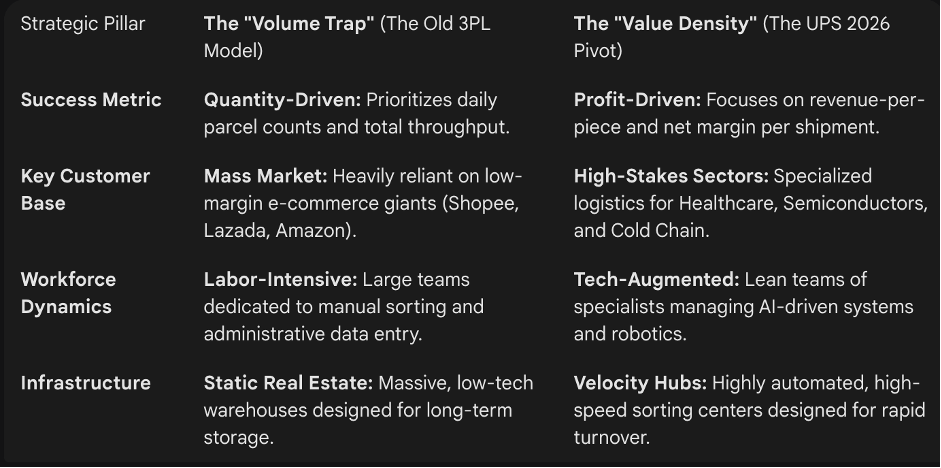
UPS appears to have reached that same decision point. By shuttering 24 facilities and cutting 25 million work-hours to focus on healthcare and B2B, the parcel giant is showing that the future of logistics in high-cost hubs like Singapore lies in value density, not package density.

The table below outlines the fundamental shift from the traditional model (which Amazon is now automating) to the high-margin model UPS is pursuing to survive the "Amazon Divorce." 
Krishnan.png 

Why This Matters for Singapore

In a high-cost environment like Singapore, the volume trap is a recipe for obsolescence. Local firms cannot out-scale Amazon's automation, but they can out-specialize it. By adopting the value density model, Singaporean 3PLs can transform from commodity movers into essential partners for Asia's most critical industries.

While 60,000 jobs are disappearing globally, the demand for trust-based logistics is higher than ever. As Amazon and UPS de-couple, the global supply chain is becoming more fragmented and regionalized.

Singapore’s opportunity lies in becoming the neutral control tower. While Amazon moves toward a closed-loop, AI-driven monopoly, and UPS moves toward high-end niches, there is a massive vacuum for a hub that can integrate these disparate systems. Singapore’s strengths, such as regulatory clarity, stable government and a workforce that understands both logistics brawn and tech brain, make it the ideal place to orchestrate this new, fragmented reality.

The Amazon-UPS divorce is a wake-up call for every logistician in Asia. The bureaucracy tax is no longer affordable. If your firm’s value proposition is simply moving boxes from A to B using manual management layers, you are standing in the path of an algorithmic steamroller.

Whether we’re watching the rise of Amazon’s robotic "Project Dawn" or UPS’s aggressive margin-cleansing, the message to Singapore is clear: Don't compete on volume; dominate on orchestration. The trucks and planes will always be there, but the profit will belong to those who own the data that directs them.

Raymon Krishnan is president of The Logistics & Supply Chain Management Society.

Logistics Outsourcing Parcel & Express Artificial Intelligence

RELATED CONTENT

RELATED VIDEOS

Subscribe to our Daily Newsletter!

Timely, incisive articles delivered directly to your inbox.

Featured Product

Popular Stories

  • On Demand - Webinar Descartes Tue Jun 23 2026 11a ET.png

    Descartes AI Exchange: AI Agents for Fleet Performance Management

    General SCM
  • A UNIFORMED OFFICER STANDS NEAR A HIGHWAY WITH TRUCKS ON IT

    U.S. Customs Ramps Up AI Investment in Push to Sharpen Enforcement

    Artificial Intelligence
  • On Demand Webinar - Arkieva - Wed Jun 24 2026 2p ET.png

    Shift Left Planning: Why Many Plans Fail to Execute—and How to Fix It

    Webinars
  • A MAP OF THE STRAIT OF HORMUZ SHOWING DOZENS OF BLUE DOTS DISTRIBUTED THROUGHOUT THE WATERWAY

    Traffic Flows Through Hormuz Despite Shock Ship Attack

    Global Gateways
  • Satellite view of the Strait of Hormuz with white graphic lines representing global shipping lanes and maritime traffic between the Persian Gulf and Gulf of Oman.

    Hormuz Highlights How Maritime Risk Assessment Needs to Change

    Global Gateways

Digital Edition

2026 esg cover main scb q2 2026 cover

SupplyChainBrain 2026 ESG Guide: ESG — The Supply Chain’s Biggest Secret

VIEW THE LATEST ISSUE

Case Studies

  • Recycled Tagging Fasteners: Small Changes Make a Big Impact

  • A GRAPHIC SHOWING MULTIPLE FORMS OF SHIPPING, WITH A HUMAN STANDING AT THE CENTER, TOUCHING A SYMBOLIC MAP OF THE WORLD

    Enhancing High-Value Electronics Shipment Security with Tive's Real-Time Tracking

  • A GRAPHIC OF INTERLACING HONEYCOMBED ELEMENTS REPRESENTING GLOBAL BUSINESS TRANSACTIONS

    Moving Robots Site-to-Site

  • JLL Finds Perfect Warehouse Location, Leading to $15M Grant for Startup

  • Robots Speed Fulfillment to Help Apparel Company Scale for Growth

Visit Our Sponsors

4flow Arkieva Blue Yonder
Carton Cloud CoEnterprise Dassault
Duravant E2Open General Logistics Systems
Hy-Tek iGPS Korber
Lyngsoe Procurability Quinyx
SAP Sikick Systech
S&P Global Mobility TADA TransImpact
US Bank Werner Enterprises WSI
  • More From SCB
    • Featured Content
    • Video Library
    • Think Tank Blog
    • SupplyChainBrain Podcast
    • Whitepapers
    • On-Demand Webinars
    • Upcoming Webinars
  • Digital Offerings
    • Digital Issue
    • Subscribe
    • Manage Email Preferences
    • Newsletters
  • Resources
    • Events Calendar
    • 2026 Event Coverage
    • SCB's Great Supply Chain Partners
    • Supplier Directory
    • Case Study Showcase
    • Supply Chain Innovation Awards
    • 100 Great Partners Form
  • SCB Corporate
    • Advertise on SCB.COM
    • About Us
    • Privacy Policy
    • Contact Us
    • Data Sharing Opt-Out

All content copyright ©2026 Keller International Publishing Corp All rights reserved. No reproduction, transmission or display is permitted without the written permissions of Keller International Publishing Corp

Design, CMS, Hosting & Web Development :: ePublishing