
• Advertise
  • Contact Us
  • Supplier Directory
  • SCB YouTube
  • About Us
  • Login
  • Subscribe
  • Logout
  • My Profile
  • LOGISTICS
    • Air Cargo
    • All Logistics
    • Facility Location Planning
    • Freight Forwarding/Customs Brokerage
    • Global Gateways
    • Global Logistics
    • Last Mile Delivery
    • Logistics Outsourcing
    • LTL/Truckload Services
    • Ocean Transportation
    • Parcel & Express
    • Rail & Intermodal
    • Reverse Logistics
    • Service Parts Management
    • Transportation & Distribution
  • TECHNOLOGY
    • All Technology
    • Artificial Intelligence
    • Cloud & On-Demand Systems
    • Data Management (Big Data/IoT/Blockchain)
    • ERP & Enterprise Systems
    • Forecasting & Demand Planning
    • Global Trade Management
    • Inventory Planning/ Optimization
    • Product Lifecycle Management
    • Robotics
    • Sales & Operations Planning
    • SC Finance & Revenue Management
    • SC Planning & Optimization
    • Supply Chain Visibility
    • Transportation Management
  • GENERAL SCM
    • Business Strategy Alignment
    • Customer Relationship Management
    • Education & Professional Development
    • Global Supply Chain Management
    • Global Trade & Economics
    • Green Energy
    • HR & Labor Management
    • Quality & Metrics
    • Regulation & Compliance
    • Sourcing/Procurement/SRM
    • SC Security & Risk Mgmt
    • Supply Chains in Crisis
    • Sustainability & Corporate Social Responsibility
  • WAREHOUSING
    • All Warehouse Services
    • Conveyors & Sortation
    • Lift Trucks & AGVs
    • Order Management & Fulfillment
    • Packaging
    • RFID, Barcode, Mobility & Voice
    • Warehouse Automation
    • Warehouse Management Systems
  • INDUSTRIES
    • Aerospace & Defense
    • Apparel
    • Automotive
    • Chemicals & Energy
    • Consumer Packaged Goods
    • E-Commerce/Omni-Channel
    • Food & Beverage
    • Healthcare
    • High-Tech/Electronics
    • Industrial Manufacturing
    • Pharmaceutical/Biotech
    • Retail
  • THINK TANK
  • WEBINARS
    • On-Demand Webinars
    • Upcoming Webinars
    • Webinar Library
  • PODCASTS
  • WHITEPAPERS
  • VIDEOS
Home » Blogs » Think Tank » The Strait of Hormuz: Walking a Tightrope

Think Tank
Think Tank RSS FeedRSS

The Strait of Hormuz: Walking a Tightrope

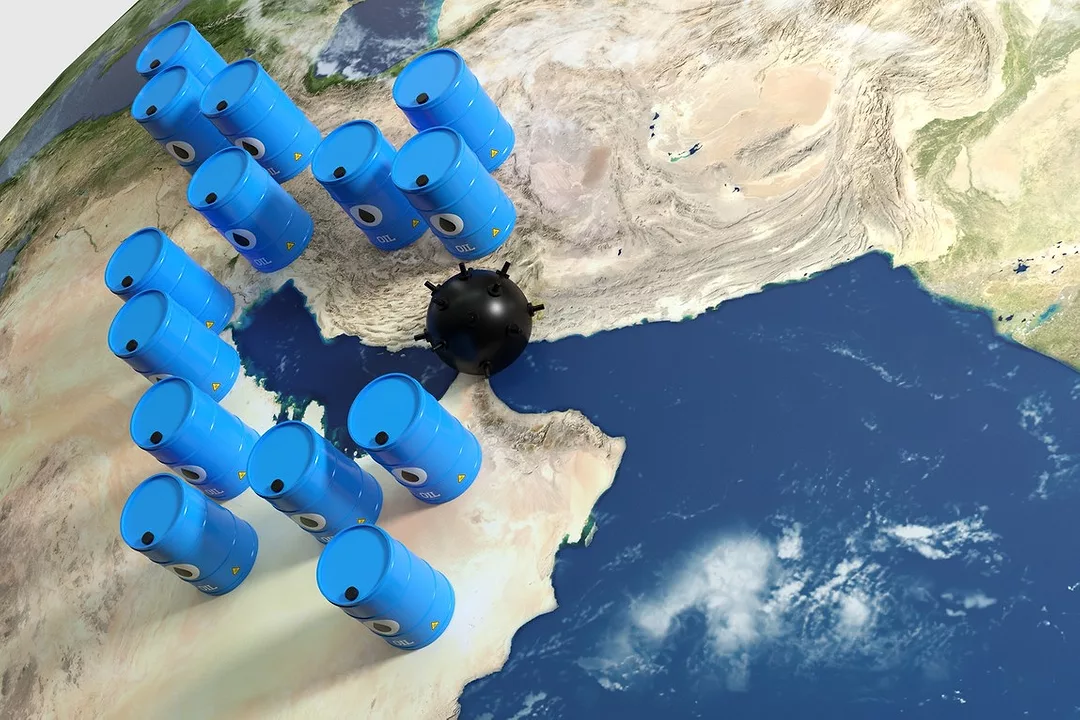
Oil Barrels sit on a Middle East Map

Image: iStock/Thibault Renard

March 31, 2026
Karin Strom, SCB Contributor

Anyone hoping for an official “open” or “closed” sign at the Strait of Hormuz is going to be disappointed. While a few vessels are slipping through, often close to Iranian waters with their Authentic Identification System (AIS) switched off, it’s far from business as usual. The possibility of mines in the water poses a very real threat and has created a palpable sense of fear. 

The rhetoric from U.S. President Donald Trump has only further complicated matters. His 48-hour ultimatum for Iran to either reopen the Strait or face strikes on power plants has expired, although attacks were placed on hold due to “productive discussions,” which Iran insists have not taken place. The markets relaxed for a moment, with the prices of oil dipping, before everyone remembered that postponement is not resolution. 

As the U.S. and Iran appear to have reached an impasse, the maritime risk picture remains inherently complex.  

The Safety Net of Insurance Cover

One persistent rumor refuses to die: that ships aren’t transiting because war insurance has been pulled or has become unaffordable. Lloyd’s of London has been uncharacteristically blunt on this, stating in no uncertain terms that war risk cover, hull, cargo and liability is still available, as is P&I cover. Premiums can be repriced, but that’s what the system is designed to do. 

Ships aren’t moving because of a lack of cover, but rather because their captains, owners, and crews are rightly prioritizing their own safety. Around 20,000 seafarers are currently caught up in this disruption, with the number of fatalities now into double figures. Ships are running low on bunkers and stores; salvage availability is uncertain, and ports of refuge are politically complicated. 

This isn’t an insurance problem. It’s a “what happens if things go wrong and no one comes?” problem. 

Uncertainty Is the Only Certainty 

The Joint Maritime Information Center hasn’t helped to restore confidence, maintaining a critical threat level and describing a pattern of attacks that looks deliberately non-selective. The idea that flying a “friendly” flag guarantees safety is fictional, especially when Iran’s own leadership has hinted that parts of its military may operate with a degree of independence. In a war, chains of command are rarely clear cut.

Western leaders are deeply nervous about being dragged into a conflict by Washington’s deadlines. Israel’s campaign looking increasingly unconstrained doesn’t help matters — it’s shrinking diplomatic off-ramps and increasing escalation risk. While military force may secure shipping lanes, logistics still has to feed, fuel, repair and evacuate whatever force is doing the securing. 

This brings us to the popular suggestion that keeps resurfacing: “Just bypass Hormuz and send trucks across Oman.” This is by no means a viable solution, however.

 A very large crude carrier (VLCC) carries about two million barrels of oil. A truck carries about 200. One tanker, therefore, equals roughly 10,000 trucks. At Gulf scale, that’s tens of thousands of trucks per day, every day, across borders, deserts and infrastructure that was never designed for it. 

Then there’s cost. Pipelines and ships move a barrel for $1 to $2. Trucks do it for $9 to $30. At that point, you’re not bypassing a chokepoint, you’re reinventing inflation. That’s why the only alternatives that actually matter are boring, expensive and pre-built. 

The UAE is quietly routing flows via Fujairah. Saudi Arabia is pushing its east-west ambition, not just to export but to become a transit system between seas. This is much more than rerouting — these are strong contingency plans, which typically get formulated years in advance.

Where does that leave us? While the Strait of Hormuz isn’t wholly closed, it certainly isn’t open for business. The Strait is selectively usable, politically conditional, operationally fragile and psychologically exhausting. While insurance is a viable option, there’s a dearth of confidence. 

Bypassing Hormuz was never about finding a clever detour. It’s about redesigning how energy and trade move at scale. Infrastructure moves cargo. Systems move markets. And right now, the system is showing that it was never built to withstand these sorts of shocks.

Karin Strom is vice president, logistics and supply chain at Proxima.

Logistics Ocean Transportation Global Supply Chain Management Sourcing/Procurement/SRM Supply Chain Security & Risk Mgmt

RELATED CONTENT

RELATED VIDEOS

Subscribe to our Daily Newsletter!

Timely, incisive articles delivered directly to your inbox.

Featured Product

Popular Stories

  • A LARGE CYLINDRICAL OBJECT SHRINK-WRAPPED IN WHITE PLASTIC IS LOWERED BY CRANE ONTO A FLAT BED TRUCK ON A DOCK

    AI Boom Has European Buyers Paying Extra to Secure Gas Turbines

    Technology
  • 016_ai_and_data_transformation_in_distribution_v1-(540p).png

    Watch: AI and Data Transformation in Distribution

    Artificial Intelligence
  • DOMINO EFFECT FINANCIAL MONEY KNOCK-ON CONSEQUENCES iStock-Devrimb-1500012566.jpg

    Podcast | The Tariff Conundrum for Supply Chains: Pass Along, or Absorb?

    Supply Chain Finance & Revenue Management
  • TWO WORKERS DISCUSS DATA SHOWN ON COMPUTER SCREENS

    Gartner: Gap in SC AI Talent Cannot Be Closed by Hiring Alone

    Artificial Intelligence
  • A pair of hands reaches towards a cluster of icons showing global logistics network distribution and transportation

    CSCMP's State of Logistics Report: Get Used to the Fog

    Logistics

Digital Edition

2026 esg cover main scb q2 2026 cover

SupplyChainBrain 2026 ESG Guide: ESG — The Supply Chain’s Biggest Secret

VIEW THE LATEST ISSUE

Case Studies

  • Recycled Tagging Fasteners: Small Changes Make a Big Impact

  • A GRAPHIC SHOWING MULTIPLE FORMS OF SHIPPING, WITH A HUMAN STANDING AT THE CENTER, TOUCHING A SYMBOLIC MAP OF THE WORLD

    Enhancing High-Value Electronics Shipment Security with Tive's Real-Time Tracking

  • A GRAPHIC OF INTERLACING HONEYCOMBED ELEMENTS REPRESENTING GLOBAL BUSINESS TRANSACTIONS

    Moving Robots Site-to-Site

  • JLL Finds Perfect Warehouse Location, Leading to $15M Grant for Startup

  • Robots Speed Fulfillment to Help Apparel Company Scale for Growth

Visit Our Sponsors

4flow Arkieva Blue Yonder
Carton Cloud CoEnterprise Dassault
Duravant E2Open General Logistics Systems
Hy-Tek iGPS Korber
Lyngsoe Procurability Quinyx
SAP Sikick Systech
S&P Global Mobility TADA TransImpact
US Bank Werner Enterprises WSI
  • More From SCB
    • Featured Content
    • Video Library
    • Think Tank Blog
    • SupplyChainBrain Podcast
    • Whitepapers
    • On-Demand Webinars
    • Upcoming Webinars
  • Digital Offerings
    • Digital Issue
    • Subscribe
    • Manage Email Preferences
    • Newsletters
  • Resources
    • Events Calendar
    • 2026 Event Coverage
    • SCB's Great Supply Chain Partners
    • Supplier Directory
    • Case Study Showcase
    • Supply Chain Innovation Awards
    • 100 Great Partners Form
  • SCB Corporate
    • Advertise on SCB.COM
    • About Us
    • Privacy Policy
    • Contact Us
    • Data Sharing Opt-Out

All content copyright ©2026 Keller International Publishing Corp All rights reserved. No reproduction, transmission or display is permitted without the written permissions of Keller International Publishing Corp

Design, CMS, Hosting & Web Development :: ePublishing