RSS

For decades, the standard playbook for supply chain excellence was written in the cloud. Enterprise planning software promised a world of optimized forecasts and neatly aligned schedules. Yet, as global supply chains navigate "The Great Reconfiguration" — a structural break from the past characterized by rapid geopolitical friction, port strikes and persistent instability — these traditional, linear software models have increasingly become a liability.
The hard truth of 2026 is that the single-point plan is a relic. Supply chains break down where physical assets meet real-world constraints. The most critical transformation in logistics is happening at the physical edge, where warehouses, yards, transportation assets, docks and labor are being orchestrated into a single, interconnected cognitive ecosystem.
The Innovation Vacuum
While front-office technology evolved at breakneck speed, the actual execution layer of logistics remained caught in a time warp. For the past few decades, critical connection nodes — specifically the warehouse dock and the yard — have seen little to no structural innovation.
Many of these vital operational spaces still rely on manual processes. Millions of dollars in inventory sit in blind spots just outside the warehouse doors, managed via clipboards, spreadsheets and manual radio calls. Drivers lose hours waiting at congested docks, and yard spotters move trailers based on static, sequential instructions that fail to account for real-time upstream disruptions.
This deterministic approach assumes a level of predictable stability that simply no longer exists. When a disruption occurs, deterministic systems optimized for a static reality break down, forcing human teams to act as "scribes" — buried in high-transaction, mundane chaos and manual firefighting just to keep the lights on.
The N.O.W. Philosophy
To lead in this volatile environment, forward-thinking organizations are adopting the N.O.W. Philosophy, an architectural blueprint designed to transition companies from reactive operators to autonomous orchestrators.
This model is built upon three core pillars that anchor digital intelligence directly to physical execution:
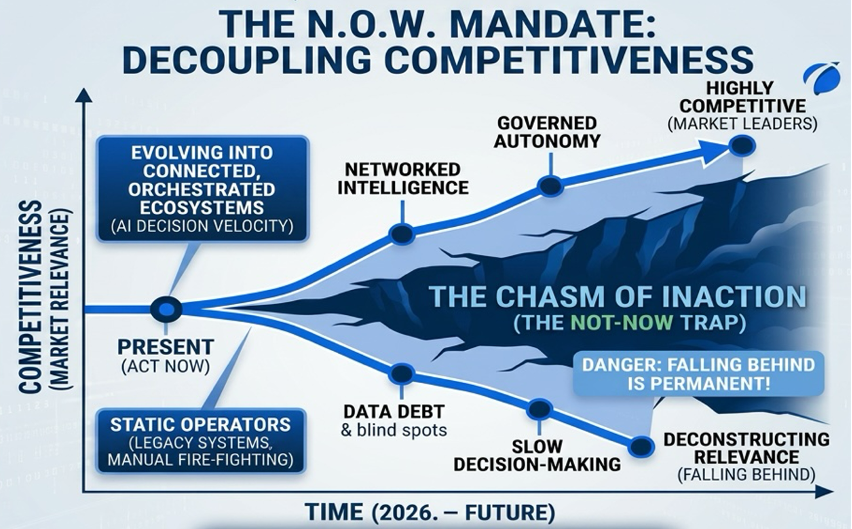
- Networked intelligence (N): Moving beyond siloed applications to connect the entire asset ecosystem. By utilizing real-time API-first infrastructure, operations can transition from historical averages to predictive modeling and continuous planning.
- Orchestrated agility (O): Visibility tells you there’s a problem, but orchestrated agility gives you the framework to fix it. It replaces static routing and manual interventions with event orchestration engines and agentic artificial intelligence that can autonomously re-route transportation, optimize warehouse labor or adjust yard moves within pre-set governance guardrails.
- Wide-angle visibility (W): Eradicating blind spots across the complete supply chain. This means integrating digital twins with external variables, such as weather, port congestion and asset constraints, to actively predict risk rather than just track historical failures.
From Scribe to Steward
The way manufacturing and distribution facilities work needs a major overhaul. The yard, as an example, serves as a perfect microcosm for how this physical-digital convergence is rewriting logistics execution. In a modern, autonomous yard, digital twin technology tracks the precise, real-time location and content of every trailer.
Instead of waiting for human coordination, an event orchestration engine automatically triggers a workflow the moment an autonomous truck checks in. Automated yard vehicles and robotic systems safely coordinate spotter movements based on real-time dock constraints.
This transformation extends across the entire facility:
- Warehouses and docks: AI-driven scheduling platforms dynamically adjust dock assignments based on predictive ETAs of incoming assets, preventing bottlenecks before they form.
- Autonomous transportation: Autonomous trucks and yard vehicles scale operations smoothly, mitigating the severe labor constraints and attrition that plague traditional operations.
- The human-machine frontier: This is an augmentation story, not a replacement one. By letting machines automate repetitive, high-transaction workflows, human operators move from "scribes" to "stewards," focusing their socio-emotional talent on critical exceptions, resilience, and strategic trade-offs.
The Value Creation Model
When digital intelligence is woven directly into physical operations, the operational benefits convert rapidly into durable financial outcomes across the entire enterprise P&L:
Value Dimension | Enterprise Operational Value | Financial Realization |
Internal Operational Value | Eradicates blind spots and introduces self-correcting systems, driving up to 40% efficiency gains while significantly reducing firefighting. | Permanent Margin Defense: Structural cost reductions from AI-driven execution build a margin floor resilient to raw material and logistics volatility. |
External Market Advantage | Enables dynamic adaptation to market signals and yields reliable, highly predictable On-Time In-Full (OTIF) delivery rates. | Top-Line Revenue Growth: Faster fulfillment and an elevated customer experience capture demand that previously slipped away, elevating Net Promoter Scores (NPS). |
Asset & Capital Efficiency | Precision inventory management scales operations smoothly without requiring a bloated footprint. | Lower Working Capital & Accelerated Cash Flow: Minimizing excess stock and shortening order-to-cash cycles frees up trapped capital. |
The Strategic Catastrophe of ‘Not NOW’
Despite these clear advantages, many executives hesitate, falling into the "Not-N.O.W." trap. They choose to treat digital transformation as a discretionary project, delaying implementation until cleaner data, more certain budgets, or a mythical "return to normal" arrives. These delays have major impacts on a company’s ability to operate efficiently and competitively.
The Five Critical Risks of Delay
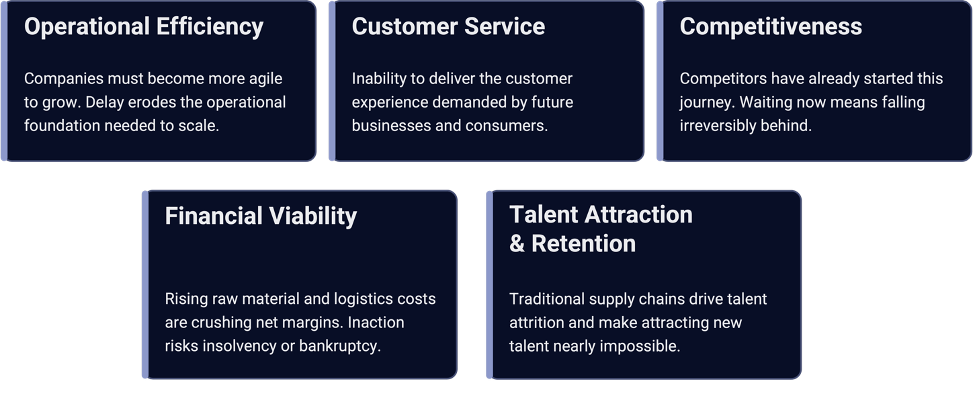
In 2026, treating transformation as a five-year plan is a fast track to irrelevance; it’s now a daily architectural requirement. Waiting systematically eliminates strategic options. Over a five- to 10-year horizon, the "inaction tax" will create an unbridgeable chasm between the 5% of market leaders who act now and the laggards who wait.
The Mandate of 2026
The storm of global disruption is already here, and stability is an obsolete expectation. When a leader says "not now" to modernizing their physical operations, they’re effectively choosing to manage the next crisis with the exact same broken tools that failed them in the last one.
The future of logistics belongs to those who successfully bridge the human-machine frontier at the physical execution layer. The window to act is closing. The time to transform your physical operations is N.O.W. — because waiting is a permanent surrender of your right to compete.
Bart A. De Muynck is a supply chain adviser and industry expert at Better Supply Chains.