• Advertise
  • Contact Us
  • Supplier Directory
  • SCB YouTube
  • About Us
  • Login
  • Subscribe
  • Logout
  • My Profile
  • LOGISTICS
    • Air Cargo
    • All Logistics
    • Facility Location Planning
    • Freight Forwarding/Customs Brokerage
    • Global Gateways
    • Global Logistics
    • Last Mile Delivery
    • Logistics Outsourcing
    • LTL/Truckload Services
    • Ocean Transportation
    • Parcel & Express
    • Rail & Intermodal
    • Reverse Logistics
    • Service Parts Management
    • Transportation & Distribution
  • TECHNOLOGY
    • All Technology
    • Artificial Intelligence
    • Cloud & On-Demand Systems
    • Data Management (Big Data/IoT/Blockchain)
    • ERP & Enterprise Systems
    • Forecasting & Demand Planning
    • Global Trade Management
    • Inventory Planning/ Optimization
    • Product Lifecycle Management
    • Robotics
    • Sales & Operations Planning
    • SC Finance & Revenue Management
    • SC Planning & Optimization
    • Supply Chain Visibility
    • Transportation Management
  • GENERAL SCM
    • Business Strategy Alignment
    • Customer Relationship Management
    • Education & Professional Development
    • Global Supply Chain Management
    • Global Trade & Economics
    • Green Energy
    • HR & Labor Management
    • Quality & Metrics
    • Regulation & Compliance
    • Sourcing/Procurement/SRM
    • SC Security & Risk Mgmt
    • Supply Chains in Crisis
    • Sustainability & Corporate Social Responsibility
  • WAREHOUSING
    • All Warehouse Services
    • Conveyors & Sortation
    • Lift Trucks & AGVs
    • Order Management & Fulfillment
    • Packaging
    • RFID, Barcode, Mobility & Voice
    • Warehouse Automation
    • Warehouse Management Systems
  • INDUSTRIES
    • Aerospace & Defense
    • Apparel
    • Automotive
    • Chemicals & Energy
    • Consumer Packaged Goods
    • E-Commerce/Omni-Channel
    • Food & Beverage
    • Healthcare
    • High-Tech/Electronics
    • Industrial Manufacturing
    • Pharmaceutical/Biotech
    • Retail
  • THINK TANK
  • WEBINARS
    • On-Demand Webinars
    • Upcoming Webinars
    • Webinar Library
  • PODCASTS
  • WHITEPAPERS
  • VIDEOS
Home » Achieving ESG Goals in a Least-Cost Manner

Achieving ESG Goals in a Least-Cost Manner

May 10, 2022
Brandon Owens, SupplyChainBrain Contributor and Rod Robinson, SupplyChainBrain Contributor

Corporate ESG programs often focus on two key areas: decarbonizing operations and diversifying suppliers.

Decarbonization typically involves a measurement and goal setting process, development of a decarbonization roadmap, and a plan for implementation and reporting. These efforts quickly descend into a range of activities focused on energy demand and supply. Energy efficient programs and clean energy procurement are typically the favored solutions for meeting environmentally focused ESG goals. 

Supplier diversity programs are different. Here, the focus is on assessing the diversity and inclusion status of an organization and then developing a set of programs designed to improve diversity metrics to achieve ESG objectives in this area. The assessment focuses on existing supplier diversity policies, processes and metrics. Supplier diversity programs are focused on achieving progress across a range of spend categories.

On the surface, decarbonizing and diversifying efforts appear distinct. However, when it comes to implementing programs to measure and improve emissions and diversity, the similarities are striking. Companies can leverage these synergies in a holistic approach to “E” and “S” goals and pursue them simultaneously.

‘Assessment Matrix’

A good starting point for supplier sustainability and diversity assessments is to create a “category assessment matrix” (Figure 1). This quadrant chart helps companies identify spend categories that represent the greatest opportunity for improvement, enabling them to execute successful programs at the lowest cost by focusing on the most impactful and “easiest” categories first.
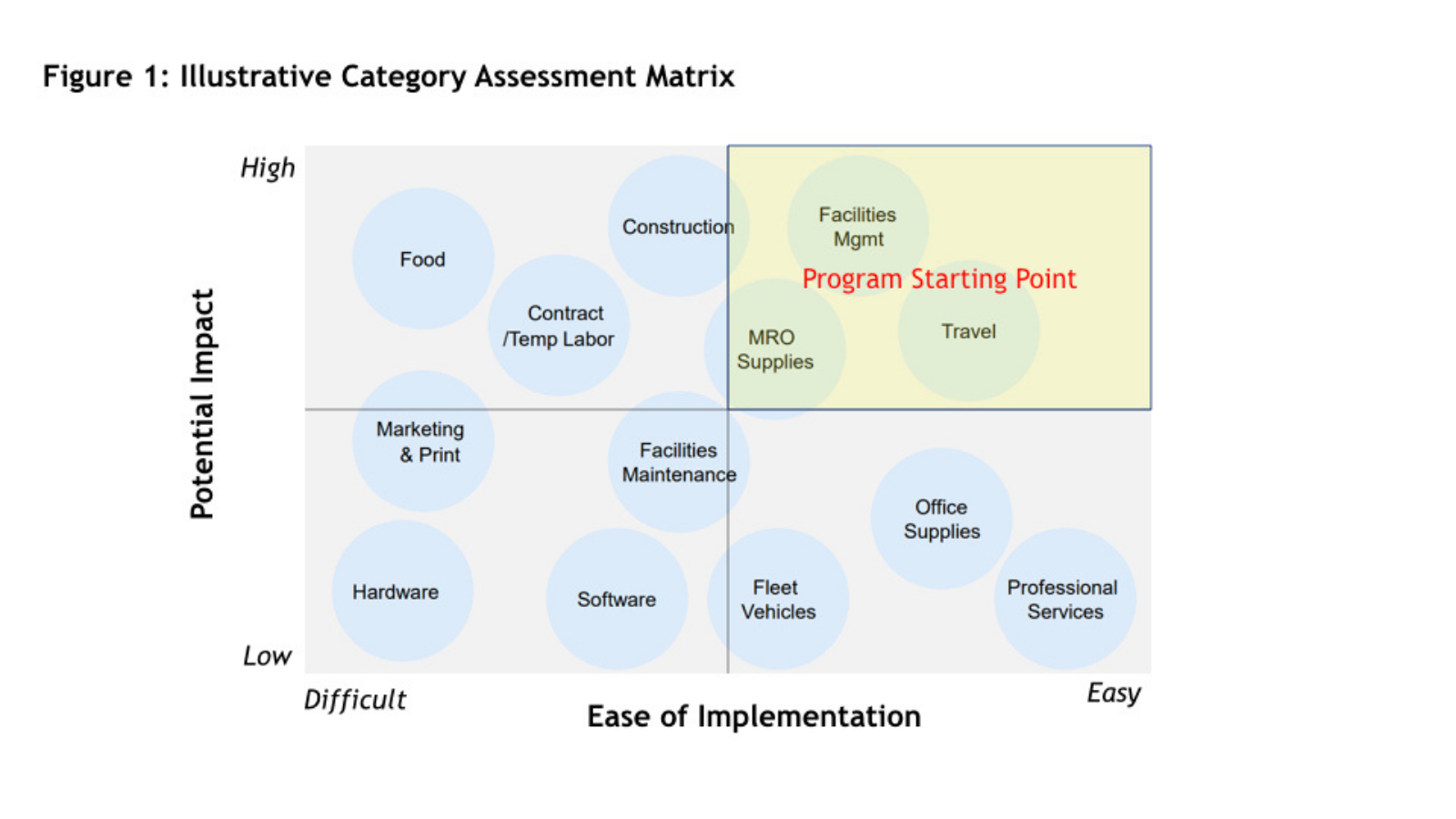
category assessment matrix

Within a category assessment matrix, two dimensions are used to identify those categories with the greatest improvement potential for both environmental and diversity programs: (1) potential impact; and (2) ease of implementation. For sustainability, potential impact is the potential for carbon reductions in each category. For diversity, potential impact is the potential for diversity improvement. Spend in each category is often the best proxy for potential impact.

Ease of implementation is a bit more nuanced. For diversity, this relates to the risk of switching suppliers and the presence of alternative suppliers. For sustainability, ease of implementation is a function of the decarbonization difficulty for suppliers. Some suppliers may operate in energy intensive industries that are difficult to decarbonize; other’s may have a plethora of decarbonization options at their disposal that they haven’t yet activated. In both cases, ease of implementation tells us the location of the low-hanging fruit.

This approach can be used by any organization that has supplier-related ESG goals and wants to determine where to start. However, a robust assessment requires high-quality data, which can be challenging to obtain. But when good data is acquired, cleansed and cast into a category assessment matrix, the benefits are enormous. Companies that have already started their ESG roadmaps can use the chart to prioritize projects and redirect resources as needed.

Just because ESG goals are targeted toward various ends doesn’t mean they can’t be pursued in a least-cost manner. With proper coordination, many of these programs can actually save money. There’s no better place to start than with a clear-eyed view of the potential impact and ease of implementation across spend categories.

Brandon N. Owens and Rod Robinson work for Insight Sourcing Group.

Read more of SupplyChainBrain's 2022 Supply Chain ESG Guide here.

    RELATED CONTENT

    RELATED VIDEOS

    HR & Labor Management Sustainability & Corporate Social Responsibility
    • Related Articles

      Tracking ESG Goals Through the Supply Chain

      How ESG Goals are Redefining Relationships with Suppliers

      Study Reveals Gap in AI Adoption and Sustainability Goals in Logistics Industry

    • Related Directories

      ProcureAbility

    Brandon Owens, SupplyChainBrain Contributor

    Four Steps to Developing a Scope 3 Emissions Program

    More from this author
    Rod Robinson, SupplyChainBrain Contributor

    More from this author

    Subscribe to our Daily Newsletter!

    Timely, incisive articles delivered directly to your inbox.

    Featured Product

    Popular Stories

    • A pair of hands reaches towards a cluster of icons showing global logistics network distribution and transportation

      CSCMP's State of Logistics Report: Get Used to the Fog

      Logistics
    • A GLEAMING TUNNEL OF LIGHTS CURVES AWAY INTO A HORN

      Gartner: Top 25 Supply Chain Organizations Are Embracing AI

      Global Logistics
    • HANDS TYPE ON A KEYBOARD UNDER A SUPER IMPOSED DIGITIZED MAP OF THE WORLD, ALONG WITH IMAGES OF A SHIP, A SHOPPING CART AND OTHER SYMBOLS OF INTERNATIONAL LOGISTICS

      Five Demand-Forecasting Mistakes Supply Chain Leaders Are Rethinking

      Technology
    • The outside of Oracle Corporation's corporate headquarters located in Silicon Valley. Photo: iStock.com/Sundry Photography

      Oracle Cuts 21,000 Jobs, More to Come From AI

      Technology
    • A CLUSTER OF BLUE LIGHTS IN THE PATTERN OF A BLOOMING FLOWER

      Supply Chains Are the First Major Test Case for Automation-Led iPaaS

      Data Management (Big Data/IoT/Blockchain)

    Digital Edition

    2026 esg cover main scb q2 2026 cover

    SupplyChainBrain 2026 ESG Guide: ESG — The Supply Chain’s Biggest Secret

    VIEW THE LATEST ISSUE

    Case Studies

    • Recycled Tagging Fasteners: Small Changes Make a Big Impact

    • A GRAPHIC SHOWING MULTIPLE FORMS OF SHIPPING, WITH A HUMAN STANDING AT THE CENTER, TOUCHING A SYMBOLIC MAP OF THE WORLD

      Enhancing High-Value Electronics Shipment Security with Tive's Real-Time Tracking

    • A GRAPHIC OF INTERLACING HONEYCOMBED ELEMENTS REPRESENTING GLOBAL BUSINESS TRANSACTIONS

      Moving Robots Site-to-Site

    • JLL Finds Perfect Warehouse Location, Leading to $15M Grant for Startup

    • Robots Speed Fulfillment to Help Apparel Company Scale for Growth

    Visit Our Sponsors

    4flow Arkieva Blue Yonder
    Carton Cloud CoEnterprise Dassault
    Duravant E2Open General Logistics Systems
    Hy-Tek iGPS Korber
    Lyngsoe Procurability Quinyx
    SAP Sikick Systech
    S&P Global Mobility TADA TransImpact
    US Bank Werner Enterprises WSI
    • More From SCB
      • Featured Content
      • Video Library
      • Think Tank Blog
      • SupplyChainBrain Podcast
      • Whitepapers
      • On-Demand Webinars
      • Upcoming Webinars
    • Digital Offerings
      • Digital Issue
      • Subscribe
      • Manage Email Preferences
      • Newsletters
    • Resources
      • Events Calendar
      • 2026 Event Coverage
      • SCB's Great Supply Chain Partners
      • Supplier Directory
      • Case Study Showcase
      • Supply Chain Innovation Awards
      • 100 Great Partners Form
    • SCB Corporate
      • Advertise on SCB.COM
      • About Us
      • Privacy Policy
      • Contact Us
      • Data Sharing Opt-Out

    All content copyright ©2026 Keller International Publishing Corp All rights reserved. No reproduction, transmission or display is permitted without the written permissions of Keller International Publishing Corp

    Design, CMS, Hosting & Web Development :: ePublishing