
SPECIAL REPORT
Automating the Cold-Chain Warehouse
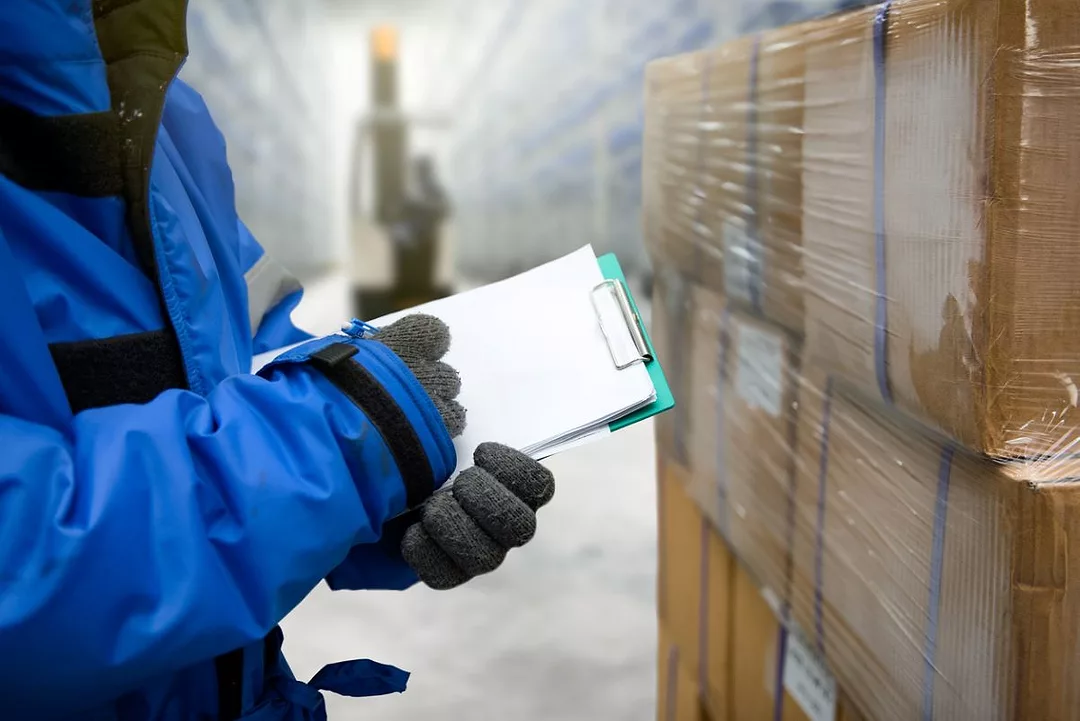
Photo: iStock/sorn340
It’s more than just robots — it’s automating decision-making processes to manage costs, enhance efficiency, build resilience and navigate a volatile labor market.
For shippers and receivers of goods that require cold storage, the automation of warehouse activities and processes is not a one-size-fits-all affair. Each cargo owner has unique attributes and requirements, which means that cold-chain logistics operators need to evaluate those and tailor solutions to fit the customer. In fact, they should first consider whether a given customer scenario is amenable to automation.
When many people think of automation in a cold chain, or any warehouse, they think about robots performing some tasks that otherwise might be done by human labor. That could be the beginning, but certainly not the end, of the implementation of cold-chain automation.
Robots have their advantages. They reduce wear and tear on human workers and take over repetitive tasks, making the human side of work more rewarding. They give employers a tool to contend with labor shortages and business surges, and they even contribute to the resilience of cold-chain facility design.
But the information systems operating in the background are the ones that automate processes in cold-chain warehouses from end to end. They orchestrate robotic and human tasks and plan loading, unloading and storage. They share data among disparate platforms to make sure all platforms are operating in tandem. The ultimate goal is to automate decision-making, and it’s the information systems that facilitate the analysis of data that allow that to happen. End-to-end automation in cold-chain warehouses can contribute to greater efficiency, higher quality and lower costs, benefiting cold-chain logistics operators — and their customers as well.
Cold-chain capabilities are assuming increasing importance in today’s world when demand for perishable goods is on the rise, but, according to the U.S. Department of Agriculture, between 30% and 40% of the food supply in the U.S. goes to waste. Around 13% of all food produced globally — amounting to over 1.6 billion tons — is lost every year due in part to poor cold-storage supply-chain capabilities, according to a study from Columbia University’s Climate School. Meanwhile, the cold-chain logistics industry faces an ongoing labor shortage. According to a recent research report from MHI and Deloitte, a majority of survey respondents said that hiring and retaining qualified workers were among their top supply-chain challenges.
The first step when considering the deployment of cold-chain automation technologies is to determine whether they will benefit a given scenario. “Automation works better in some use cases than others,” says Daniel Walet, a senior operations research scientist at Lineage Logistics, a temperature-controlled logistics services provider. “If you have customers whose products sit in the warehouse and don't move much,” he explains, “then automation is less suitable than in the case where products are moving. You want to use automation when there's a lot of work to automate.”
It goes without saying that the objective of the cold chain is to keep products at low temperatures throughout their journey through the supply chain, and to make sure they spend as little time as possible outside the freezer. On the other hand, one of the primary objectives of cold-chain automation is to keep human workers out of the freezer, where temperatures can reach -30 degrees Fahrenheit.
“Freezers are harsh environments and can be difficult to staff,” says Matt Goebel, a senior project manager. “It’s advantageous to keep people in the warmer sections of the warehouse.”
Manual warehouses use reach trucks operated by human workers in freezers, but those pieces of equipment have their height limitations, around five or six levels. Automated warehouses often use automated storage and retrieval systems (ASRS), which deploy cranes and shuttles that are programmed to retrieve pallets as directed by warehouse management systems (WMS). That configuration allows freezers to be built taller, which has several advantages.
“It creates greater density of product in the same footprint,” says Goebel, “and can reduce the land costs for the cold-chain warehouse.”
Building taller also contributes to more efficient and resilient building designs. “They're higher density cubes, which are much more efficient to cool,” says Claire O'Connor, vice president of automation systems at Lineage. “Heat-producing forklifts are no longer required in those frozen spaces, so there's a reduced heat load. The openings in the freezer get a lot smaller because you have only a conveyor and a pallet or a box moving through a smaller aperture. You don't need a larger opening to accommodate a forklift, and those smaller openings reduce temperature loss.”
All of that, of course, will reduce the energy costs for the automated cold-chain facility. “In the refrigerated world, energy costs are very high,” says Goebel, “so density helps to reduce costs.”
Using robots allows warehouse operators to better manage labor costs, according to O’Connor. “Especially during difficult labor markets,” she says, “it allows warehouse operators to smooth out the peaks and troughs when they might have to ramp up or ramp down staff. Automation solutions help to address labor volatility.”
Automating work in the freezers by consigning tasks to robots, adds O’Connor, also “creates a safer work environment for team members.” Besides removing the human element from the freezer as much as possible, cold-chain operators also endeavor to automate repetitive tasks in the warehouse. Moving repetitive tasks from humans to robots benefits accuracy too, according to Walet, and systems are equipped to “task both team members and robots and use data to have them work in harmony.”
In traditional cold storage, much of the human labor involves case picking — moving boxes from one area of the warehouse to another. “Those are the kinds of tasks that should be automated,” says Walet. “Using robots to do case picking ensures that the right number of cases are being picked. It’s also less likely that product gets damaged or lost, and it’s easier to more reliably track where inventory is located.”
“Less human touches means less human error,” explains O’Connor, “so you get an overall increase to inventory accuracy and that can lead to costs savings.”
Automating repetitive tasks frees up team members to perform more meaningful work. Once the pallets are unloaded, advanced cold-chain warehouses use automated receiving technologies to capture all of the products’ relevant data. “In traditional manual warehouses, that's all done by humans,” says Walet. “A team member walks around the pallet to record the information.”
Computer vision systems, by contrast, automatically identify the contents of each pallet. Photographs of pallets are analyzed to grab information such as the kinds of products, number of boxes, stacking configuration and sell-by date — all of which is captured in the WMS. That data, in turn, allows the warehouse operator to validate the information received from the shipper.
“The receipt of the shipment is confirmed with the customer,” says Walet, “so the warehouse operator can close out the loads and the truck driver is good to go.”
That’s just the beginning of how information systems contribute to automation success. “Ultimately, it’s about automating decision-making,” says Walet. “Automating data capture facilitates the optimization of pallet storage, inventory tracking and order fulfillment.”
As part of automating the receiving process, cold-chain warehouse operators apply algorithms — integrated with WMS and machine learning capabilities — to historical and real-time data to predict a given pallet’s length of stay in the warehouse. That’s going to have an impact on where the pallet is going to be stored.
“It often depends on the demand for that product,” says Walet. “Fast-moving products will be put in the front of the warehouse and slower products in the back. That reduces the distance that team members and robots need to travel to retrieve the fast-moving ones.” In determining the ideal location within the warehouse for a pallet, the WMS also considers its size, the distance between rack locations and first-in-first-out (FIFO) principles.
On the outbound side, cold-chain warehouses are typically tasked with assembling pallets containing different products. Visibility platforms provide views to inventory levels and alert shippers and logistics providers to schedule shipments and coordinate orders to satisfy demand. These platforms interact with operating software to ensure that tasks are prioritized to achieve high levels of throughput and productivity.
Systems also “calculate up front how they’re going to build out the pallet and how to load it,” says Walet. “Trucks have to be loaded in a strategic way to make sure that they don't go over weight.”
Team members on the floor have limited visibility to what's going on everywhere in the warehouse, especially in larger buildings. That's why it’s crucial to use software to plan and coordinate warehouse activities.”
In automated cold-storage warehouses, WMS, automated receiving technologies, computer vision systems, algorithms, visibility platforms and machine learning capabilities all work in tandem to create end-to-end process automation. “They make sure that product gets to the right location on the inbound side,” says Goebel, “and that the right product and quantity are picked on the outbound side. A warehouse control system, or WCS, connects all the software that runs the warehouse.”
At a high level, the “number-one benefit” to end-to-end cold-chain automation, according to Goebel, is improving quality and food safety. “It’s necessary to meet regulatory and customer requirements,” he explains. “Warehouse operators need to have systems that monitor temperatures to ensure compliance, and automation can make that easier.”
In the end, the success of any given implementation of cold-chain automation depends on the scenario presented by individual cargo owners — their mix of products, shipment velocities and other factors. “Tailoring the automation solution to the individual customer and their specific needs,” says O’Connor, “is going to lead to the best outcomes.”
Resource Link: www/lineagelogistics.com/services/automated-warehousing
Popular Stories





SupplyChainBrain 2026 ESG Guide: ESG — The Supply Chain’s Biggest Secret
VIEW THE LATEST ISSUECase Studies


Visit Our Sponsors |
|
|
| |
|
|
|
|
|
|
|
|
|
|
|
|
|
|
|
|
|
|
|
|
|
|
|
|
|
|
|
|