
Xi’s Careful Reply to Trump Tariffs Shows China Has More to Lose
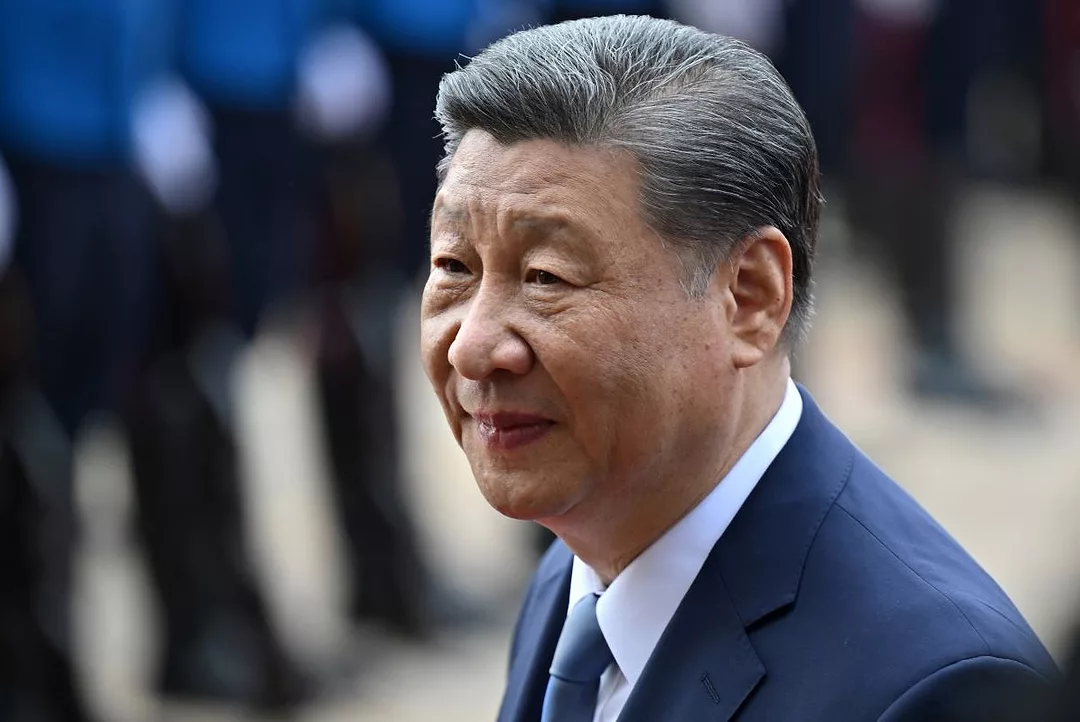
Xi Jinping. Photographer: Oliver Bunic/Bloomberg
The first volleys in the latest U.S.-China trade war made clear that Xi Jinping is taking a more cautious approach than during Donald Trump’s first term.
After the U.S. leader gave a last-minute reprieve to both Canada and Mexico, his 10% tariffs on China took effect after midnight Washington time on February 4. Within seconds, Beijing announced additional tariffs on roughly 80 products to take effect on February 10, launched an antitrust investigation into Google, tightened export controls on critical minerals, and added two U.S. companies to its blacklist of unreliable entities.
The swift but calculated retaliation signaled that Beijing had learned a lesson from its first trade fight with Trump, when China retaliated with tariffs on par or close to what the U.S. imposed. This time Xi only put tariffs on $14 billion worth of American products, a sliver of what Trump targeted, while taking other measures that showed off China’s ability to inflict further pain on U.S. companies if needed.
 China Customs
The shift reflects Xi’s success at diversifying imports away from the U.S. since Trump’s first term, as well as China’s more precarious economic situation. The Chinese leader has been relying on manufacturing and overseas sales to keep growth ticking along as he moves to burst a property bubble, all while dealing with increased deflationary pressure.
China is being restrained because it “has more to lose,” due to its huge trade imbalance with the U.S., according to Larry Hu, head of China economics at Macquarie Group Ltd.
“A full-blown tariff war is not in China’s interest,” he added. “Instead, China is likely to respond to tariffs mainly through domestic stimulus.”
The Chinese leader’s cautious reply avoided roiling markets, which have been whipsawed in the past week by Trump’s tariff twists and turns. The Hang Seng China Enterprises Index of Chinese stocks listed in Hong Kong rebounded to gain 3.5% on February 4, while the offshore yuan was little changed after paring earlier losses.
The question now is whether leaders of the world’s biggest economies can quickly reach an agreement before Chinese tariffs kick in. Trump said on February 3 he will seek a deal with China and floated a call “probably over the next 24 hours,” although it’s unclear if Xi is in the mood to engage. He tamped that down on February 4 after the tariffs came into effect, saying there’s no rush to speak with Xi and a call would take place at the appropriate time.
Talks between the two leaders would offer first a glimpse of Trump’s priorities this time around. The U.S. president has alternated tough talk on China with more dovish statements, laying out the potential contours of an agreement.
Trump wants more balanced trade. He’s ordered an agreement he signed in 2020, known as the Phase One deal, to be reevaluated, suggesting tariff talks with China could yet drag out for months. But he’s also seeking Xi’s help in swiftly stopping Russia’s war in Ukraine, and is pushing for China to split ownership of video app TikTok with a U.S. company within a ticking 75-day deadline.
In a sign that deal is front of mind, Trump wrote on his Truth Social platform hours before the U.S. tariffs took effect that there was “great interest” in TikTok, adding a deal would “be wonderful for China.”
Trump has previously said that Microsoft Corp. is in talks to acquire the U.S. arm of ByteDance Ltd.’s TikTok, while Chinese officials favor a sale to the president’s billionaire advisor Elon Musk, Bloomberg News has previously reported. A deal would rescue the China-owned app from a U.S. ban, but could put its prized algorithm in foreign hands.
Chinese officials enter talks with less bargaining room. The Asian manufacturing powerhouse exports over three times more goods to the U.S. than it buys, according to data from China’s Customs General Administration, meaning it has fewer goods to tariff.
Some of Beijing’s warning shots were purely symbolic, underscoring that more limited room for maneuver. China honed its regulatory sights on Google, even though Alphabet Inc.’s search services have already been unavailable in the country since 2010. There are other companies such as Musk’s electric vehicle giant Tesla Inc. and smartphone giant Apple Inc., however, that still have massive business interests in the world’s No. 2 economy.
Chinese regulators are also considering launching a probe into Intel Corp., the Financial Times reported February 4, citing two people familiar with the matter. Intel didn’t immediately respond to a request for comment.
The shape of any future deal will hinge on what concessions China might agree to make, said Helen Qiao, chief economist for greater China for Bank of America Global Research.
China’s options range from promises to buy more American oil and gas and keeping the yuan stable to delivering on the Phase One deal, she said. “It’s probably going be a combination of those measures that would probably help repair the relationship.”
China’s influence over the Panama Canal — where a Hong Kong company has two of the five ports adjacent to the waterway — is a wild card that Trump could press Xi on, according to Chang Shu, chief Asia economist for Bloomberg Economics. His administration has already threatened to take back the canal if Panama doesn’t reduce China’s sway.
“China could twist the arm of CK Hutchison Holdings Ltd. to reduce its operations there,” she said, noting that was a “remote” possibility.
Panama, meanwhile, is weighing whether to cancel the contracts with the CK Hutchison subsidiary that operates the ports, according to people with knowledge of the situation. The people, who asked not to be identified, cautioned that no decision has been made and that the government would proceed in a way intended to avoid lawsuits and follow due process.
For now, Beijing is striking a balancing act between looking strong while not upping the ante, according to Josef Gregory Mahoney, a professor of international relations at Shanghai’s East China Normal University.
“We might be seeing two giants sizing each up and testing each other’s resolve while also playing to their domestic audiences before shaking hands,” he added.
Popular Stories




SupplyChainBrain 2026 ESG Guide: ESG — The Supply Chain’s Biggest Secret
VIEW THE LATEST ISSUECase Studies


Visit Our Sponsors |
|
|
|
|
|
|
|
|
|
|
|
|
|
|
|
|
|
|
|
|
|
|
|
|
|
|
|
|
|
|
|
|
|
|
|
|
|
|