Sail Freight Business Handbook Lays Groundwork for Change
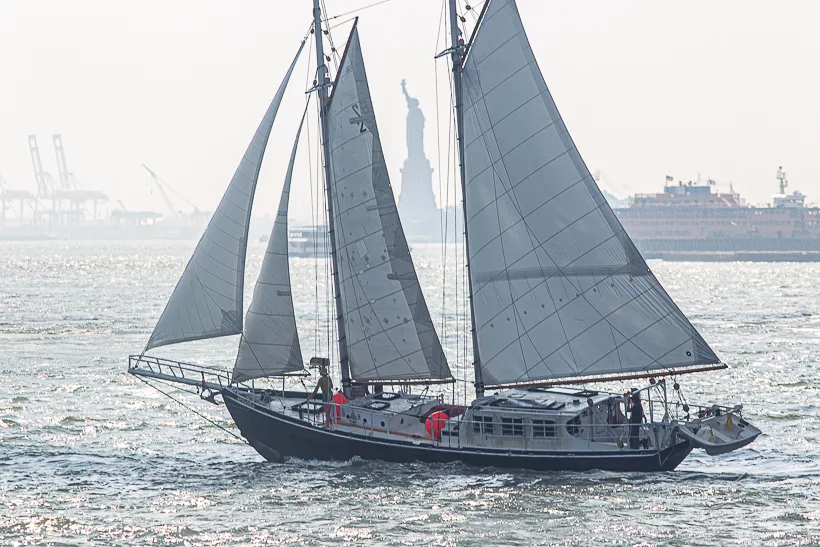
Schooner Apollonia sails across New York Harbor. Photo: Center for Post Carbon Logistics
The Center for Post-Carbon Logistics, Inc. (CPCL) has published an overview of the state of sail freight in the United States, arguing that this emerging sector can meaningfully reduce emissions while strengthening local economies.
The idea is simple: Replace trucks with short-sea shipping where sail freight offers the highest emissions-reduction potential due to heavy congestion and inefficiencies on regional highways.
At present, the U.S. has only one active cargo-carrying sailing vessel — the Schooner Apollonia (pictured). CPCL has mapped the ecosystem around this pioneering ship and developed a replicable, competitive business model for short-distance, high-frequency freight routes.
Read More: ‘Windshipped’ Offers a Vision of an Alternative to Commercial Trucking in Hudson Valley
The authors argue that sail freight wins through cost stability, not by being the cheapest option. While trucking prices fluctuate constantly, the fixed-cost nature of sail freight allows operators to offer a predictable yearly rate — something businesses increasingly value. The study finds that using sailing vessels under 500 Gross Tons is the optimal approach for the sail freight industry, with a focus on local routes where a cost leader or cost stabilization strategy can be used to compete with trucking.
The Sail Freight Business Handbook is designed to expand year-round, near-zero-emission coastal maritime shipping in the United States. It provides entrepreneurs and advocates with an open-source how-to guide to start a sail freight business.
Read a summary here, and The Sail Freight Business Handbook can be downloaded here as a pdf.
Popular Stories





100 Great Supply Chain Partners 2026: The Secret to Supply Chain Success
VIEW THE LATEST ISSUECase Studies


Visit Our Sponsors |
|
|
|
|
|
|
|
|
|
|
|
|
|
|
|
|
|
|
|
|
|
|
|
|
|
|
|
|
|
|
|
|
|
|
|
|
|
|
|
|
|
|
|
|
|
|
|
|
|
|
|