.webp?height=100&t=1783959879&width=150 "014_how_ai_is_transforming_the_transportation_back_office_v1-(540p).jpg")
War in Iran Roils Containership Traffic, Rates
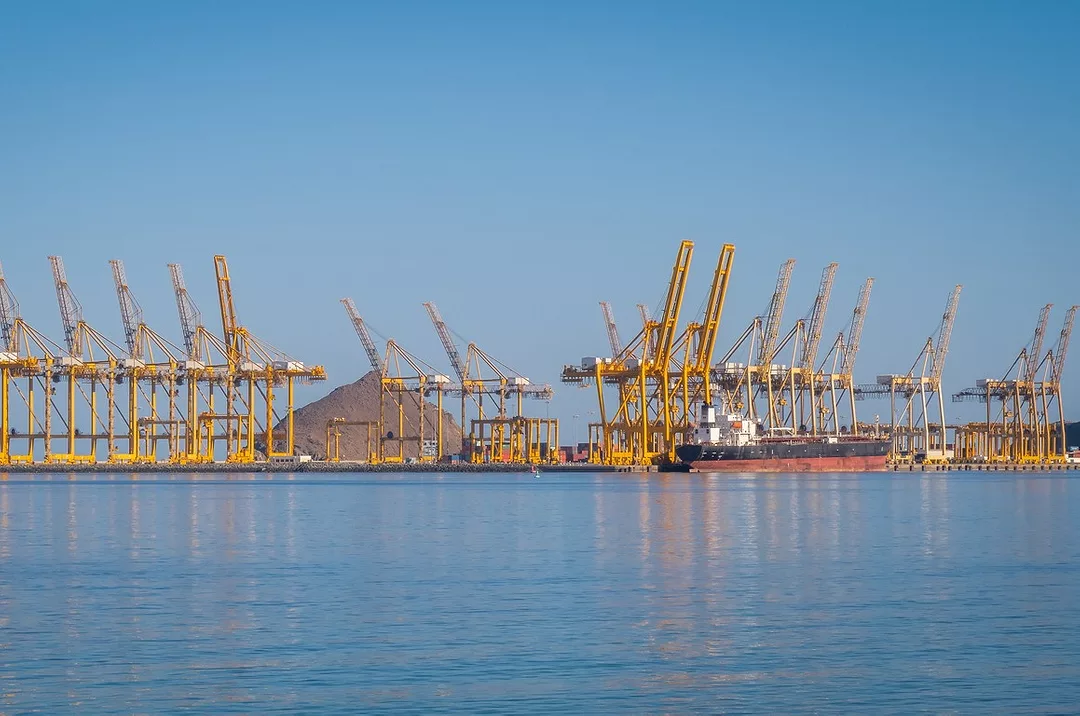
Photo: iStock/Aleksandra Tokarz
While the focus on the impact on shipping of the Israel-U.S. war on Iran has mostly been on oil and LNG tanker traffic, there are significant effects on containership trade, even far away from the area, say analysts.
Judah Levine, Head of Research at online freight shipping marketplace Freightos, said in a March 17 statement that container carriers initially suspended all service to the Persian Gulf. But now, carriers including CMA CGM and Maersk are accepting new bookings by diverting volumes to alternative accessible ports in the region – including ports in Oman, UAE and Saudi Arabia – with containers moving on by landbridge.
Levine said carriers are also relying heavily on ports in India with new shuttle services ferrying containers to those accessible Middle East ports – though even some of these, like UAE’s Fujairah (pictured) are now being directly targeted by Iran.
Congestion is already building at these alternative ports as well as in India, with reports that the Port of Colombo in Sri Lanka is declining to absorb Gulf-bound volumes because of pre-existing congestion.
Meanwhile, carriers are headed for tussles with customers over increased rates, with Karin Ström, VP at procurement and supply chain consultancy Proxima, urging shippers to “push back firmly and ensure pricing reflects actual risk, not opportunism.”
“Ocean freight rates have increased mainly out of China, linked in part to China’s role as a key buyer of Iranian oil in recent years. With Iran restricted in who it can sell to, China benefited from heavily discounted volumes, and any disruption or heightened risk in these flows is now feeding into Chinese export pricing and capacity dynamics,” said Ström in a March 10 statement. “By contrast, ocean lanes between Europe, the U.S. and Latin America remain largely unaffected for now.”
Freightos said carriers have announced flat-rate global emergency fuel surcharges of several hundred dollars per FEU that will go into effect early next week, but that they would not represent unprecedented fuel pass-throughs, and would be “expensive, but not destructive” to the market, possibly pushing rates back up to 2024 levels.
Meanwhile, Ström said that some carriers are attempting to introduce “war surcharges” on lanes with no direct exposure. Levine at Freightos said, “there is some skepticism that market dynamics will see these increases succeed fully,” and that beneficial cargo owners in the midst of annual ocean contract negotiations are pushing back against carrier fees associated with Iran war disruptions that do not directly impact these shippers’ volumes.
“From an operational standpoint, ocean freight remains manageable. Rates are still materially lower than in recent years, open tenders are coming back reasonably well, and after years of disruption in this region the industry has learned how to operate around instability,” said Ström. “Hopes of a return to shorter and cheaper transit times via Suez have faded, but carriers such as Maersk and Hapag‑Lloyd, already structured around Cape routing, are performing strongly, with exceptionally high schedule reliability into ports like London Gateway.”
Popular Stories


.webp?height=100&t=1784001702&width=150 "013_what's_really_needed_for_'lights-out'_capability_v1-(540p).png")


SupplyChainBrain 2026 ESG Guide: ESG — The Supply Chain’s Biggest Secret
VIEW THE LATEST ISSUECase Studies


Visit Our Sponsors |