.webp?height=100&t=1782792122&width=150 "005_veteran_winemaker_gallo_embarks_on_an_ai_journey_v2-(540p).jpg")
SCB FEATURE
War Shortage of Helium Looms for Hi-Tech Manufacturers, Others
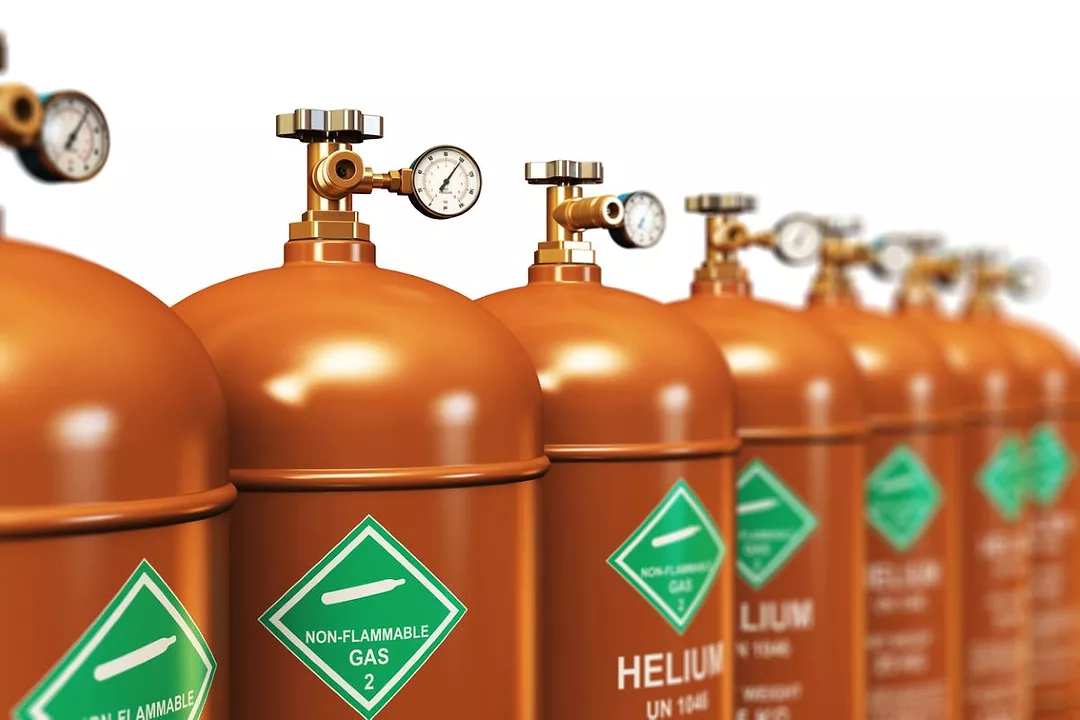
Photo: iStock/scanrail
Moody’s Ratings published a report April 20 reiterating warnings in March about lost helium production potentially hampering AI, data center supply chains, and much besides.
“Helium supply disruptions resulting from the conflict in the Middle East shine a spotlight on the exposure of downstream industries like semiconductors,” said the report from the credit rating agency.
“Helium doesn’t get much attention in the AI supply chain, but it should,” said David Pan, director and AI industry practice lead at Moody’s, a separate entity that provides financial software and economic research.
Reuters reported March 26 that industry executives said they were scrambling to secure alternative supplies of the gas, but the Moody's Ratings report delves deeper into the potential consequences of a shortage. “It’s essential for cooling wafers during chip etching, and there is no viable substitute at scale,” said Pan in an April 21 statement.
“Hyperscalers are committing roughly $650 billion to U.S. AI infrastructure this year alone. And, that investment assumes the supply chain holding it together remains intact,” said Pan. “The AI economy runs on tokens, tokens run on GPUs, and GPUs depend on Qatari helium, Israeli bromine, and LNG tankers with a single, 21-mile-wide exit from the Persian Gulf. This is the risk of a critical, irreplaceable input in the AI supply chain colliding with surging reliance on AI compute.”
Helium isn’t manufactured; it accumulates over millions of years through radioactive decay and is captured only as a byproduct of natural gas processing.
According to Oxygen Service Company (OSC), there are only 14 helium refineries worldwide, and helium supply was already rapidly shrinking before the current interruptions to sources in Qatar, which accounts for roughly 30% of global high purity helium, which it collects as a byproduct of natural gas production. Meanwhile, worldwide industry’s dependence on helium is only increasing, according to OSC, a U.S.-based independent industrial distributor of gases. However, before the current conflict, demand was forecast to grow slower than the pace of new supply for several years, with the helium market remaining in surplus, Moody’s Ratings said.
Last year, global helium supply exceeded demand. Worldwide demand was estimated at about 170 million cubic meters in 2025, while supply reached around 184 million cubic meters. This oversupply pushed prices down, incentivizing producers to store excess. Several large industrial gas companies invested in storage infrastructure to absorb surplus production, including facilities in Germany and Beaumont, Texas.
The Middle East conflict altered this balance by disrupting Qatari production and exports, introducing renewed tightness, particularly for high-purity helium used in electronics, said Moody’s Ratings. Spot prices are sharply higher, though most helium continues to be sold under long-term contract.
Helium is critical in several stages of semiconductor manufacturing — including as a cooling agent and for leak detection — and there are no effective substitutes. As a result, semiconductor companies, and consequently the artificial intelligence and data center supply chains, are vulnerable to disruptions by shocks to the supply of helium. Another major point of consumption is the medical industry. Helium is the best gas to cool down ultra-powerful magnets used in magnetic resonance imaging (MRI) machines. It is also used in automobile airbags, and the production of fiber optic cables.
The U.S. is the largest producer of helium, followed by Qatar, Algeria, Russia and Australia.
Moody’s Ratings said indicators show that major Asian semiconductor manufacturers started the year with several months of helium inventory. South Korean chipmakers, including Samsung Electronics Co. (Aa2 stable) and SK hynix Inc. (Baa1 stable), have sufficient stocks to last through at least June, according to Reuters, although companies are paying premiums to secure inventory, primarily from U.S. suppliers.
Given liquid helium can only be maintained in containers for 45 days, after which it begins to degrade, the supply figures likely include contracted supply from gas companies, which Moody’s Ratings said it assumes have sufficient production or stored helium to honor contracts.
Helium has “had a hand in creating nearly every electronic device you have,” said OSC.
A Bit of History
In 1925, the U.S. Congress passed the Helium Act of 1925, which aimed to stockpile helium for the use in blimps in a war effort, via the creation of the National Helium Reserve in Amarillo, Texas, and the banning of exports of helium.
Even back in 1937, that disruption to the global helium supply chain had unanticipated, far-reaching consequences.
Because there was no helium to fill the Hindenburg passenger airship in Frankfurt, Germany, it was instead filled with highly flammable hydrogen as a lifting gas. A spark of hydrostatic electricity while mooring at its destination in Lakehurst Naval Air Station in New Jersey, on May 6, 1937, caused the airship to catch fire and crash.
Before that, Zeppelin airships conducted hundreds of flights across the Atlantic and even around the world, ferrying tens of thousands of passengers and light freight without a single casualty. The entire passenger and cargo airship industry collapsed within days of the disaster, which killed 36 people.
Popular Stories

.webp?height=100&t=1782739023&width=150 "003_the_future_of_ai_in_transportation,_warehousing_and_logistics_v1-(540p).png")



SupplyChainBrain 2026 ESG Guide: ESG — The Supply Chain’s Biggest Secret
VIEW THE LATEST ISSUECase Studies


Visit Our Sponsors |
|
|
|
|
|
|
|
|
|
|
|
|
|
|
|
|
|
|
|
|
|
|
|
|
|
|
|
|
|
|
|
|
|
|
|
|
|
|