
Companies Start Paying Off 'Carbon Debt' to Erase Past Sins
Companies routinely set targets for reducing their greenhouse gas emissions. But a new kind of environmental target is emerging that has been likened to paying reparations to victims of past injustice. The idea is to eliminate not only current pollution but also to account for and counteract climate damage from the corporate past.
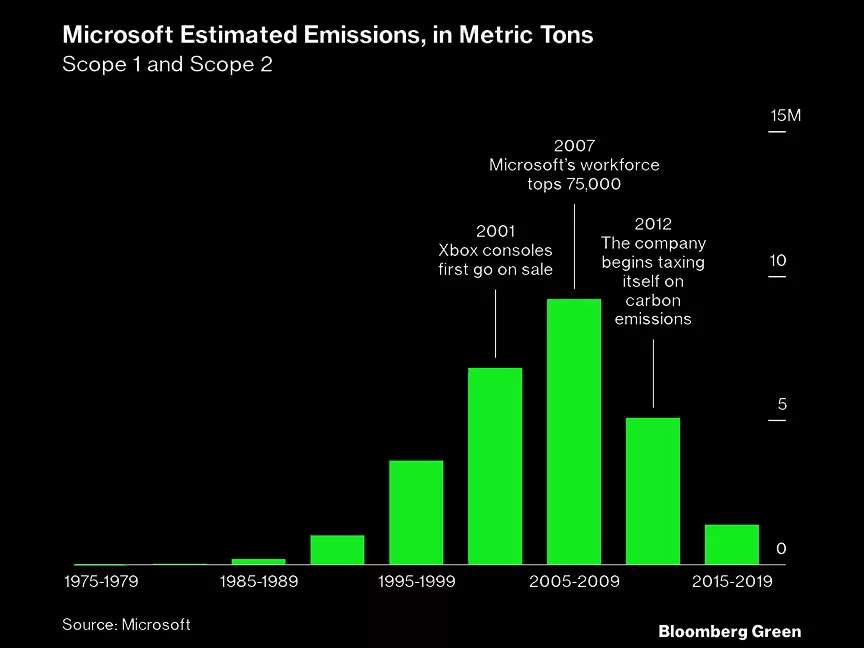
The first big company to make such a pledge was Microsoft Corp. In January it announced plans to remove enough greenhouse gas to zero out its emissions and energy use dating back to its founding in 1975 — some 27.3 million tons of carbon dioxide. Now this week, Velux A/S, a Danish maker of roof windows, pledged to eliminate carbon dioxide that matches its estimated emissions since its founding in 1941. That effort, along with a new 2030 climate goal, would allow Velux to claim “lifetime carbon neutral” status by its centenary in 2041.
The idea of measuring historical CO₂ has been gaining traction, particularly following the 2015 Paris Agreement that emphasized the need for equity between rich and poor countries in the effort to limit global warming to 1.5 degrees Celsius. Wealthy nations have historically emitted far more greenhouse gas than poorer nations, and so the Paris framework asserts a responsibility for them to take the lead.
The U.K., for example, became the first country to adopt a target for zeroing out greenhouse gases by 2050, in part because of its past pollution. Despite making up only 1% of the global population today, the U.K. is responsible for between 2% and 3% of global temperature rise, according to the U.K. Committee on Climate Change. Some companies are starting to think along similar lines.
“You’re trying to eliminate prior damage,” says Cynthia Cummis, director of private sector climate change mitigation at the World Resources Institute. Measuring and eliminating historical carbon, she says, is similar to paying reparations — and sometimes, it seems, nearly as controversial to implement and difficult to measure.
For Velux, these payments for emissions of its past will take the form of investments in forest conservation projects, which can act to reduce carbon dioxide by preventing deforestation. Microsoft also backs forest projects as well as other nature-based methods, and the software giant created a $1 billion climate investment fund to bolster carbon-removal technologies, a nascent field that works to pull planet-warming gases from the atmosphere.
Accounting for the past is a tricky matter, with virtually no independent assessment at the corporate level. A project by the Climate Accountability Institute, a watchdog group, tracks the historical emissions of the world’s biggest oil companies. The group’s data, which goes back to 1965, ranks Saudi Aramco at No. 1 with past emissions equal to nearly 60 billion tons of carbon dioxide. ExxonMobil, Chevron, BP and Shell all rank in the top seven.
There’s no comparable data for most other industries. An early adopter of climate action, Velux has been recording its own operational emissions since 2007. This left a gap covering its energy use data between 1941 and 2006, without an easy way to account for those emissions. “Our strategy is fully homegrown, so it’s totally our own people who have come up with how ambitious we should be,” said David Briggs, chief executive officer of Velux.
To estimate the footprint of its first Danish factory in 1941, the privately held window maker took the emissions factor of coal-reliant Poland in 1990 — which was the worst in Europe — and then added 10%. The carbon intensity of electricity has improved dramatically since World War II, driven by the first oil crisis in 1972. But it's hard to calculate accurately because countries vary in the rate at which they've switched to cleaner fuels, and Velux now operates in 40 countries.
The final figure came to about 4 million tons of CO₂ equivalent in its historical operations and electricity use, known in carbon accounting terms as Scope 1 and Scope 2 emissions. These estimates have been verified by the Carbon Trust, an organization that tracks carbon footprints. Velux added a 25% safety buffer, assigning itself a total of 5.6 million tons through 2041.
The company joined with environmental charity World Wide Fund for Nature to work on forest conservation projects in Uganda and Myanmar that will start to repay the carbon debt over the next two decades. Briggs said that Velux won’t claim any carbon credits from those projects. Many companies, rather than reduce their carbon output, will buy credits to meet targets. If one of the forestry projects fail or under-delivers, Briggs added, the safety buffer in its carbon accounting makes for allowances.
“This is not offsetting,” Briggs said. “This is our — I hesitate to use the word — but this is our gift to society.”
For both Microsoft and Velux, the goal is to eliminate only those past emissions from direct operations and electricity. The vast majority of corporate emissions often come from either the supply chain or through the use of products, which is known as Scope 3. For Velux, this category accounts for about 94% of emissions. Briggs said the company plans to halve those emissions by 2030, largely by finding ways of reducing the energy intensiveness of making aluminum and glass, a process that emits much of its carbon.
Like Microsoft, Velux won’t seek to eliminate its past supply chain emissions. The old data would be too sketchy to measure. That’s fine with World Resources Institute’s Cummis, who thinks companies ought to first work on decarbonizing their current business operations before tackling past pollution.
Perhaps the biggest impact of these early carbon-debt plans will be to encourage other companies and even governments to follow suit. “Companies often do what they can to influence the direction of policy,” Cummis said. “It could be interesting to see how you could translate that into a national target.”
Popular Stories





SupplyChainBrain 2026 ESG Guide: ESG — The Supply Chain’s Biggest Secret
VIEW THE LATEST ISSUECase Studies


Visit Our Sponsors |
|
|
| |
|
|
|
|
|
|
|
|
|
|
|
|
|
|
|
|
|
|
|
|
|
|
|
|
|
|
|
|