.webp?height=100&t=1784835632&width=150 "LSG26_LTAgentEdgeImage_DB-1313-1 (1).png")
Local Hazards Grow as States Ship Their Garbage Overflow

As U.S. cities struggle to rein in garbage while propping up pricey recycling efforts, more companies are profiting from America’s growing waste problem and leaving local communities to face the environmental consequences.
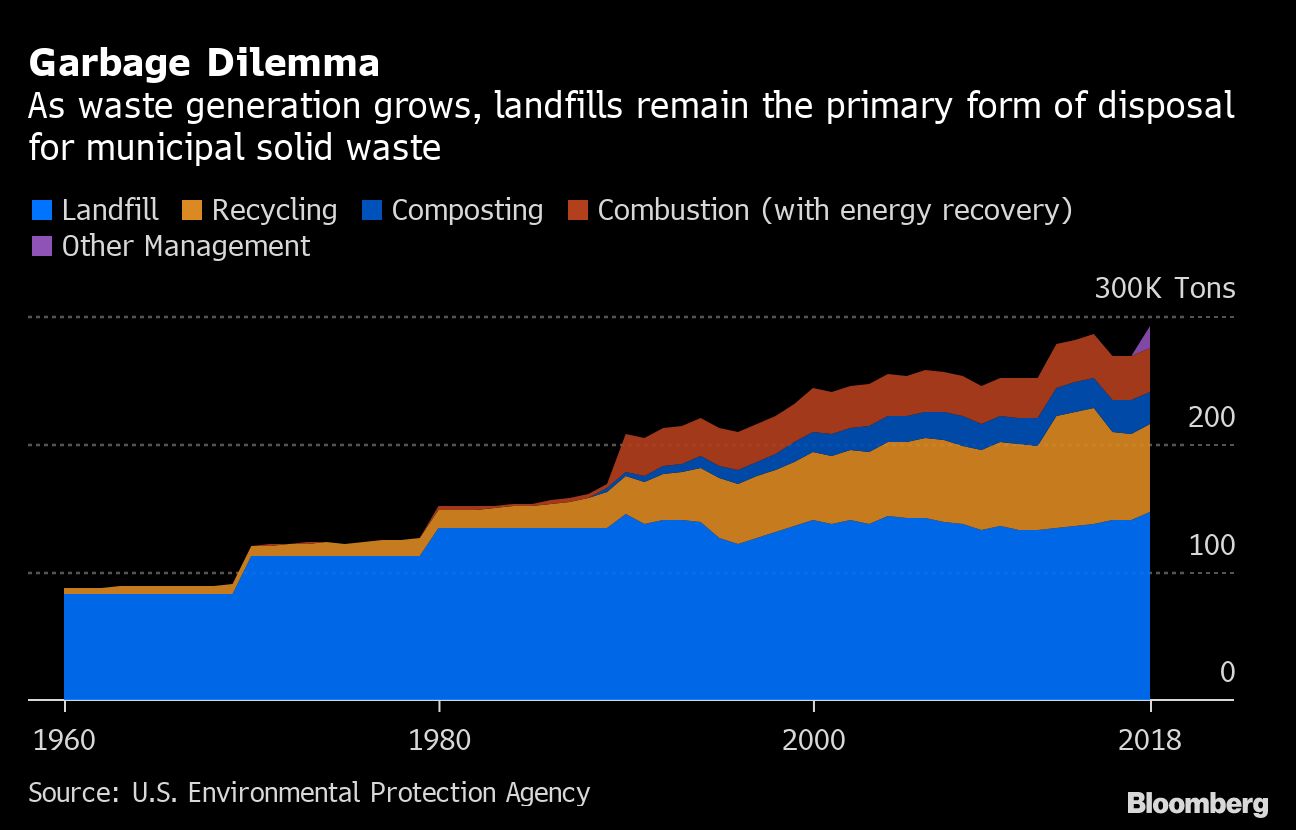
At 4.9 pounds of trash per person, per day, the U.S. is the most wasteful country on the planet. Of the 292.4 million tons of refuse Americans generated in 2018, half was buried in landfills while another 32% was recycled or composted, according to the U.S. Environmental Protection Agency. The rest was burned (the preferred term being “combusted”) to generate electricity.
Before 1970, the U.S. dealt with its trash by dumping it in open pits. But in 1976, waste management fundamentally changed, thanks to the Resource Conservation and Recovery Act. That law created disposal standards for solid and hazardous waste, bolstered recycling programs and mandated landfills install better protection against seepage into the surrounding environment.
Over the past three decades, the rate of U.S. recycling and composting has more than doubled. Combusting has become a key (yet hardly climate friendly) waste management method. During that same period, however, the number of available landfills shrunk by about 74%, according to Stifel Financial Corp. analyst Michael Hoffman. Amid growing costs to operate, maintain, and expand local landfills, waste management shifted away from small municipal dumps to large, privately-controlled regional sites.
Private companies now own more than half of the 1,280 remaining U.S. landfills, Hoffman said, effectively controlling 75% of all garbage disposed of in the U.S. Meanwhile, of the remaining 580 landfills owned by municipalities, 300 will close over the next decade as they reach capacity.
But waste generation isn’t slowing down. And as the overall number of landfills shrinks, those still operating will continue to balloon in size, creating more environmental stress for neighboring communities.
Garbage now fuels a $67 billion industry across the U.S., Stifel estimates. Waste firms make money from removal contracts with municipalities, and fees they charge companies to bury their trash in landfills. These days, it’s not just garbage that ends up there.
Since China stopped importing U.S. recyclables in 2017, cities have been scrambling to find new markets for plastics and other materials that would typically be repurposed, said Mike Ewall, a Philadelphia-based environmental activist and executive director of the Energy Justice Network. For many urban centers, recycling just became too expensive. “It sent the whole market into a tailspin,” he said. “Until our domestic recycling system catches up, there’s just nowhere for plastics to go.”
Steven Changaris, a vice president at the National Waste and Recycling Association, an industry lobby, said some cities have scaled back collection or stopped recycling altogether. Add to that a steady increase in waste generation, and you start running out of space. “It’s had a tremendous impact,” he said.
As a result, more companies are capitalizing on the need to haul that garbage away. In doing so, more of it is moving across state lines to landfills or incinerators in communities that want no part of it.
Burying Waste in Maine
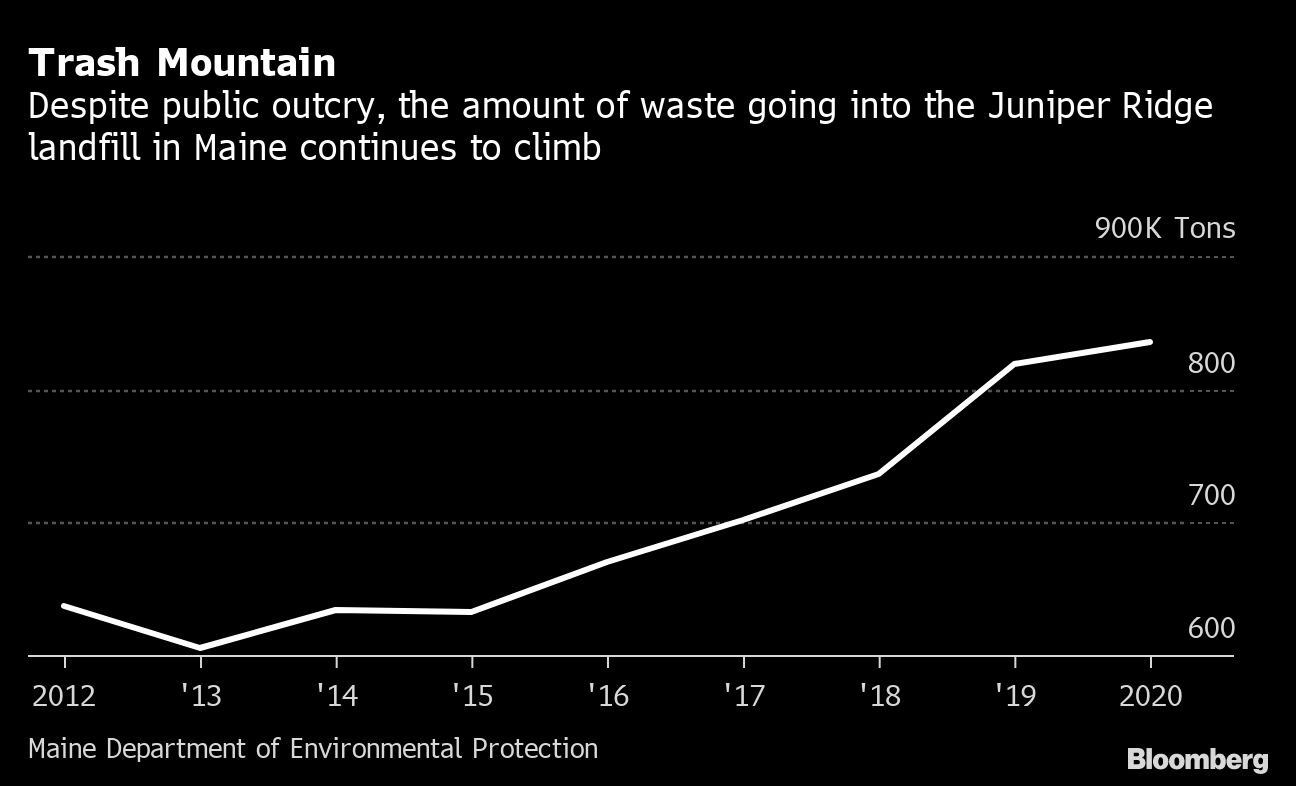
In 2019, Maine’s waste generation increased 2.5% to more than 1.8 million tons compared with the year prior, according to the state’s Department of Environmental Protection. But hundreds of thousands of tons of additional waste arrived from other states, dumped at the Juniper Ridge Landfill in Old Town, a few miles northeast of Bangor.
Spread over 179 acres, the state-owned landfill looms over the Penobscot Nation, an indigenous reservation located on an island at the stem of the Penobscot River. It’s been the cornerstone of tribal life for the small community of 500 people.
“Archeologists tell us we’ve been in the watershed for over 10,000 years,” said John Banks, natural resources director for the tribe. The river isn’t only a recreational gathering place, rich in cultural traditions for the tribe; it’s also a source for medicinal plants, sustenance fishing, hunting and trapping, he said. For decades, the Penobscot Nation has been raising the alarm about rising contamination. The amount of waste going to Juniper Ridge has increased about 31% since 2012, according to the Maine DEP.
“Many consider it sacred and our source of life. It’s our homeland.” Now, Banks said, “we’ve become the dumping ground for other states.”
“The issue is it’s all perfectly legal,” said Sarah Nichols, a program director with environmental nonprofit Natural Resources Council of Maine.
The state acquired Juniper Ridge in 2004 in order to preserve landfill capacity for waste generated by its citizens. In Maine, it is generally illegal to dump imported waste into state-owned landfills. However, Nichols said that due to a loophole in Maine’s waste regulations, out-of-state trash funneled through local processing facilities gets classified as Maine-generated waste.
Those facilities “recycle and recover” waste for contractors, property management companies and homeowners, dumping whatever can’t be recycled into landfills. The majority of the waste is construction and demolition debris, which has been banned from disposal in other New England states like Massachusetts and New Hampshire.
One such company is ReEnergy Resources, which has a processing facility in Lewiston, Maine. More than 90% of the 230,000 tons of construction waste ReEnergy accepted in 2019 came from out-of-state, according to its annual report. After processing, ReEnergy said it sent 93% of the imported trash to the Juniper Ridge landfill, which while owned by the state is operated by a private company, New England Waste Service of Maine, a subsidiary of Casella Waste Systems.
Casella collects a “tipping fee” from ReEnergy for taking its waste. Fees for construction and demolition debris vary, but range from $33 to $95 per ton, according to the state’s environmental agency. ReEnergy didn’t return emails or calls seeking comment.
Exacerbating the concerns of local residents isn’t just what’s going into landfills, but what’s coming out. According to Nichols, garbage imported for disposal contributes to leachate, a liquid that forms when rain water filters through garbage. The result is a toxic soup that can include mercury, arsenic and lead.
The National Institute for Environmental Health Sciences has found that the leachate is also a source of per- and polyfluoroalkyl substances (PFAS), known as “forever chemicals,” found in consumer products like cookware or food packaging. Studies by the Agency for Toxic Substances and Disease Registry reveal that exposure to PFAS chemicals is linked to health risks including decreased fertility, developmental problems in children and kidney and testicular cancer.
EPA Administrator-designate Michael Regan told a U.S. Senate committee last month the agency would make regulation for PFAS chemicals “a top priority” during the Biden administration.
Maine doesn’t test leachate for PFAS levels at commercial or state-owned landfills like Juniper Ridge, Nichols said, leaving the Penobscot tribe in the dark about the level of toxicity of the leachate being discharged into the river. The Maine DEP didn’t reply to requests for comment.
In 2016, local nonprofit environmental groups completed a restoration initiative for the river, a project Banks called “one of the most successful efforts to improve the ecological integrity of the Penobscot Nation’s homeland.” But under the shadow of the landfill, hopes the project would lead to a cleaner river are diminishing.
“It’s a huge blister on the face of the earth that’s just waiting to explode,” Banks said of the massive landfill. “The whole region gets its drinking water from the aquifer that is directly underneath this landfill. When that thing leaks, it’s not just the tribe that’s going to be suffering.”
In its 2019 annual report, Rutland, Vermont-based Casella said that leachate generated at its landfills and transfer stations is “tested on a regular basis,” but added that the toxic compound is generally “not regulated as a hazardous waste under federal law.”
Landfills typically apply liners, or barriers made of plastic or clay, to prevent toxin from leaking out. Most states require a two-liner system, but Maine only requires one, said Peter Blair, an attorney with environmental nonprofit Conservation Law Foundation. “All landfills eventually have leachate seep out once liners start to disintegrate,” he said. “It’s not a matter of if it will leak, but rather when.”
Leachate that’s collected from the Juniper Ridge landfill is taken to a wastewater treatment plant, where Dr. Jean MacRae, an associate professor in the Civil & Environmental Engineering department at the University of Maine, said “a majority” of the toxic matter can be treated to remove pollutants.
“Stuff still gets through, and it’s ultimately discharged into the river where it gets absorbed by fish,” she said. Even more concerning, MacRae said, is the unique composition of PFAS chemicals found in the leachate that makes it more resistant to traditional methods of treatment. “There’s no good way to break these types of contaminants down. It’s a big concern.”
In a statement, Casella said the Juniper Ridge Landfill is “fully compliant” with Maine environmental regulations. “The state-owned landfill is highly engineered with double liners, leak detection systems and a sophisticated liquid conveyance system,” the company said. Casella added that it is “also concerned” about PFAS chemicals. “While it’s tempting for environmental groups — and too easy — to point the finger at landfills, the truth is that for decades many of the products and day-to-day items used in our society contain these compounds and end up in our environment through many sources.”
Burning Garbage in Pennsylvania
In Chester, Pennsylvania, residents live with the fallout of imported waste in the air they breathe. The small town of 33,000 is home to the Covanta Delaware County combustion plant. More than one-third of municipal solid waste accepted by the facility last year came from Delaware, New Jersey and New York, according to the Pennsylvania Department of Environmental Protection.
The state has six waste-to-energy facilities and 46 active landfills — 19 of which will close in the next decade, according to the EPA’s Landfill Methane Outreach Program database. Homegrown waste generation has increased 48% since 1990, while garbage tonnage from other states has grown 100% over the same period, DEP data show.
“People put their trash on the curb and think nothing of it,” said Zulene Mayfield, a lifelong resident who runs the Chester Residents Concerned for Quality Living, a community group which has been railing against the health hazards burning waste. “Little do they know it ends up here in Chester. You can’t sit on your porch or have your windows open because of the dust. We don’t have barbecues anymore and parents don’t want their kids to play outside.”
Also known as a waste-to-energy plant, the Covanta facility burns garbage to produce steam in a boiler that’s used to generate electricity. However, when trash is burned, nitrogen oxides and sulfur dioxides are emitted, both of which are linked to a host of health issues, according to researchers at the Center of Excellence in Environmental Toxicology at the University of Pennsylvania.
Delaware County, where Chester is located, has disproportionately high rates of asthma, cancer and other chronic health conditions compared with the rest of the state, according to Pennsylvania health records. The city, which is 69% Black, is also home to other waste treatment facilities.
Covanta contends its facility’s output, which includes an emissions control system, is below state and federal regulator safety limits. “To say we are the source of the problem is just factually not accurate,” said Paul Gilman, chief sustainability officer at Covanta.
Proponents of burning trash argue the emissions from the waste-to-energy plants are a fraction of the pollution caused by landfills. Some say that’s still too much.
Companies like Covanta are “working within the regulations imposed on them, but that doesn’t necessarily mean that it’s the best practice, especially for communities of color,” said Yinka Bode-George, environmental health manager at the National Caucus of Environmental Legislators. With 35 states introducing recycling and waste-oriented bills in the last year, “there is powerful momentum for legislation to move forward,” she said.
In Connecticut, an initiative led by the state’s Department of Energy & Environmental Protection and leaders from more than 70 cities and towns are pressing lawmakers to consider more sustainable waste management solutions, including a “pay-as-you-throw” model that would charge residents based on the amount of trash produced, similar to a utility bill.
At the federal level, efforts to advance recycling legislation lost traction amid the COVID-19 pandemic. U.S. Representative Tony Cardenas of California, a Democrat, proposed the RECOVER Act, which would allocate $500 million for states and municipalities to improve waste and recycling infrastructure. Cardenas plans to reintroduce the legislation before summer.
Cost of Recycling in Maryland
It turns out that fixing the economics of waste and recycling is critical to reversing America’s waste crisis.
In the beachside resort town of Ocean City, Maryland, recycling was discontinued in 2009 after the financial crisis crippled its budget. The municipality contracts with Covanta to truck out the majority of its waste, including recyclables, to Chester, paying $67.90 per ton, according to Ocean City’s 2021 budget records.
The fee is a fraction of the cost of collecting recyclables, which averages about $120 per ton, according to Stifel estimates.
“The cost to recycle doesn’t make financial sense for many municipalities,” Changaris of the waste industry group said. “But it has to go somewhere.”
Covanta’s Gilman acknowledged that the increased cost of recycling has landed more of those materials in the trash it processes at the Chester facility. “If we have control, we will turn it away,” he said. “But if we have a contractual agreement, we have to adhere to that.”
Even so, communities like the Penobscot Nation and Chester end up paying a steep price. “People ask me why I still live here,” said Mayfield of Chester. “I just want them to know it’s not a wasteland.”
Popular Stories


.webp?height=100&t=1784491177&width=150 "030_ai_in_the_warehouse-_real_use_cases_v1-(540p).png")

SupplyChainBrain 2026 ESG Guide: ESG — The Supply Chain’s Biggest Secret
VIEW THE LATEST ISSUECase Studies


Visit Our Sponsors |