
Ukraine War Gives U.S. LNG Chance to Shed Its Stigma
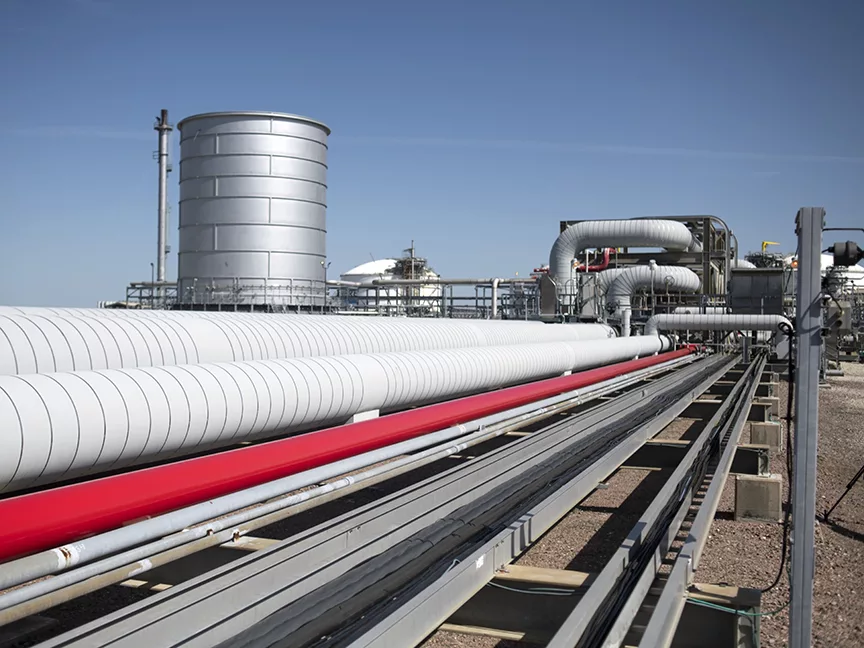
Deep in Louisiana’s bayou country, 18 maroon canisters discharge clear, odorless methane into the air as hard-hatted engineers patrol wind gauges, solar panels and a laser surveillance system shooting beams at mirrors.
The experts and employees of Cheniere Energy Inc., the largest U.S. exporter of natural gas, are part of a high-stakes campaign to show Europe that as it abandons Russian gas, it can substitute the American variety without fear. Their job is to find the most efficient leak detecting system.
“If we do our job of leading the North American industry to reduce its emissions profile, it will be very clear that natural gas has a seat at this energy transition table for decades and decades,” Chief Commercial Officer Anatol Feygin said at Cheniere’s headquarters in Houston.
Europe’s energy crisis, magnified by the Ukraine war, has driven demand for natural gas to new heights, offering American producers an opportunity to win over buyers wary of their fracked product, with its reputation for environmental wreckage and history of climate-warming methane leaks.
Exporters are seizing the moment and eager to showcase their due diligence. For the potential clients in the EU, it’s a complex calculus involving technology, price, ecology and geopolitics.
Russia’s gas comes mainly via pipelines that can be shut off once cleaner sources, like wind or solar, are available. U.S. gas is not only fracked but cooled into liquid — LNG — for shipment, requiring major infrastructure, such as terminals, and susceptible to more points of leaks.
Cheniere, which has contracts to expand its Texas terminal, hopes to do the same for its Sabine Pass terminal in Louisiana, the largest in the U.S.
That seemed out of reach until Russia’s invasion of Ukraine. It’s a new energy landscape now. The EU wants to replace 50 billion cubic meters of Russian gas with LNG by the end of this year. Under an EU-U.S. deal last month, Europe will get at least 15 bcm by the end of the year. Feygin said the U.S. likely already delivered that in the first quarter as global shipments were rerouted in reaction to surging prices on the continent. At a gas conference in Vienna last month, security of supply was top of the agenda and the Netherlands, Germany and the Baltic nations are already setting up LNG import terminals.
Carbon Intensity
The European Commission’s proposal late last year to include natural gas as a sustainable investment “was a key development for us,” Feygin said.
The move, met by fierce opposition from environmental advocates, poses a challenge to Europe’s obligations under the Global Methane Pledge, which the EU, U.S. and some other countries committed to at last year's climate talks in Glasgow. The goal is to reduce all man-made methane emissions by 30% by 2030 compared to 2020 levels.
Russia’s war is changing things. The EU, which relies on Russia for 45% of the gas needed to heat homes, fuel power plants, run factories and produce fertilizers, is working on a strategy for getting off Russian gas.
Before the war, French company Engie SA halted a $7 billion deal in 2020 to buy LNG from Texas’s NextDecade Corp. amid concerns about fracking and prolific flaring.
Now, under a deal signed last month, Engie requires Cheniere to disclose the carbon intensity of every cargo it sells and quantify emissions starting from the wellhead. Cheniere plans to start releasing cargo emissions to its customers this year.
Others may have to follow. In December, the European Commission put forward a regulation to improve measuring, reporting and verification of emissions across their supply chains. If approved, it’ll be binding on all member states.
Cheniere and the natural gas industry have a two-fold problem: leaks have been unchecked in the U.S. for the better part of the shale boom that began in the mid-2000s. And even if they’re all plugged, companies are still selling a fossil fuel that is almost pure methane. Burning that methane produces carbon dioxide, which takes hundreds of years to eliminate from the atmosphere.
Read: Methane Leaks Make LNG-Powered Ships Dirtier Than Other Vessels
Engie said the deal with Cheniere, which extends their gas supply agreement beyond 2040, is compatible with its carbon trajectory while also diversifying its gas supplies amid geopolitical concerns.
“Accelerating the energy transition is essential,” and gas will play a role alongside renewable sources, Engie spokeswoman Sandrine Deparis said. “Engie now obviously needs to be prepared for any eventuality in terms of Russian gas supplies.”
Deal Dilemma
Europe’s quandary — whether it can get enough gas amid a global push for energy security — is a multi-billion dollar question for Cheniere and others in the U.S. gas industry seeking to justify new LNG export terminals and production.
Europe needs to decide whether enough global reshuffling of supplies can make spare LNG cargoes available or whether it needs to sign new long-term deals. In the first quarter, 75% of Cheniere’s cargoes landed in Europe, up from about 38% from a year earlier.
“I have not seen a lot of appetite for new long-term contracts for European gas utilities in the face of this crisis,” said Clark Williams-Derry, an analyst at the Institute for Energy Economics and Financial Analysis.
Contractual flexibility that allows buyers of U.S. LNG to ship their cargoes anywhere may buy enough time to help Europe substitute some of its gas needs and allow the continent to speed up development of alternative energy without building new export terminals, Williams-Derry said. Export volumes can also be increased by operating the terminals closer to capacity and as privately-held developer Venture Global LNG Inc. starts up its operations.
Cheniere’s Feygin said that while some European buyers are expressing interest in deals beyond 10 or 15 years, the vast majority of new LNG contracts will likely come from Asia, where overall energy demand is growing. Financiers are still very interested in banking projects backed by strong customer agreements. Buyers’ interest in talking about emissions is mixed, he said. “There are transactions that we simply would have not had a seat at the table for had we not done all of this work.”
For environmental advocates, the whole issue is a disaster in the making.
“There is no time for fossil fuel detours,” said Rachel Cleetus, policy director with the climate and energy program at the Union of Concerned Scientists. “Calling for infrastructure that takes years to build is not going to help Europe right now, it’s not going to help gas prices right now, but it is going to lock us into fossil fuel infrastructure for a long time.”
Read: Russia’s War Supercharges Push to Make New Green Fuel
Methane is more than 80 times more potent than carbon dioxide in its first two decades and is accumulated more than twice as fast, according to a study from Stanford University. The U.S.’s National Oceanic and Atmospheric Administration said methane levels rose at a record clip last year. And a United Nations-backed panel of scientists warned emissions of the gas must be reduced by a third by 2030 to try to keep warming to around 1.5 degrees Celsius (2.7 Fahrenheit).
“We, the industry overall, will very quickly respond to this new focus and dramatically improve its lifecycle emissions profile and will ensure its place in this energy transition as a result,” Feygin said. “If there is a criticism of the industry, I think, it is that all of this could have been done earlier.”
Supply Chain Cleanup
Figuring out the carbon footprint of an LNG cargo is a massive task. There are countless well sites in Pennsylvania to Texas to western Canada and 26 pipeline pathways to Cheniere’s two Gulf Coast terminals. Cheniere estimated that a tanker of cargo produces 47,000 to 84,000 metric tons of carbon dioxide equivalent emissions based in part on the voyage length and the type of ship fuel used, or roughly the same amount of emissions as 10,000-18,000 gasoline-fueled passenger vehicles on the road for a year. As such, deliveries to Pakistan and Israel have higher emission intensities than those to Jamaica.
Those are based on engineering calculations, and Cheniere is trying to find out whether actual measured emissions will be higher or lower, said Fiji George, Cheniere’s senior director of climate and sustainability as he oversees the testing at the Gillis station in Louisiana. “Nobody really knows.”
Last year, Cheniere sold a “carbon neutral” cargo with Royal Dutch Shell that used carbon offsets when others in the industry were trying the same, but George said that practice has all virtually died down amid criticism. The industry has to use measurement-based calculations to show its carbon footprint and progress in eliminating waste. Ultimately that will mean surveillance along the U.S.’s network of hundreds of gas compressor stations and hundreds of thousands of miles of pipeline, he said.
Cheniere has begun a collaboration with five pipeline operators to figure out how to clean up its supply chain, including Kinder Morgan Inc., Williams Cos., MPLX LP, DT Midstream Inc. and Crestwood Energy Partners LP. Cheniere is contributing its Creole Trail Pipeline and the Gillis compressor station to the project. It builds on a similar project at drilling sites that supply gas to Cheniere that was announced last year.
Cheniere processes nearly 8% of U.S. gas production a day and up to 1.5% of the total goes through the Gillis compressor station in Ragley, Louisiana, which then pumps it almost 100 miles south to Cheniere’s Sabine Pass Export terminal. Because of big engines, most of the emissions at the site are carbon dioxide. But they are more easily calculated because they are produced from combustion. Methane is tricky. It can leak from virtually anywhere and even very small leaks can add up over time.
Gillis is almost entirely controlled from Houston, where operators are part of the trial to see how well the monitoring equipment works. Meanwhile, Dan Zimmerle of Colorado State University watches the data stream into his lab to check for accuracy while a team develops an algorithm to pinpoint and quantify emissions. In the field recently, he said the methane was being released at different concentrations, ranging from about one unlit household burner on a gas stove with the knob turned up to more than 37 such burners at the high end. Cows burping up a similar amount of methane on the neighboring field won’t interfere with readings because their emissions are spread over a day rather than concentrated in an hour, he said.
The plume shouldn’t have been big enough to be detected by the European Space Agency’s Sentinel-5P satellite that made its scheduled flyby at noon. Cheniere has tasked Kayrros SAS to evaluate the captured image. They are conducting a six-month study, which will choose from among four vendors.
“All these guys have their own secret sauce,” George said. “We are essentially in a cooking contest to find out which sauce is worthy to put on the table.”
Popular Stories




SupplyChainBrain 2026 ESG Guide: ESG — The Supply Chain’s Biggest Secret
VIEW THE LATEST ISSUECase Studies


Visit Our Sponsors |
|
|
|
|
|
|
|
|
|
|
|
|
|
|
|
|
|
|
|
|
|
|
|
|
|
|
|
|
|
|
|
|
|
|
|
|
|
|