
SPECIAL REPORT
How AI Can Deliver a Better 3PL Customer Service Experience
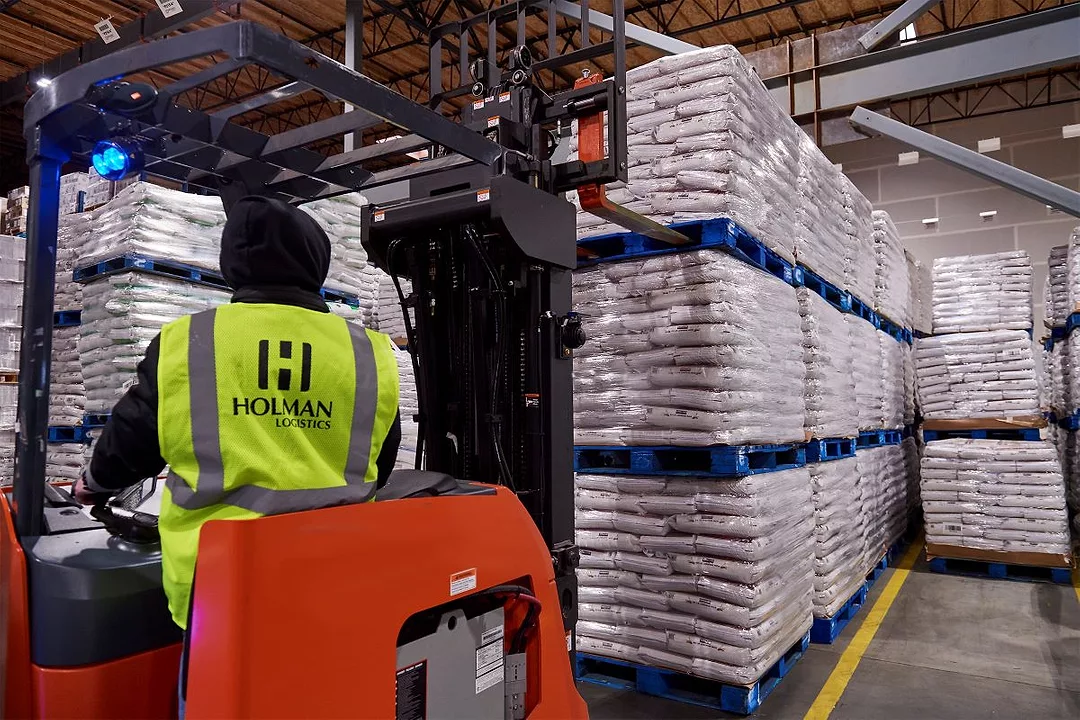
Photo: Holman Logistics
A primary objective of all third-party logistics (3PL) organizations is to provide their clients with outsourced logistics support by handling the movement of goods and materials from manufacture to storage to delivery. But how can this be done in an operating environment characterized by increasingly scarce labor, unexpected and often disruptive events, and information overload?
“All 3PL organizations face similar challenges,” says Brien Downie, president of Holman Logistics. “Clients want their inventory protected when it’s in the warehouse. They want accurate, real-time information on the location of their raw materials and finished goods. They want everything shipped on schedule, and nothing shipped that’s not supposed to be. Most of all, they want their deliveries to be complete and on time. Those are many of the key drivers for how the service of a 3PL organization is measured.”
Meeting these client needs would be difficult enough if orders were confined to full truckload quantities shipped directly from warehouses to recipients’ receiving docks. Reality, though, is far different. Order patterns are complex, particularly for e-commerce transactions that are taking an increasing share of the nation’s commerce. “Customers may order things one at a time,” says Downie. “but handling individual and small-quantity items can be expensive.”
Things come to a stop when the supply chain gets hit with damaging weather, transport breakdowns, or labor activities. “Any time there’s a disruption, things get really costly,” says Downie. “You end up taking on extra capacity in terms of personnel for accurate order tracking or material-handling equipment for unusual circumstances. Then there’s the challenge of what to do with people and equipment when the crisis is over.”
Increasing Efficiencies
To meet the requirements of an increasingly demanding operating environment, 3PL organizations are teaming up with AI-driven software providers. Leading-edge technology can address many issues that improve operational efficiency. One important example is increased safety. “A safe warehouse is an efficient warehouse,” says Downie. “Fewer accidents mean a 3PL provider can take better care of the people working in the warehouse and of the products stored there.” Accident-free operations contribute directly to the bottom line and customer service goals by reducing injuries and product movement interruptions.
The traditional approach to ensure safety has been to mount sensors that shut down lifts when bumps are detected. On the surface, that sounds like a great solution. In reality, such a system leads to higher costs when sensors can’t distinguish expected or normal bumps from harmful ones.
“Traditional sensors don't give you enough information,” says Downie. “They aren't able to separate the signal from the noise. They often have g-force sensors that shut down the lift trucks when a vibration level is exceeded. The intention is to identify when someone has had a collision or run into a piece of tracking. But the problem is that, very often, just driving over a harmless bump in the floor activates the sensor. And when the system can’t distinguish the good from the bad, people are going to turn off the system and stop using it entirely.” That, of course, escalates the risk of costly accidents.
The sensor system needs improvement to filter out exceptions to normal operations. That’s where AI processing comes in. Its advanced pattern recognition quickly and accurately separates the signal from the noise. The result is a decrease in the leading indicators of safety issues. Employers can identify which operators have been bumping into racks or making aggressive turns, along with how and when they're doing it. “AI provides a clear picture of what’s really going on in the warehouse,” says Downie. “It can effectively identify potential accidents before they happen.”
Optimal Slotting
Goods arrive at the warehouse, get processed by the team, and then move on to the shelves. However, what should be a seamless process can be fraught with inefficiencies that increase labor and handling costs and threaten on-time delivery.
“Historically, there have not been many developments from a machine learning standpoint as to how product goes into and comes out of the warehouse,” says Downie. “That's rapidly changing.” Now, 3PL organizations can adopt AI-based warehouse management software with automatic slotting, which utilizes past patterns of product movement to automatically direct the handling of new inventory.
An AI-powered warehouse management orchestration platform can make the 3PLs of the world run more efficiently in operations such as picking, put-away, and inventory accuracy. “Many warehouses do not place products in optimal locations because they just don't know a whole host of data points, such as what orders are coming in real-time, how many warehouse workers will be on a shift, and the expertise of those workers,” says Yosh Eisbart, chief executive officer and co-founder at Fulfilld, an AI-enabled warehouse orchestration company. “AI can ingest this information and use it to run ‘what if’ scenarios. For example, ‘What if we were to move this product in this location or these products in these locations for the fastest 20 moving items? What would that look like with regard to higher picking efficiency and lower labor needs?’ The result is a level of warehouse efficiency that just doesn't exist otherwise.”
Before AI, warehouse managers would try to rearrange product on a periodic, ad hoc basis to increase efficiency. “Sometimes that would work, and sometimes it wouldn’t,” says Eisbart. “But even in the best cases, the decisions would be based only on a snapshot in time. AI allows for a constant reassessment and reallocation, along with continual results testing that reveals percentage changes in efficiencies and costs.”
By reducing wasted warehouse worker footsteps, the 3PL organization becomes more productive, more cost-effective, more accurate, and nimbler. It can ship orders more quickly and less expensively, providing end-user satisfaction and decreasing client expense.
AI systems can even designate which employees should move each product, based on an analysis of personal history and performance. “While this assessment has traditionally been done by a supervisor, what works for a few people quickly gets too cumbersome for thousands of workers,” notes Downie. “Software tools allow the company to optimize the allocation of labor for maximum efficiencies.”
AI is more efficient in these decisions because it incorporates the principles of the traditional “digital twin” into its software. The technology has immediate and continuing access to warehouse information such as building dimensions, positions and heights of aisles, the distance between aisles, loading dock locations, the number and expertise of the employees on-premises, and the locations and details of the available forklifts, autonomous mobile robots, and automatic storage retrieval systems. “Making the digital twin part and parcel of the core AI product allows it to orchestrate greater warehouse efficiency, which results in a better client experience,” says Eisbart.
The digital twin can also help resolve the costly issue of warehouse worker turnover. Replacement personnel, who often must be hired quickly to meet demand, too often lack the requisite expertise to maintain optimal efficiency. “New workers will be unfamiliar with the layout of a warehouse, but AI can bring them quickly up to speed by providing maps with optimized routing instructions,” says Eisbart. “Instead of walking halfway around the warehouse to get from point A to point B, the new worker can follow a suggested route. The result is an improved ability to locate and process inventory quickly.”
The Human Factor
Impressive as it is, AI alone cannot move a 3PL to peak efficiency. Human expertise is still required. “Leveraging AI will not automatically result in efficiency gains,” says Downie. “People need to stay involved. While AI can master the subject matter, it will very often reach incorrect conclusions. The 3PL organization must ensure that it retains the insights of people who think critically and can recognize AI limitations.”
The advantages of AI will not happen overnight, and it will take time for employees to become convinced of the technology’s potential. “People will get excited about AI once they see how it can help them avoid a lot of tedious, repetitive labor,” says Downie. “They will come to appreciate the increases in productivity.”
Companies face two challenges in implementing AI technology. At one level, authentic engagement is important. “There are companies out there that are truly leveraging AI,” says Eisbart. “And there are companies that are just putting it on their website to polish their image.”
At a second level, there is the challenge of monitoring results. “Gains will vary by installation,” says Eisbart. “Some use cases will offer optimization opportunities, and some will not.” One recent Fortune 500 company was able to reduce wasted warehouse worker footsteps by 40%, increase picking efficiency by 15%, and increase put-away efficiency by 20%. Factors contributing to the level of AI success include the size of the facility, current worker expertise, product velocity, and the degree to which operations have already incorporated machine learning.
Above all, says Eisbart, 3PL organizations that incorporate AI need to keep their eye on the ultimate goal: an improved bottom line. “Organizations that lead with technology or that focus on innovation without assessing the impact upon business results are missing the point.”
Resource Link: www.holmanusa.com/technology
Popular Stories





SupplyChainBrain 2026 ESG Guide: ESG — The Supply Chain’s Biggest Secret
VIEW THE LATEST ISSUECase Studies


Visit Our Sponsors |
|
|
| |
|
|
|
|
|
|
|
|
|
|
|
|
|
|
|
|
|
|
|
|
|
|
|
|
|
|
|
|