• Advertise
  • Contact Us
  • Supplier Directory
  • SCB YouTube
  • About Us
  • Login
  • Subscribe
  • Logout
  • My Profile
  • LOGISTICS
    • Air Cargo
    • All Logistics
    • Facility Location Planning
    • Freight Forwarding/Customs Brokerage
    • Global Gateways
    • Global Logistics
    • Last Mile Delivery
    • Logistics Outsourcing
    • LTL/Truckload Services
    • Ocean Transportation
    • Parcel & Express
    • Rail & Intermodal
    • Reverse Logistics
    • Service Parts Management
    • Transportation & Distribution
  • TECHNOLOGY
    • All Technology
    • Artificial Intelligence
    • Cloud & On-Demand Systems
    • Data Management (Big Data/IoT/Blockchain)
    • ERP & Enterprise Systems
    • Forecasting & Demand Planning
    • Global Trade Management
    • Inventory Planning/ Optimization
    • Product Lifecycle Management
    • Robotics
    • Sales & Operations Planning
    • SC Finance & Revenue Management
    • SC Planning & Optimization
    • Supply Chain Visibility
    • Transportation Management
  • GENERAL SCM
    • Business Strategy Alignment
    • Customer Relationship Management
    • Education & Professional Development
    • Global Supply Chain Management
    • Global Trade & Economics
    • Green Energy
    • HR & Labor Management
    • Quality & Metrics
    • Regulation & Compliance
    • Sourcing/Procurement/SRM
    • SC Security & Risk Mgmt
    • Supply Chains in Crisis
    • Sustainability & Corporate Social Responsibility
  • WAREHOUSING
    • All Warehouse Services
    • Conveyors & Sortation
    • Lift Trucks & AGVs
    • Order Management & Fulfillment
    • Packaging
    • RFID, Barcode, Mobility & Voice
    • Warehouse Automation
    • Warehouse Management Systems
  • INDUSTRIES
    • Aerospace & Defense
    • Apparel
    • Automotive
    • Chemicals & Energy
    • Consumer Packaged Goods
    • E-Commerce/Omni-Channel
    • Food & Beverage
    • Healthcare
    • High-Tech/Electronics
    • Industrial Manufacturing
    • Pharmaceutical/Biotech
    • Retail
  • THINK TANK
  • WEBINARS
    • On-Demand Webinars
    • Upcoming Webinars
    • Webinar Library
  • PODCASTS
  • WHITEPAPERS
  • VIDEOS
Home » Why Congestion Could Be on the Horizon for Port of L.A. Headed into Peak Months
SCB FEATURE

Why Congestion Could Be on the Horizon for Port of L.A. Headed into Peak Months

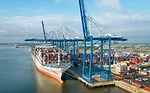
A LARGE CONTAINER SHIP IS DOCKED NEXT TO CRANES AT THE PORT OF LOS ANGELES.
The Port of Los Angeles, Los Angeles, California. Photo: iStock.com/viavado
April 2, 2024
Nick Bowman, Senior Editor

A March 18 briefing from the Port of Los Angeles offered a rosy picture of volumes and capacity at the critical gateway in recent months. But a potentially perfect storm of geopolitical and economic factors could lead to problems come spring and summer. 

Already in 2024, the port has moved around 1.6 million 20-foot equivalent units (TEUs), a 35% increase over the same period last year. With port terminals operating at 75% to 80% capacity, "market confidence in our gateway is as strong as it's ever been," executive director Gene Seroka said in the March briefing.

Despite that level of confidence, Bryn Heimbeck, co-founder and president of global logistics platform Trade Tech, believes the port should anticipate larger volumes by April and May, before picking up even more in June, July and August. Market-driven increases in volume are likely to be exacerbated by the crisis at the Panama Canal that severely limited volumes in the vital shipping lane. And, with that, comes the threat of congestion.

"Unfortunately, the Panama Canal is at a fraction of its capacity," Heimbeck says, citing the canal's traffic jams fueled by drought. 

With U.S. economic growth of more than 3% a year, and an unemployment rate hovering under 4%, "we're living in a significant economic period," Heimbeck says. "And that means more consumption," where consumers are able to buy more products sourced in Asia, which are moved through West Coast ports. 

Combined with a years-long pushback against automation that could potentially increase throughput from union dockworkers at the ports of Los Angeles and Long Beach, those factors could add up to trouble for the shipping hub. 

"I don't think you have to be a genius to think we're going to get to congestion," Heimbeck says. 

The port is already experiencing longer-than-usual container dwell times at rail transfer facilities, averaging between five and eight days as of March 15 (the target is usually two to four days). And while the port says it has "the infrastructure, labor force, analytics and capabilities to handle additional cargo," it doesn't arrange offloaded container stacks to account for when trucks will be arriving to pick up their cargo, Heimbeck points out.

"The real problem with the current processes is that the terminal doesn't know when the container's going to leave," he says. "If you don't know, then you can't plan; if you can't plan, you're stuck digging for the container that a trucker comes to get." As volume ramps up, that could leave a line of trucks waiting at the terminal gate. 

Short of quickly enacting infrastructure modifications that allow for planned stacks ahead of the spring and summer months, Heimbeck offers a relatively simple solution for carriers, should the port struggle with congestion: pivoting to the Pacific Northwest. 

"People just so rarely think of the PNW/Seattle-Tacoma as an alternative," he says. "Their volumes are actually down, and you've got the rail infrastructure to service virtually everywhere."

So far in 2024, the Northwest Seaport Alliance is reporting average terminal dwell times of two and a half days at the ports of Seattle and Tacoma. 

"This means that shippers can save time using our terminals in the event the supply chain becomes strained along the West Coast," NWSA spokesperson Melanie Stambaugh says. 

She adds that the Port of Seattle is in the final stages of opening a second berth at its Terminal 5, which would provide even more cargo-handling capabilities. 

Meanwhile, the Port of Los Angeles remains confident about the current state of affairs. 

"All of our vital statistics are in good shape," Seroka says. "If issues do arise, we will help our supply chain partners in addressing them. 

"As we learned during the COVID-19 pandemic, it is critical that we keep Port of Los Angeles docks fluid," he adds. "The port can’t be used as a warehouse. Cargo must be discharged from vessels and moved out swiftly."

    RELATED CONTENT

    RELATED VIDEOS

    Global Gateways Ocean Transportation Transportation & Distribution Forecasting & Demand Planning Global Trade & Economics Supply Chains in Crisis
    • Related Articles

      Red Sea Delays the 'New Normal' Headed into Peak Shipping Season

      To Fend Off Competitors, Port of L.A. Plans to Put Billions Into Infrastructure Improvements

      Indie Truckers Can't Serve the Port of L.A.? Never Mind

    Nick Bowman, Senior Editor

    Supreme Court Ruling Reshapes Risk for Freight Brokers

    More from this author

    Subscribe to our Daily Newsletter!

    Timely, incisive articles delivered directly to your inbox.

    Featured Product

    Popular Stories

    • A LARGE CYLINDRICAL OBJECT SHRINK-WRAPPED IN WHITE PLASTIC IS LOWERED BY CRANE ONTO A FLAT BED TRUCK ON A DOCK

      AI Boom Has European Buyers Paying Extra to Secure Gas Turbines

      Technology
    • 021_what_is_ai_in_warehousing_and_the_supply_chain- (540p).png

      Watch: What Is AI in Warehousing and the Supply Chain?

      Artificial Intelligence
    • TWO WORKERS IN A WAREHOUSE PUSH ROLLING CARTS LOADED WITH BRIGHT BLUE BINS

      Walmart Caps Usage of an AI Tool for Employees After High Demand

      Artificial Intelligence
    • Close-up hands of unrecognizable man holding and using smartphone standing on city street.

      Five Supply Chain Security Risks Hiding Inside Your Mobile Apps

      Supply Chain Visibility
    • Businessman using AI agent system on laptop computer.

      AI in Supply Chain Can’t Succeed Without Foundational Systems

      Artificial Intelligence

    Digital Edition

    2026 esg cover main scb q2 2026 cover

    SupplyChainBrain 2026 ESG Guide: ESG — The Supply Chain’s Biggest Secret

    VIEW THE LATEST ISSUE

    Case Studies

    • Recycled Tagging Fasteners: Small Changes Make a Big Impact

    • A GRAPHIC SHOWING MULTIPLE FORMS OF SHIPPING, WITH A HUMAN STANDING AT THE CENTER, TOUCHING A SYMBOLIC MAP OF THE WORLD

      Enhancing High-Value Electronics Shipment Security with Tive's Real-Time Tracking

    • A GRAPHIC OF INTERLACING HONEYCOMBED ELEMENTS REPRESENTING GLOBAL BUSINESS TRANSACTIONS

      Moving Robots Site-to-Site

    • JLL Finds Perfect Warehouse Location, Leading to $15M Grant for Startup

    • Robots Speed Fulfillment to Help Apparel Company Scale for Growth

    Visit Our Sponsors

    4flow Arkieva Blue Yonder
    Carton Cloud CoEnterprise Dassault
    Duravant E2Open General Logistics Systems
    Hy-Tek iGPS Korber
    Lyngsoe Procurability Quinyx
    SAP Sikick Systech
    S&P Global Mobility TADA TransImpact
    US Bank Werner Enterprises WSI
    • More From SCB
      • Featured Content
      • Video Library
      • Think Tank Blog
      • SupplyChainBrain Podcast
      • Whitepapers
      • On-Demand Webinars
      • Upcoming Webinars
    • Digital Offerings
      • Digital Issue
      • Subscribe
      • Manage Email Preferences
      • Newsletters
    • Resources
      • Events Calendar
      • 2026 Event Coverage
      • SCB's Great Supply Chain Partners
      • Supplier Directory
      • Case Study Showcase
      • Supply Chain Innovation Awards
      • 100 Great Partners Form
    • SCB Corporate
      • Advertise on SCB.COM
      • About Us
      • Privacy Policy
      • Contact Us
      • Data Sharing Opt-Out

    All content copyright ©2026 Keller International Publishing Corp All rights reserved. No reproduction, transmission or display is permitted without the written permissions of Keller International Publishing Corp

    Design, CMS, Hosting & Web Development :: ePublishing