• Advertise
  • Contact Us
  • Supplier Directory
  • SCB YouTube
  • About Us
  • Login
  • Subscribe
  • Logout
  • My Profile
  • LOGISTICS
    • Air Cargo
    • All Logistics
    • Facility Location Planning
    • Freight Forwarding/Customs Brokerage
    • Global Gateways
    • Global Logistics
    • Last Mile Delivery
    • Logistics Outsourcing
    • LTL/Truckload Services
    • Ocean Transportation
    • Parcel & Express
    • Rail & Intermodal
    • Reverse Logistics
    • Service Parts Management
    • Transportation & Distribution
  • TECHNOLOGY
    • All Technology
    • Artificial Intelligence
    • Cloud & On-Demand Systems
    • Data Management (Big Data/IoT/Blockchain)
    • ERP & Enterprise Systems
    • Forecasting & Demand Planning
    • Global Trade Management
    • Inventory Planning/ Optimization
    • Product Lifecycle Management
    • Robotics
    • Sales & Operations Planning
    • SC Finance & Revenue Management
    • SC Planning & Optimization
    • Supply Chain Visibility
    • Transportation Management
  • GENERAL SCM
    • Business Strategy Alignment
    • Customer Relationship Management
    • Education & Professional Development
    • Global Supply Chain Management
    • Global Trade & Economics
    • Green Energy
    • HR & Labor Management
    • Quality & Metrics
    • Regulation & Compliance
    • Sourcing/Procurement/SRM
    • SC Security & Risk Mgmt
    • Supply Chains in Crisis
    • Sustainability & Corporate Social Responsibility
  • WAREHOUSING
    • All Warehouse Services
    • Conveyors & Sortation
    • Lift Trucks & AGVs
    • Order Management & Fulfillment
    • Packaging
    • RFID, Barcode, Mobility & Voice
    • Warehouse Automation
    • Warehouse Management Systems
  • INDUSTRIES
    • Aerospace & Defense
    • Apparel
    • Automotive
    • Chemicals & Energy
    • Consumer Packaged Goods
    • E-Commerce/Omni-Channel
    • Food & Beverage
    • Healthcare
    • High-Tech/Electronics
    • Industrial Manufacturing
    • Pharmaceutical/Biotech
    • Retail
  • THINK TANK
  • WEBINARS
    • On-Demand Webinars
    • Upcoming Webinars
    • Webinar Library
  • PODCASTS
  • WHITEPAPERS
  • VIDEOS
Home » Collapse of Baltimore Bridge Highlights the Cost of Failing to Safeguard Critical Spans
SCB FEATURE

Collapse of Baltimore Bridge Highlights the Cost of Failing to Safeguard Critical Spans
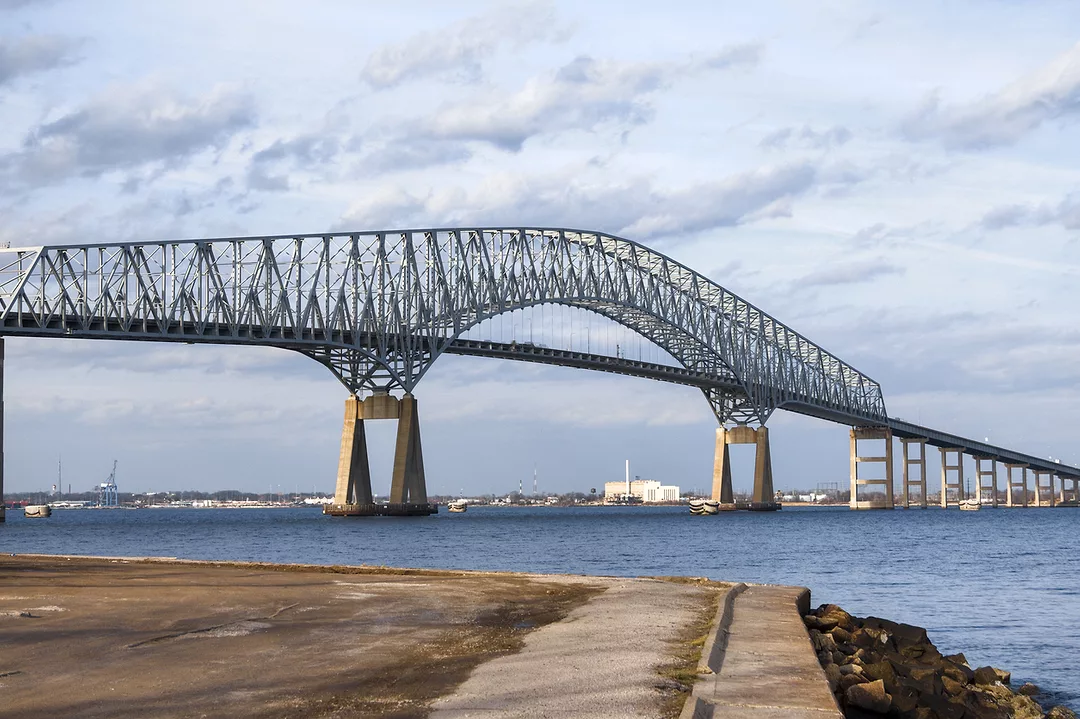
Baltimore's Francis Scott Key Bridge
March 28, 2024
Nick Bowman, Senior Editor

The collapse of Baltimore's Francis Scott Key Bridge March 26 raises urgent questions about the relative vulnerability of infrastructure that keeps ships flowing through vital U.S. ports.

"We really are going to see the costs of not safeguarding our critical bridges," warns Northeastern University's founding director for its Global Resilience Institute Stephen Flynn.  

The Dali container ship crashed into the bridge early on March 26, sending a large portion of the span — along with several vehicles containing construction workers — plunging into the water below.

As of March 27, the Port of Baltimore had closed all vessel traffic until further notice, with no estimate for when that may change, as investigators and crews work to search for survivors and clear the waterway. 

Flynn predicts months-long disruptions brought on by the closure at the Port of Baltimore, the country's number one import port for cars, where much of the shore-side infrastructure and roll-on/roll-off capability can't be shifted to other ports. 

General Motors issued a statement to Auto Blog saying that they "are working to re-route any vehicle shipments to other ports," although they did not specify which ports would be chosen. Volkswagen Group of America — which includes Audi, Lamborghini, and Bentley — said that it does not anticipate impacts on its vessel operations, but could see trucking delays as traffic is rerouted in the area. 

Infor Nexus VP of strategy Heidi Benko also warns that surrounding ports should expect "significant delays" over time. Given that New York and Norfolk are already high-volume ports, she believes excess containers are going to struggle to find a slot, since they're booked well in advance. 

With this level of impact to the supply chain brought on by the collapse of a single bridge, Flynn argues steps can be taken to mitigate an incident such as this at other vulnerable ports. He references the collapse of Tampa Bay's Sunshine Skyway Bridge in 1980, where 1,200 feet of the span was knocked down by a container vessel. 

After that incident, the bridge was rebuilt with what Flynn describes as a "mini island" around the support structure, capable of at least cushioning the impact of a rogue vessel, thereby preventing another disaster. And while that structure may not be as effective at completely stopping some of today's container ships — which are getting larger every year — it suggests an approach that could at least minimize the impact by repelling the vessel from critical infrastructure. 

"Trying to build something that's so hardened, that if a ship of (the Dali's) magnitude or even bigger ones hit it, is probably too much of a demand," Flynn says. "But you could think about a design where you're basically redirecting the risk to somewhere else, ideally back into the channel."

Flynn also says that building something similar to the mini island around the Sunshine Skyway Bridge "is not a huge civil engineering project," likening it to a structural island composed of a pile of boulders around the pylons of the bridge itself. "Not a huge lift, and something that's absolutely critical," he added, particularly as larger and larger container vessels have been operating in port environments that weren't originally designed to handle them. 

Flynn points out that vessels operating in the early and mid 1980s were roughly a third the size of the Dali, which is itself nearly two-thirds the size of even larger ships being used today. That creates unique new challenges, where infrastructure designed to protect ports like Baltimore hasn't been able to keep up with the risks presented by bigger vessels.  

As for what can be done to prevent another disaster like the Key Bridge collapse, Flynn recommends inventorying all the potentially vulnerable bridges in major U.S. ports with what he calls a "resilience-centric approach." In practice, that would have the U.S. look at the supply chain's most valuable and vulnerable assets, and weigh the consequences of the loss of that asset, independent of a potentially low probability for a worst-case scenario (such as a bridge collapse).

And if such a survey had been done previously, "I suspect the first would that would likely jump out as both vulnerable and consequential would have been the Key Bridge."

    RELATED CONTENT

    RELATED VIDEOS

    Global Gateways LTL/Truckload Services Ocean Transportation Supply Chains in Crisis
    • Related Articles

      Biden Administration to Release $60M for Rebuilding, Recovery After Collapse of Baltimore Bridge

      Dali Re-Floated, Pulled Out of Baltimore Bridge Wreckage

      Lloyd’s of London Says Baltimore Bridge Collapse Could Lead to Record Insurance Loss

    Nick Bowman, Senior Editor

    Supreme Court Ruling Reshapes Risk for Freight Brokers

    More from this author

    Subscribe to our Daily Newsletter!

    Timely, incisive articles delivered directly to your inbox.

    Featured Product

    Popular Stories

    • A LARGE AIRCRAFT BEARING THE LUFTHANSA LOG FLIES ABOVE FLUFFLY CLOUDS

      787-9 Dreamliner’s Nose Collapses on Runway

      Air Cargo
    • Close-up hands of unrecognizable man holding and using smartphone standing on city street.

      Five Supply Chain Security Risks Hiding Inside Your Mobile Apps

      Supply Chain Visibility
    • A CIRCUITBOARD INCLUDES A CAPSULE CONTAINING A MODEL OF THE DNA DOUBLE HELIX

      Podcast | A ‘Genetic’ Algorithm for Warehouse Network Inventory Strategy

      Artificial Intelligence
    • 031_how_ai_platforms_enable_supply_chain_resilience_and_orchestration_v1-(540p).png

      Watch: How AI Platforms Enable Supply Chain Resilience and Orchestration

      Artificial Intelligence
    • oung man walking and listening to music in VR environment of bright lines stretching out in enormous complexity

      The Quiet Rearchitecting of Manufacturing's Tech Stack

      Technology

    Digital Edition

    2026 esg cover main scb q2 2026 cover

    SupplyChainBrain 2026 ESG Guide: ESG — The Supply Chain’s Biggest Secret

    VIEW THE LATEST ISSUE

    Case Studies

    • Recycled Tagging Fasteners: Small Changes Make a Big Impact

    • A GRAPHIC SHOWING MULTIPLE FORMS OF SHIPPING, WITH A HUMAN STANDING AT THE CENTER, TOUCHING A SYMBOLIC MAP OF THE WORLD

      Enhancing High-Value Electronics Shipment Security with Tive's Real-Time Tracking

    • A GRAPHIC OF INTERLACING HONEYCOMBED ELEMENTS REPRESENTING GLOBAL BUSINESS TRANSACTIONS

      Moving Robots Site-to-Site

    • JLL Finds Perfect Warehouse Location, Leading to $15M Grant for Startup

    • Robots Speed Fulfillment to Help Apparel Company Scale for Growth

    Visit Our Sponsors

    4flow Arkieva Blue Yonder
    Carton Cloud CoEnterprise Dassault
    Duravant E2Open General Logistics Systems
    Hy-Tek iGPS Korber
    Lyngsoe Procurability Quinyx
    SAP Sikick Systech
    S&P Global Mobility TADA TransImpact
    US Bank Werner Enterprises WSI
    • More From SCB
      • Featured Content
      • Video Library
      • Think Tank Blog
      • SupplyChainBrain Podcast
      • Whitepapers
      • On-Demand Webinars
      • Upcoming Webinars
    • Digital Offerings
      • Digital Issue
      • Subscribe
      • Manage Email Preferences
      • Newsletters
    • Resources
      • Events Calendar
      • 2026 Event Coverage
      • SCB's Great Supply Chain Partners
      • Supplier Directory
      • Case Study Showcase
      • Supply Chain Innovation Awards
      • 100 Great Partners Form
    • SCB Corporate
      • Advertise on SCB.COM
      • About Us
      • Privacy Policy
      • Contact Us
      • Data Sharing Opt-Out

    All content copyright ©2026 Keller International Publishing Corp All rights reserved. No reproduction, transmission or display is permitted without the written permissions of Keller International Publishing Corp

    Design, CMS, Hosting & Web Development :: ePublishing