Wildfires Briefly Shut Dardanelles as Heat Blasts Europe
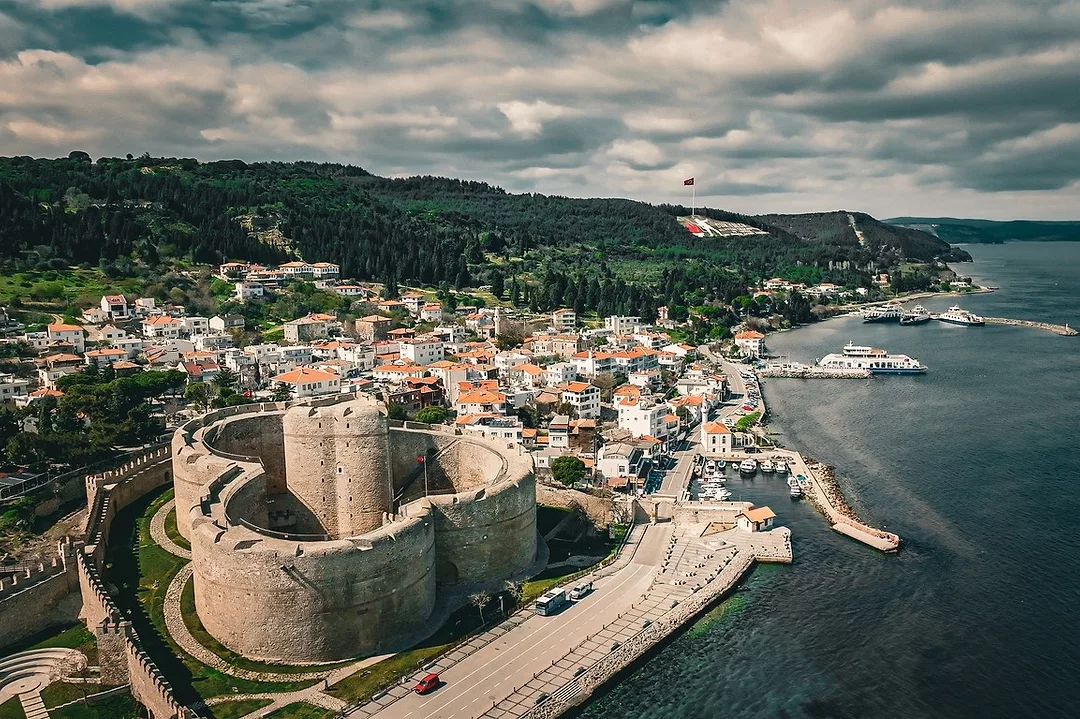
Canakkale City, on the shores of the Dardanelles Strait. Photo: iStock/Guven Ozdemir
Wildfires briefly shut the Dardanelles Strait to shipping on August 11, as extreme heat and strong winds fueled blazes across the Mediterranean.
The Dardanelles — a vital maritime chokepoint for oil and gas from the Black Sea and Central Asia — was reopened in the evening after being closed to allow firefighting aircraft to scoop up water from the sea to tackle nearby blazes.
Turkish firefighters contained wildfires ravaging its north Aegean coast, but towns and pine forests in Canakkale province are still threatened, and almost 2,900 residents have been evacuated, the state-run Anadolu Agency reported.
Large parts of Europe are facing wildfire threats, as scorching weather bakes the region this week. Blazes have ignited across the continent, from the outskirts of Madrid and London to the Greek islands and forests across the Balkans.
The fires are being fed by strong winds and extreme temperatures. Red heat warnings have been issued for Spain, France, Croatia, Serbia and Romania, as a high-pressure system is amplified by wind patterns boosted by the remnants of tropical storm Dexter.
Temperatures are forecast to exceed 44C (111F) in Portugal and Spain on August 12, with southwest France topping 42C, according to government forecasters.
Climate change is increasing the frequency and intensity of heat waves in Europe, triggering more extreme weather events such as the deadly wildfires that ravaged Aude in southwest France last week. In Spain, hundreds of people were evacuated on the evening of August 11, and one person later died as a fire started in Tres Cantos on the outskirts of Madrid.
El #IFTresCantos está perimetrado y ha evolucionado favorablemente durante la noche.
Han estado trabajando en la extinción:
33 dotaciones de #BomberosCM.
11 de @BomberosMad, 9 de la @UMEgob y #AgentesForestalesCM.
No hay ninguna carretera cortada al tráfico. pic.twitter.com/OOpFkQSVHD
— 112 Comunidad de Madrid (@112cmadrid) August 12, 2025
Several forest fires ignited in Greece, triggering evacuation orders on the islands of Zakinthos and Kefallonia, as well as in Peloponnese, Etoloakarnania, Preveza in the northwest and Arta in the center west.
Greek firefighters are currently tackling 106 blazes nationwide and the government has applied to the European Union for aircraft to help.
With strong winds and temperatures as high as 41C, large swaths of Greece are at very high fire risk, including most of Peloponnese, Athens and the second-largest island of Evia. Cyprus was also on the highest red alert for wildfires.
Forest fires are also raging in Albania and Montenegro, the Adriatic state heavily reliant on summer tourism. The worst hit areas are near the capital Podgorica, and on the coast, close to popular resorts where fire from a broken car quickly spread, endangering homes and hotels.
Serbia, Croatia and Italy are dispatching firefighting aircraft to help tackle the blazes. A soldier died in Montenegro after troops were deployed to help contain the fires.
A fatality was also reported in Albania, where 500 tourists were evacuated from a national park and the residents of three villages were ordered to flee.
Wildfires in Italy and Scotland this week also forced authorities to close tourist areas near Vesuvius National Park and Arthur’s Seat, respectively.
Nearly 1,600 wildfires have been recorded across the European Union in 2025, more than twice the long-term average, according to estimates from the Copernicus satellite service.
With temperatures 12C above normal in southwest France, cooling demand is surging, while the heat wave is curbing nuclear power output.
Electricite de France SA was forced to shut four atomic reactors after a swarm of jellyfish — multiplying in the marine heat wave that’s affecting the English Channel — clogged up filter drums at its Gravelines power plant. EDF has also said high temperatures in the Garonne and Rhone rivers are likely to compromise cooling procedures and limit generation at nearby nuclear plants.
Intraday prices for the hour from 8 p.m. in France traded at €161.79 per megawatt hour on August 12, about 55% higher than the same time on August 10, data from Epex Spot SE show.
Popular Stories




SupplyChainBrain 2026 ESG Guide: ESG — The Supply Chain’s Biggest Secret
VIEW THE LATEST ISSUECase Studies


Visit Our Sponsors |
|
|
|
|
|
|
|
|
|
|
|
|
|
|
|
|
|
|
|
|
|
|
| |
|
|
|
|
|
|
|
|
|
|
|
|
|
|
|