
SPECIAL REPORT
Warehouse Labor: A Delicate Balancing Act
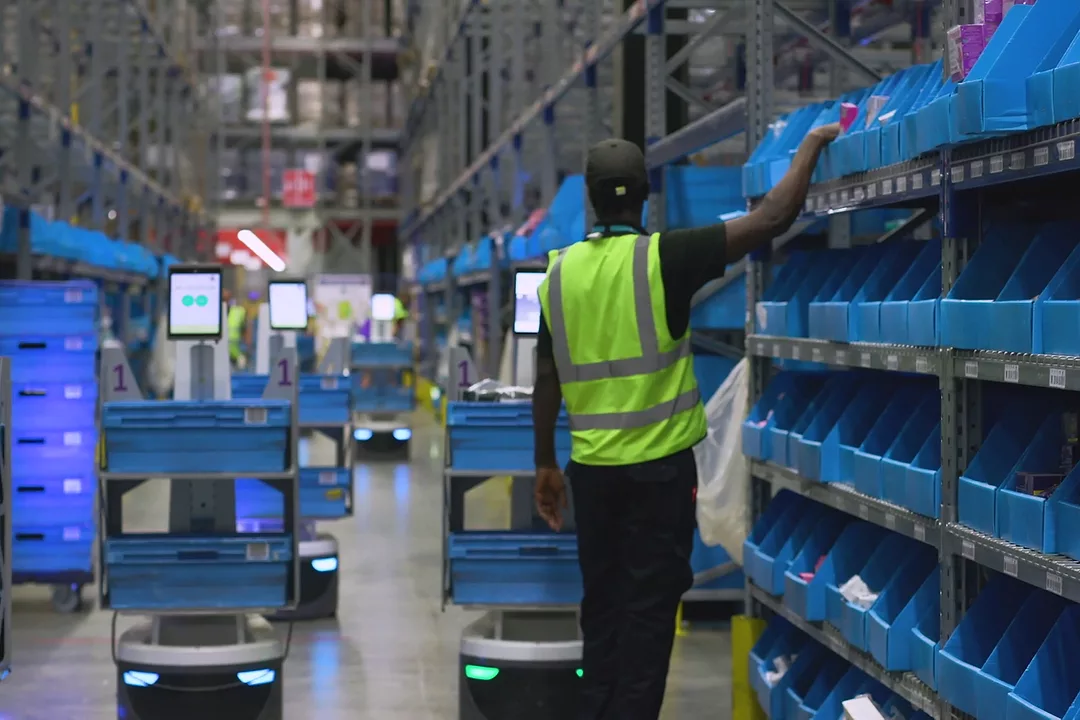
Photo: Locus Robotics
With e-commerce now nearing 20% of total U.S. retail sales, the warehouse has taken on an elevated role in manufacturing and retail supply chains. Even traditional business-to-business (B2B) operations are adopting direct-to-consumer (D2C) processes and key performance indicators to increase visibility, resilience and customer value while lowering costs.
At the same time, more than four years after the labor struggles of COVID-19, getting the workforce right remains a constant challenge.
The shift from longer-term storage and distribution of cases and pallets to the continuous flow of deconsolidated, repacked and cross-docked eaches has significantly impacted both the workplace and workflow. Set shifts with predictable hours are difficult to maintain, and repetitive physical stress impacts the workers from loading heavy cartons onto pallets or walking miles of warehouse aisles per day.
As leaner operations have narrowed career options and data-driven decision-making has displaced “tribal knowledge” from experience, older workers have chosen to retire early. Despite incentive offers, younger workers have opted for office, online or gig work instead of manual labor. Even today, churn rates of 30% or more — rising as high as 80% during peak periods — are common.
When employees are asked via survey what could help them make their jobs less stressful, the results include regular schedules, less physical and mental stress, and more interesting work with advancement opportunities.
Send in the Robots
Resilience strategies put in place during and since COVID increasingly deploy a flexible workforce to combine a core of well-trained and motivated steady workers and temporary workers as needed when demand surges, with automated warehouse systems supporting both.
Warehouse automation can mean anything from software that automates repetitive documentation functions, to fixed conveyors or automated guided vehicles (AGVs) and automated mobile robots (AMRs) that work alongside humans to reduce travel time for pick, putaway and replenishment.
“Every customer is still feeling that labor pinch in finding and retaining warehouse labor today,” says Jared Johnson, senior director for customer success with Wilmington, Massachusetts-based Locus Robotics. “Many have shifted from a ‘wait and see’ to an ‘automate and adapt’ model. They’re not looking to automate to replace people, but to stabilize their operations and make better use of the labor force that they currently have.”
Working with new technology has been a plus for both management and labor. “We're seeing a younger workforce more comfortable with technology,” Johnson adds, “and it’s easier and more intuitive to train with robots. Customers ramp up hires faster, and new workers are more productive from day one.”
Besides helping with labor struggles, AMRs have broadened the options for warehouse operators in calculating how and when to introduce automation. As more freight moves to a D2C model, facility priorities are shifting from storage and distribution capacity to operational throughput and flexibility.
Most D2C orders are time-definite with tiered pricing for same-day, next-day, two-day or standard delivery in five to seven days. Deliveries can be at home at the doorstep or out-of-home (OOH) at a dropship location such as a locker or neighborhood store, often involving different vehicles and partners. Online demand on any given day is far less certain than in the B2B environment.
Relying on fixed systems running on legacy warehouse or inventory management systems assumes predictable, high demand, making them poorly suited to a D2C environment and smaller warehouses. Installation and later customization are also costly, with long lead times.
“Customers need flexibility,” explains Locus director of product management data and solutions Dan Coote. “They might be using more gig workers, for example, that turn up on the day they’re called to pick or put away, and AMRs make that easier. Then, when volumes go back down, everything ramps back down. With fixed automation you build to a design point, and you’ve basically got that cost all year round.”
Robots-as-a-Service
AMRs use remote sensing technology to navigate warehouse aisles, with the ability to see around corners and avoid people and objects. The absence of any installed structure or track on the floor gives them greater versatility working in tandem with human workers.
The robots operate on a software platform integrated with a facility’s warehouse management system (WMS) to map the warehouse, locate inventory and track and execute orders. Analytics optimize travel and pick sequencing according to defined performance metrics and business objectives, including customers’ own service level agreement (SLA) requirements.
The subscription-based “Robots-as-a-Service” (RaaS) model allows customers to size a leased robot fleet more precisely to their needs and add or subtract units as necessary with changing demand. This helps speed return on investment (ROI) and has made robotics practical for fulfilment center operations in sizes both large and small.
The ability to easily scale temp workers and robots up or down helps stabilize a core, permanent workforce, and typically creates new floor- and fleet-management opportunities for skilled talent as productivity improves. System-directed workflow takes guesswork and potential for errors out of pick, putaway and replenishment for temps. Instructions can be purely visual or be translated and made available in a range of languages on the screen for workers with limited English-language skills. Companies report a 2-3x increase in volumes handled in a typical shift.
Related data from this orchestrated movement of people and assets is also captured in the system. “You've got traceability throughout the facility,” Coote explains. “Then, through AI and machine learning, you can take into account variables like priority, type of task, relative demand for that task, and travel distance, to make adjustments.”
We Don’t Sell Sweaters Here
Columbus, OH-based Kimball Midwest, a family-owned and operated nationwide distributor of industrial products used in maintenance, repair and operations (MRO), began considering robotics for its regional distribution centers in 2008, when the global financial crisis hit. By the time the U.S. economy was recovering, its preferred provider, Kiva Systems, had been acquired and taken in-house by Amazon.
Kimball Midwest held out for a provider that could handle both pick and putaway, but labor disruption during COVID was the final straw. “The nationwide shortage woke us up,” recalls director of operations Steve Good. “Our jobs aren’t hybrid jobs; they’re on-site. Turnover was high, retention rates were low, and we were struggling to keep headcount where it needed to be.” All at a time when business was going well, compounding the difficulty.
The company had just integrated a new WMS and was wary of more complexity and delay, but AMRs were up and running smoothly in a few weeks. “The beautiful thing,” Good says, “is that you don't have to move your furniture. You can leave your shelving and your pallet racks where they are. The solution is adapted to your environment.”
Kimball Midwest’s product lines include heavy chemicals, paints, lubricants, tools and automotive parts and supplies, so associates struggled with full carts weighing 600-800 pounds. “We’re not pushing around T-shirts and clothing,” Good adds. “Part of what we communicated to our associates is that this machine is not taking your job; this is your coworker. The purpose of this machine is to make your job easier.”
Retention was up 17% in the first year, and turnover has been cut by 43% since AMR implementation, while return on investment came in less than a year. “Co-bots,” as Good calls them, are now in three of Kimball Midwest’s five DCs — Columbus, Dallas and Reno — with plans to introduce them in the remaining two. With a ratio of three to four AMRs supporting each human floor associate, overall headcount has declined slightly over time — but from regular attrition, without layoffs, thanks to the combination of automation and organic growth.
Training that once required two weeks of shadowing with an experienced worker now takes as little as an hour with the AMR visual displays and system-guided labor and Kimball Midwest has phased out temporary hires altogether.
The AMRs and Kimball Midwest DCs don’t pick by order; they batch like parts collected by associates for multiple prioritized orders at once to maximize the pick per stop. Associates then build orders by locating robots near them with the needed parts. Lighting indicates which bot an associate should be looking for to complete the assigned task, and the same bots also do putaway simultaneously.
Kimball Midwest fills 100% of orders that come in before 4 p.m. each day and relies heavily on zone-skipping and multiple UPS trucks, continuously re-prioritizing the pick. AMRs store task data that provides visibility to track and redirect inventory if, for example, an order is canceled.
Future Use Cases
Next up in warehouse robotics: lights-out 24-hour picking, enabled by AI and vision technology; managing inventory count to track returns; AMRs capable of heavier lifting; and wider use of real-time AMR data to verify regulatory compliance and to track and manage reverse logistics for returns.
“Automation before COVID was nice to have,” Johnston says, “but now it’s essential to deliver throughput, even just in day-to-day performance, to hit SLA targets and get things out the door.” The good news is that it’s affordable and accessible.
Popular Stories





100 Great Supply Chain Partners 2026: The Secret to Supply Chain Success
VIEW THE LATEST ISSUECase Studies


Visit Our Sponsors |
|
|
|
|
|
|
|
|
|
|
|
|
|
|
|
|
|
|
|
|
|
|
|
|
|
|
|
|
|
|
|
|
|
|
|
|
|
|
|
|
|
|
|
|
|
|
|
|
|
|
|