.webp?height=100&t=1784121195&width=150 "018_what's_holding_back_ai_initiatives-_v1-(540p).png")
Record AI Spending Coincides with Deepening U.S. Job Cuts
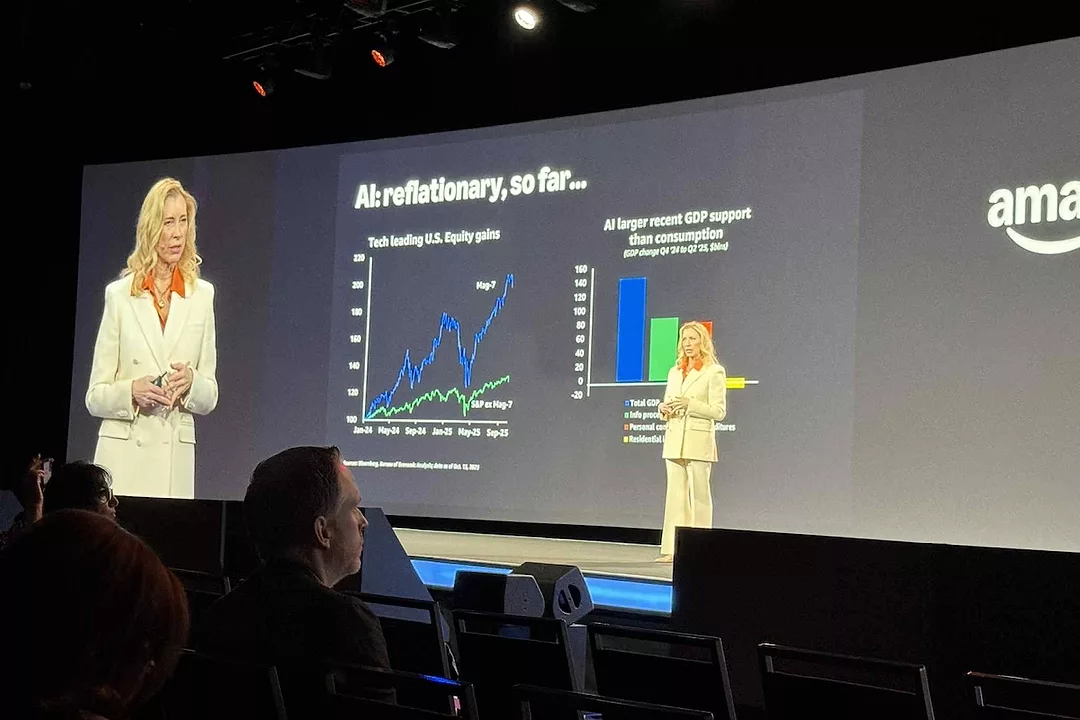
Economist Rebecca Patterson speaking at Amazon Business Reshape in Seattle, Washington. Photo: SCB File Photo
While corporate spending on artificial intelligence is reaching unprecedented levels, signaling healthy economic growth, layoffs in the U.S. are climbing at startling rates. In fact, one is causing the other, according to an economics expert.
Speaking at Amazon Business's Reshape conference in Seattle, Washington on November 13, economist Rebecca Patterson, currently a member of the Council on Foreign Relations, estimated that Microsoft, Meta, Alphabet and Amazon are on track to invest $380 billion in AI infrastructure by the end of 2025. But even with that record spending, executives have pushed to keep budgets flat, in a year where U.S. tariffs have thrown global economies into flux.
"So, how do I invest in AI and keep the budget flat?" she posited. "I have to find offsetting cost cuts, and it's largely coming from personnel."
According to a November 6 report from outplacement firm Challenger, Gray & Christmas, job cuts at U.S. employers rose 175% year-over-year in October, and year-to-date have hit their highest levels since 2003. The tech sector has also seen the most cuts of any industry, driven primarily by AI-related restructuring efforts.
Patterson, formerly chief investment strategist for investment advisory firm Bridgewater Associates, predicts that, if this trend continues into the new year, we might see what's known as "jobless growth," where the GDP of the U.S. remains strong, but job growth either stagnates or contracts. This could then create a scenario where high earners in the tech sector reap the benefits, while unemployment rises and consumer spending dips, eventually leading to a nationwide economic slowdown.
The Federal Reserve could try to help by cutting interest rates to encourage borrowing and hiring, Patterson noted, but that would risk fueling inflation. And if spending and hiring don’t recover, the U.S. could slip from a "jobless expansion" into a modest recession, where persistent social and political strains form between those benefiting from AI investments, and those left behind in the labor market.
Popular Stories

.webp?height=100&t=1784491177&width=150 "030_ai_in_the_warehouse-_real_use_cases_v1-(540p).png")


SupplyChainBrain 2026 ESG Guide: ESG — The Supply Chain’s Biggest Secret
VIEW THE LATEST ISSUECase Studies


Visit Our Sponsors |