
EXECUTIVE OPINION
How Robots-to-Goods (R2G) Will Define the Next Era of Warehouse Automation

Photo: Locus Robotics
Over the last couple of decades, the growth of automation has made warehouse operations denser, faster and more efficient. However, even with many of the most advanced systems in place today, a truly flexible, predictable and resilient warehouse, at any scale, has been elusive.
The reason for that has been simple: Nearly every automation model trades flexibility for density or speed, all while carrying the uncertainty that accompanies human labor. Those are the limitations that the robots-to-goods model seeks to remove.
The Right and Wrong Systems
If you look at your options for automating your warehouse, you can break it down into a handful of metaphors. First is “goods-to-person,” (G2P) where a robot, conveyor or shuttle brings an object directly to an operator. This approach offers a boost in storage density but can also often exist within a sealed black box where it’s difficult to access inventory freely, and even harder to easily scale up throughput without adding stations. Basically, once the system is built, it’s extremely hard to change it afterward.
Second is “person-to-goods” (P2G), where robots go to where goods are; a person meets the robot there, the person picks, and the robot transports it to the next place. This solution is more flexible and can improve productivity, but at the end of the day, humans are still doing the picking themselves, and with that come all the variables inherent in a warehouse labor force.
Third, we have automated storage and retrieval systems (AS/RS), which store inventory in fixed racks or grids and rely on cranes or shuttles to mechanically retrieve items. This is capital-intensive, and much like goods-to-person, it can be very difficult to adapt to changes in peak-season demand.
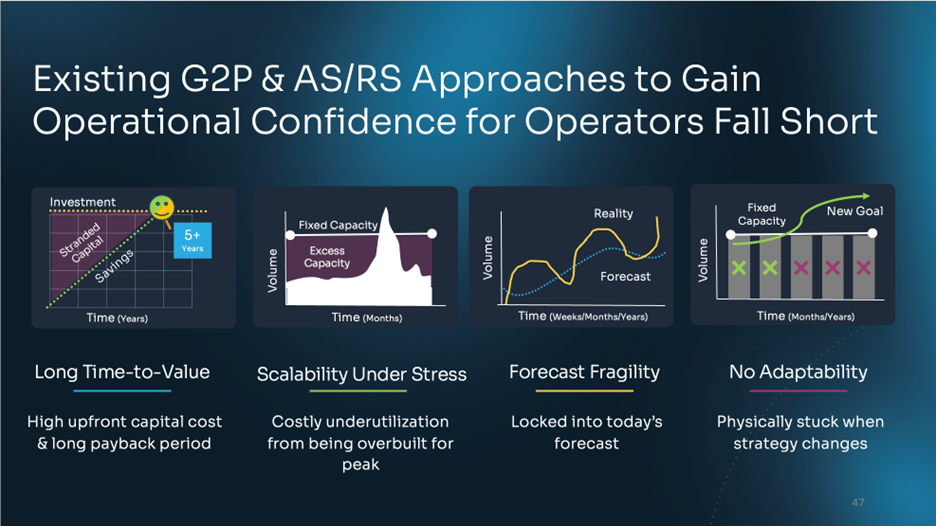
The chart below points to the four major operational challenges of G2P and AS/RS solutions. G2P and AS/RS systems promise efficiency, but many operators discover that the rigidity built into these architectures creates new operational risks. These systems often require large upfront capital investments and long implementation timelines before value is realized. The payback on the capital investment can be five years or more.
Because capacity is fixed once installed, operators frequently overbuild for peak demand, leading to costly underutilization during normal periods.
At the same time, warehouse volumes rarely align with the forecast assumptions used to design the system, leaving operations locked into infrastructure that cannot easily adapt as demand patterns shift.
As fulfillment strategies evolve, operators can find themselves physically constrained by automation that was designed for yesterday’s workflow rather than today’s reality.
A robots-to-goods (R2G) approach, by contrast, is designed to address all of those issues and almost entirely eliminate the need for human labor, at the lowest cost per pick, with more flexible density. Instead of bringing goods to people, or people to goods, robots go directly to warehouse inventory, pick items autonomously, and place them precisely into destination totes, with no human involvement.
When you remove humans from the picking and putaway workflow, the operation becomes machine-like. Throughput is predictable, performance is consistent and reliable, and variability drops out of the equation. You know exactly how many units per hour the system will deliver, and it will do that every hour of every shift. And in the meantime, you no longer have to account for human employees missing workdays, showing up late, or missing crucial benchmarks.
Most importantly, robots-to-goods doesn’t require the same tradeoffs as traditional goods-to-person systems. It doesn’t demand massive construction projects, nor does it force operators into rigid layouts. It can also be deployed in brand new buildings, or integrated into existing systems, and can be adapted over time to account for shifts in capacity and demand.
The Density Trap
One of the biggest traps in warehouse automation is chasing pure storage density as the primary metric for success.
Sure, some systems can store more units per square foot than anything else on the market. But density without flexibility can be a massive liability. These systems lock inventory behind fixed access points, and throughput becomes constrained by station count, while scaling becomes expensive and slow. And if demand forecasts are wrong, the operator pays the price for years.
Robots-to-goods takes a different approach. It doesn’t deliver maximum density, but it gives you enough of it without sacrificing agility and flexibility. Inventory is still accessible, workflows remain adaptable, and the system can evolve as the business evolves. In a market where warehouse demand can turn on a dime, that flexibility is worth its weight in gold.
The Technology that Makes it Possible
Solving the puzzle of autonomous picking has not traditionally been simple. A robot needs to be able to identify the correct SKU, pick up a corresponding item in the correct way, and then safely transport and store that item elsewhere on the warehouse floor. Additionally, picking something as fragile as an egg requires a different type of finesse than a roll of tape or a can of soda, while placement on the other end matters just as much when it comes to avoiding damage or pile-on.
Today, artificial intelligence can be integrated directly into robot-to-goods technology, equipping a robot with the ability to discern the difference between items based on vision, select the appropriate grasp point, and place each item deliberately and intelligently. That’s turned what was once an edge case for automation into a repeatable, reliable workflow that improves with every pick.
The same software stack that allows these robots to navigate complex warehouse layouts can also coordinate how work gets sequenced and routed across the entire floor. Robots are constantly making decisions about where to go next, how to avoid slowdowns, and which task delivers the lowest cost per pick at any given moment.
The Next Era of Automation
Robots-to-goods has the potential to become the future of warehouse automation, as a technology set to define the category. In practice, it addresses virtually all the problems that have plagued automated solutions for the last 20 years by eliminating the variability created by labor, preserving flexibility in how facilities are designed and operated, and delivering a level of predictability that other automation models were simply never built to provide.
Just as vital is the fact that robots-to-goods makes it possible to think about automation as a living system that grows and improves over time, rather than a one-time plug-and-play operation. As technology continues to evolve, the range of SKUs that can be handled autonomously can expand; additional workflows, such as replenishment, returns and re-slotting, can be folded in, and labor requirements will continue to shrink.
Instead of locking operators into rigid assumptions about what their business will look like years from now, robots-to-goods allows automation to evolve alongside a warehouse itself, which is exactly what modern warehouses need to survive and thrive in an environment defined by constant change.
Popular Stories





SupplyChainBrain 2026 ESG Guide: ESG — The Supply Chain’s Biggest Secret
VIEW THE LATEST ISSUECase Studies


Visit Our Sponsors |
|
|
|
|
|
|
|
|
|
|
|
|
|
|
|
|
|
|
|
|
|
|
|
|
|
|
|
|
|
|
|
|
|
|
|
|
|
|