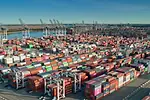
Short Sea Shipping, the Most Efficient Way Between Two Points?
Ports, highways and all arteries in-between are congested, and the forecast calls for more of the same. Much more. Thirty million containers are expected to flow though U.S. ports in 2010, according to some government analyses, with 40 million or more arriving 10 years from then. How can that volume of cargo get to end users in an expeditious, safe and cost-efficient way? Chuck Raymond, president and CEO of Horizon Lines, says the solution lies partly in short sea shipping. Though defined in several different ways, the practice largely refers to moving cargo between a nation's ports by smaller vessels and barges on coastal or inland waterways. Short sea shipping has been a success in much of Europe for years, Raymond says, and he is convinced that shippers and their supply chains in the U.S. will benefit as well.
Q: What do you mean by the term short sea shipping? And is short sea shipping as it's practiced in Europe a model that's applicable to the U.S. and North America?
Raymond: There's been a lot of confusion about it, but there are three types of short sea shipping. Our view is that there is justification for focusing on short sea shipping to remove cargo that's been congesting the interstate highways, particularly along the Atlantic and Gulf Coasts. That's one kind: going after the 53-foot trailer market, and accommodating that on a vessel, that's one market. That will require different kinds of assets than exist today. You're talking about large ferry-type operations that have a low-cost port infrastructure, where you sort of drive up like the old ferry system. That's one segment. Another involves the international containers coming in from overseas, and being discharged in a deep water port like New York or Halifax, Nova Scotia, then being moved to a shallower port at some distance by a smaller vessel. That's the part of the market that we're focusing on right now. That can be done with existing assets. There is no infrastructure required, although that which is out there is going to have to be a little more efficient. And then finally, there's a model that replicates the European ferry successes. That includes passengers, and trucks, and gambling and that sort of stuff. That exists up in the Baltic countries, in Scandinavia, down in the Greek isles, and is very successful. It's the so-called auto trade because they move vehicles and passengers, but there is no such model here in the U.S.
Q: Your definition of short sea shipping includes use of barges as well as vessels?
Raymond: Yes, but for some markets, the use of tugs and barges will be difficult. For example, the international container business. What's going to be very important to the international carriers that use a smaller Jones Act vessel to deliver cargo up and down the coast is the ability to maintain a very high-level integrity in the schedule. And that's been a problem for tugs and barges for a number of reasons.
Q: Outline for us the precise advantages of short sea shipping as you see them.
Raymond: The first is that it's going to remove cargo from the marine facilities quicker than occurs today. That has the collateral benefit of decongesting those facilities and allowing you to have more throughput with a given number of acres. The second benefit is it will remove that cargo from the intermodal system on the land, either from rail or from truck. And the third benefit is ecological. The particulate matter that goes into the atmosphere from fossil fuels to run trains and run trucks is reduced by virtue of going by sea.
Q: You say short sea shipping can be a boon for supply chains, but shouldn't managers concerned about just-in-time delivery opt for another shipment mode?
Raymond: On the contrary, accuracy of schedule keeping and the ability to manage supply chains has proven to be very effective in the European model. Sometimes you have four or five smaller vessels working against a larger ship, and connecting in both directions. The European economy depends on that, and it works well. I don't see any reason why it wouldn't work just as well in the United States.
Q: Aside from time concerns, are there any types of cargo that short sea shipping may be ideal for?
Raymond: Overweight cargo that can't traverse the road system can move by vessel in many cases. Cargo that is oversized, things like large heat exchangers or boilers, or electrical generators and machinery, things of that nature, would not have to go on the highways and be a wide load or deal with the tunnels and bridges. Then there's hazmat. There's much more awareness today about the risks of having hazardous materials on the highways, particularly where you have tremendous congestion.
We had a few examples last year on I-95 [a main corridor spanning much of the U.S. East Coast] where tanker trucks turned over and caught fire and shut down the interstate system for 10 hours or so. It won't be much longer before local politicians start to really recoil against those kinds of things.
Q: European proponents initially had to deal with conflicting national regulations and port inefficiencies. Are these the kinds of hurdles impeding widespread adoption in the United States?
Raymond: With regard to getting it started in Europe, part of that was driven by the whole process of clearing customs and the documentation that had to accompany the shipments in the various countries. As you know Europe has loosened up on that. From the standpoint of port congestion, I would challenge that. A good portion of freight that goes into the base ports in Europe goes right on [short sea] ships to the ultimate port of destination and does so in an efficient way.
I think there are three or four barriers here in the U.S., and they are not the same as we had in Europe. The first one is that are no companies that have really focused in on this, and for a very good reason: the need wasn't there. The East Coast ports typically had not been congested. There had been adequate capacity on the Atlantic Coast. Deep draft vessels, ships drawing 50 to 52 feet, have not been in existence, at least in the liner trades. Those two criteria are changing. The origins of the cargoes that the consumer on the East coast is importing are moving closer and closer to the Atlantic Coast ports via the Suez route as opposed to coming across from the Pacific or going through the Panama Canal. So you will see growth in the Atlantic Coast ports, and with that is going to come deeper vessels. Unfortunately there will only be two or three ports that those ships will call. So there will be a need for short sea shipping because clearly our highways can't handle all that cargo.
The other disadvantage in the U.S. is the Harbor Maintenance Tax, which would be applied twice on an imported shipment if it were moved by water to the ultimate port of entry. I think that's going to be dealt with. Congress understands the issue and is working on getting the HMT repealed. I think that will happen this year.
Q: Elaborate on the double payment, please. Why is the HMT paid twice?
Raymond: It is paid twice, but not by vessel operators. It's paid by the importer of record. So if you're Nike, for example, and you bring cargo in from Korea to New York and then move it by water, by smaller vessel, down to Boston, you will pay your Harbor Maintenance Tax twice, once in New York and once in Boston. So that's clearly a disincentive, but that's going to go away, we believe.
Q: Any other barriers or hurdles?
Raymond: There's the issue of the ability to replace the ships. If you go ahead and say, OK, we want to enter the short sea shipping market, there's no funding in the Title 11 program of the Merchant Marine Act of 1936 that provides government backing to give bankers a degree of confidence that they will continue to be paid if the short sea shipping experiment is in extremis. We're fighting for a revitalization of Title 11, but it's a matter of the appropriators in Congress and the administration supporting there being a provision for Title 11 in the operating budget each year.
Q: The Jones Act requires that vessels operating between U.S. ports must be built in the U.S., and staffed and operated by American firms. Is this in any way an impediment to encouraging short sea shipping here?
Raymond: It's true about the Act, and some might think it's a deterrent, but I frankly do not think it is. We build barges that operate very effectively here. When you think about the cost of running cargo by vessel between two U.S. ports, a very small part of that cost is the ship. A big part of it is the fact that longshore labor is on both ends. You've got capital investment for your container and your chassis, marketing costs, you've got fuel costs for the trucking portion of the inland conveyance-those are all the same whether the ship is built in China or the United States.
Q: If projected cargo volume increases are at all realistic, will there be any choice other than to promote short sea shipping?
Raymond: I do believe it's going to be necessary. Number one, American citizens are going to continue to consume, and the products are generally going to come from countries with a lower cost base than we have, so the imports will continue to grow.
Then, aside from the impact on the highway system, there's the environmental concerns, particularly on the West Coast of the U.S. The local people there don't want more of these container ships and acreage being converted to marine facilities. They want the wetlands and they want to preserve them.
Frankly if we got the right kind of throughput in these facilities, we could go a long way toward accommodating this kind of growth with existing assets.
Q: Is the U.S. government fully behind the short sea shipping concept?
Raymond: I think they understand the need, but I'm not sure they have well-defined processes for dealing with it. Everyone in government talks very eloquently for the need for short sea shipping and the need to get cargo off the highways, etc., but the barriers, particularly the barrier of having a program where the U.S. government would put its good faith and strength behind loans necessary to build the assets-that's going to make it very difficult for venture capitalists to jump off and address the issue.
The Title 11 fund should be provided with dollars so venture capitalists can go forward knowing that the risks are vacated in this area where some pioneering is going to be required.
RELATED CONTENT
RELATED VIDEOS
Related Articles
Related Directories
Subscribe to our Daily Newsletter!
Timely, incisive articles delivered directly to your inbox.
Popular Stories



100 Great Supply Chain Partners 2026: The Secret to Supply Chain Success
VIEW THE LATEST ISSUECase Studies
-
Recycled Tagging Fasteners: Small Changes Make a Big Impact
-

Enhancing High-Value Electronics Shipment Security with Tive's Real-Time Tracking
-

Moving Robots Site-to-Site
-
JLL Finds Perfect Warehouse Location, Leading to $15M Grant for Startup
-
Robots Speed Fulfillment to Help Apparel Company Scale for Growth
Visit Our Sponsors |
|
|
|
|
|
|
|
|
|
|
|
|
|
|
|
|
|
|
|
|
|
|
|
|
|
|
|
|
|
|
|
|
|
|
|
|
|
|
|
|
|
|
|
|
|
|
|
|
|
|
|