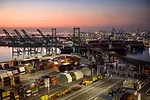
The year 2014 will see the debut of the Triple E, first of a series of at least 20 containerships to be operated by Denmark's Maersk Line, each with a capacity of 18,000 twenty-foot equivalent units (TEUs). Few could have imagined this behemoth at the dawn of containerization in the mid-1950s. (Malcom McLean's Ideal X carried only 58 boxes.) In the ensuing decades, containerships grew steadily in size, as operators sought to squeeze the most out of their investments. When ships became too wide to fit through the Panama Canal, builders doubled down. Between 2008 and 2015, average ship size will have risen from 6,000 TEUs to more than 11,000 TEUs, according to Lars Jensen, chief executive officer and partner with SeaIntel Maritime Analysis. Maersk's Triple Es will dwarf them all.
Fifty companies, the Southeast Asia challengers, have been rapidly expanding, competing in the Asian and global economy, and throwing a spotlight on a region that has experienced an economic renaissance that has largely escaped
attention, according to a report published by The Boston
Consulting Group (BCG).
Analysts' Insights: As companies plan and strategize for long-term effectiveness in supply management, they must focus on one aspect to truly derive value out of their procurement and sourcing efforts: evolution. Organizations globally must look to the future and adapt their reliance on technology as solutions evolve for the better. Christopher J. Dwyer, senior research analyst, Aberdeen
As organizations continue to adjust their technology footprint into the next decade, the question around SaaS is not if but how SaaS will be leveraged within the procurement enterprise. Constantine G. Limberakis, senior research analyst, Aberdeen
Warehouse-management system (WMS) software is hardly new, but users are increasingly on the lookout for new applications that can be implemented more quickly and less painfully, says Diego Pantoja-Navajas, president and chief executive officer of Logfire. Among the new features they are exploring is the software-as-a-service (SaaS) model, dubbed more recently cloud-based technology.
Although the Food Safety and Modernization Act of 2010 was passed nearly a year ago, and food and beverage companies have had a significant period of time to calculate and understand its impact, and implement traceability solutions, there are still many issues and processes to be resolved or implemented before food and beverage enterprises can be considered 100-percent compliant.
Hubspan Inc., a vendor of business-integration software based in the cloud, has released six new business-to-business applications, built using the NetSuite SuiteCloud Computing Platform.
Analyst Insight: The Congressional bills to implement the U.S. free-trade agreements with South Korea, Colombia and Panama and to renew the Generalized System of Preferences and Andean Trade Preferences Act have gained congressional approval and President Obama's signature, thus paving the way for the long awaited realization of the agreements and their inherent trade benefits and opportunities. Simultaneous approval highlights the challenges of managing global supply chains to take advantage of the benefits provided. - William M. Methenitis, partner, global director, and Kristine L. Price, partner, both of Ernst & Young LLP, Customs and International Trade
Analyst Insight: While on one hand the container shipping industry has become ever more commoditized, a new range of service measurements could increase the potential for market differentiation. The key to any differentiation is the ability to make it clear to the customer what the difference is. Such transparency would certainly be a novelty in the industry. - Lars Jensen, CEO, SeaIntel Maritime Analysis
With ever-changing business challenges such as transportation costs, volatile demand and an evolving customer base, supply management organizations are exploring new and unique ways to use collaboration in their supply chains. One such effort is turning traditional vertical collaboration strategies on their side and may change the way organizations view their supply chain - and their competitors.
The game of musical chairs in the Pacific Northwest will continue this summer when Grand Alliance carriers NYK Line, Hapag-Lloyd and Orient Overseas Container Line leave the Port of Seattle and move to Tacoma.