 RSS
RSS
.webp?height=100&t=1783959879&width=150 "014_how_ai_is_transforming_the_transportation_back_office_v1-(540p).jpg")
Upon opening my email this morning, I was presented with an alert on an old message I had sent. The alert said, “Sent 10 days ago; would you like to follow up?” Indeed, I did need to remind my colleague to respond. The experience left me reflecting on how far we have come and what lies ahead with artificial intelligence (AI) in business.
I became fascinated with this field almost 40 years ago, when I was an undergraduate student at Berkeley under Professor Alice Agogino. Professor Agogino drew this simple diagram on the board.
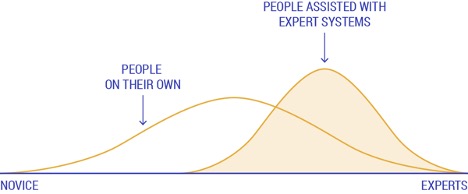
Back then, AI systems were called expert systems. They enabled more people to complete most tasks at an expert level. They improved users’ potential and shifted the performance curve for the entire business. With these systems, experts could focus on the most challenging tasks that only they could tackle.
Over the years, this compelling idea — that technology can extend our performance at scale — stayed with me. It has shaped my passions, and my own professional journey has followed the trajectory of AI itself.
But along the way, there were several challenges. Models in our systems tended to lag changes in the business; although they would solve yesterday’s problem optimally, gradually they would become stale. They needed dedicated teams for use as well as for maintenance.
Where We Are Today
Today’s AI systems are fundamentally different from early expert systems and traditional business solutions in three ways:
-
We use them differently;
-
The emphasis on intelligence has shifted from automation to augmentation, and
-
AI systems learn from usage and adapt to changes in the business.
How we use them: Traditional business solutions are often fragmented. One set of systems tells you how your business is currently running (traditional business intelligence), another helps you decide how to run your business, and yet another allows you to record what you did to run your business (enterprise resource planning).
Users must follow tedious and disconnected paths, from descriptive and diagnostic analytics to predictive analysis and optimization using digital twin models. Then, once a decision is made, they must turn around and record that decision in their ERP.
In contrast, when we use AI, we start directly with recommendations and can explore predictive, diagnostic and descriptive insights as explanations. AI offers step-by-step guidelines to take actions, even when we may make decisions that are different from the recommendations.
A shift in emphasis: Traditional expert systems were overly focused on automation. Today’s AI systems can help us navigate and orchestrate business processes. In my opinion, it’s better to think of AI as augmented intelligence rather than artificial intelligence. Today, we see AI as something we can train and adapt to our needs.
Learning and adaptation: Traditional business systems are static and tend to go stale over time. They need enhancements and revisions to incorporate feedback or changes in the business. AI systems, by contrast, are dynamic. They learn and adapt to changing business needs. The more you use them, the smarter and more effective they become over time.
|
Traditional BI |
AI |
|
Requires users to follow tedious and often disconnected paths, starting from descriptive and diagnostic analytics to explore alternatives, predict outcomes, make choices ,and eventually take actions to run the business. |
Offers users recommended actions and the ability to explore predictive, diagnostic, and descriptive insights as explanations. The AI has already done all the heavy lifting across the usual analysis steps. |
|
Is limited to descriptive dashboards, reports, and alerts. |
Blends into how users perform day-to-day tasks; you may not even realize it’s there. |
|
Tends to become increasingly general to target broader audiences as they evolve. |
Learns to become personal and increasingly specific to individual users’ behavior and preferences, even as the span of users grow over time. |
|
Focuses on analyzing data. |
Focuses on making decisions. |
|
Is static and can go stale over time. They need enhancements and revisions to keep up with changing business needs and preferences. |
Is dynamic and designed to learn and adapt to change. The more you use it, the smarter and more effective it becomes over time. |
What Lies Ahead
Although powerful, AI capabilities do pose some challenges.
First, getting the most value from AI requires diligent change management, in both behavior and attitude toward technology. If people see technology as a threat or a means to stretch their performance targets, they’ll work to sabotage its success. Also, if AI adoption means a loss of control or personal touch with customers and suppliers, or obstructs cross-functional thinking, it will fail.
On the other hand, if people see the AI as a new set of tools that makes their lives easier, makes them smarter, collaborates across organizations, and achieves more, they’ll work to make it successful.
The second issue is about ethics in AI. We need to make AI more transparent and ethical. Machine-learning models learn what they’ve been taught and exposed to. If the data is biased, the AI will be, too. Also, no one likes to follow recommendations from a black box. AI models must explain their recommendations, what assumptions were made, what patterns were sensed, and which options were explored transparently.
Finally, we must ask ourselves if the problems we're working to solve with AI are the right ones to solve in the first place. We should be working to leverage AI to extend human reach and improve lives, rather than controlling them.
The transformation of AI to date has been, in a word, revolutionary. The more we embrace, capitalize on and improve this technology, the more our businesses will improve.
Adeel Najmi is chief product officer at LevaData.



.webp?height=100&t=1784001702&width=150 "013_what's_really_needed_for_'lights-out'_capability_v1-(540p).png")


