Who's Paying for Added Airport, Seaport Security?
Following the bottling up of a score of would-be "liquid bombers" in the UK last month, emotions ranged from anger to resignation to risque humor as new security procedures went into effect for airports and airlines. Initially, some passengers, particularly those whose work has them in the air quite a lot, said they might forego scheduled airlines in favor of chartered flights. Later, many travelers seemed to shrug off the hassles created by the new security regime. Perhaps the whattaya-gonna-do attitude was summed up best by the traveler who said he'd prefer to have six people screen him than six bearing him to the cemetery. Then there was RyanAir, the discount airline that got a little cheeky with British security authorities. First it threatened a lawsuit over the new screening procedures, then a photo of naked people running away from their clothing went up on its company web site. The caption: "New Airport Security Procedures Put the Fun Back Into Flying."
If anything is running people away from flying, it seems to be the high cost of fuel, not the new security rules. The same is true on the cargo side. As the cost of airfreight continues to rise, shippers increasingly are looking at ground delivery options.
That's not to say there are no ramifications from tightened security procedures. In the short term, cargo-in the form of laptops and carry-ons of every description-pour into cargo holds like water on a bad roof. On combination aircraft, that's diminished space for "real" cargo, at least temporarily.
Is there a cost to that, and if so, who pays in the end for these new security mandates? And while the emphasis has been on the safety of passengers, isn't there a corresponding need to heighten screening of air cargo loaded into freighters? Finally, is there an analog with the ocean transportation business, whose concerns with container and port security, have been well documented for years?
Clearly, the air industry and its regulators must be careful about this, in the view of Oliver Evans, head of cargo operations for Swiss WorldCargo. He feels existing security procedures are appropriate given the balance that's necessary between security--which is "a matter on which nobody can compromise"--and the cost of such protection. He says he's very much aware that criminal elements are constantly looking to take advantage of loopholes, and airlines and handling companies are obligated to identify such gaps where they can. But imposing additional security barriers carries a serious downside for business.
"Cargo processes have costs associated with them and the more complex these processes, the more expensive the equipment that's required to execute those processes, the more pressure there is on the air industry," Evans says. "While the industry strives to remain competitive, it also needs to be viable. If there are increased costs, they are applicable throughout the supply chain. That's a sad reality."
Evans says security rules can't be applied to just one part of the industry, such as passenger flights, but not to cargo freighters. "We strongly advocate that security processes apply no matter what kind of aircraft is used, but it's incumbent upon any player in the industry, including the airlines, to try to improve their efficiency in order to minimize the impact of these costs."
While the need for increased security is a fact of life for the industry, the precautions taken after the arrests in the United Kingdom are "not a major cargo event, despite the sudden deluge of baggage that would normally go topside," says Ted Scherck, president and CEO of the Colography Group, Atlanta.
 | |
| "If there are increased costs, they are applicable throughout the supply chain. That's a sad reality." - Oliver Evans of Swiss WorldCargo | |
The domestic picture, at least in the U.S., is more problematic, he says. There the trend is toward smaller craft and more frequent trips. But capacity is not the sole factor there, according to Scherck. Other things have been impacting the domestic market for a decade now. For instance, the surface distribution networks of the LTL, truckload and parcel carries have become more attractive to shippers recently. More and more cargo is moving to the ground, particularly regional ground.
"That trend has been negative toward air cargo in the United States and in Europe for quite some time, and recent events aren't going to drive some of that stuff that's moved to the ground back to the planes."
The pressure on the airlines and others mounts every time an event like the arrests in Britain takes place. Scherck, like Evans, says the air cargo industry has not been standing still, especially on investigating security technology. But it's one thing to say something is needed, it's quite another to invent it, he says.
"Some people think that all of a sudden on Sept. 12 [2001], we should have had a machine to do all this security stuff," says Scherck. The reality is that performance in some technology investment has been lacking up until now. "If you get a lot of false positives and opening up of a lot of bags and cargo, you've defeated your purpose, and that's one of the problems with some of the machinery out there."
The fact is, he says, the air industry has been aggressively moving on security issues for some time. In terms of cargo screening, "Everything that they are currently doing, they were doing anyhow."
He believes security risks continue to be greater on the passenger side than in cargo. A so-called "dirty bomb" has been one of the nightmares of the ocean transportation business. While theoretically possible, Scherck says, it would be "exponentially more difficult" to realize such a scenario in an airfreight context. First of all, while air cargo is up in volume, less than half of one percent of pounds shipped globally moves by air, he says. The opportunity is simply not as great with airfreight. Second, he feels the security is much greater on air facilities, carriers and certificated forwarders with air. "Also, air containers are usually loaded by the airline itself or a licensed intermediary. It's not loaded by the shipper. Many, many vessel containers are loaded inland. They may pass through two or three truckers' hands, go through a couple of drayage yards, sit in a port facility for two weeks and then got loaded on a vessel. There are all kinds of opportunities for someone to mess with those containers."
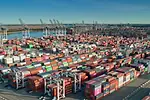
Guarding against that very kind of event-and paying for that protection-has become a major concern for port authorities worldwide, according to Paul Zimmermann, director of operations for the Port of New Orleans.
"You want to put your money into facilities and encouraging cargo to move through your port," he says. "Now, because of security requirements, however, we're putting more and more money in security initiatives and there's no return on that.
"We pass the expense on to the importers and exporters and also the shipowners in the form of a security fee--so much per ton or per container--and that helps to offset our internal costs, meaning for fences, and lighting, and cameras. But it offsets it only to a degree, and then it becomes a competitive issue.
"If cargo had to choose between the Port of New Orleans and the Port of Houston, it's conceivable that if it costs more to move through New Orleans because of larger security fees, then it enters into a competitive issue."
The American Association of Ports Authorities says that a minimum of $400m a year is needed for various security initiatives at all ports. Zimmermann notes, however, that for fiscal year 2006, the Department of Homeland Security has authorized only $169m for such projects.
The GreenLane Maritime Cargo Security Act, introduced last November by Sens. Patty Murray, D-Wash., and Susan Collins, R-Maine, probably would augment that amount. The AAPA has endorsed it, but some in Congress have attacked it as wasteful. GreenLane, held up for almost a year now, would supplement existing DHS grants, but it's the act's proposal to establish an Office of Cargo Security Policy that troubles some politicians. They say it's unnecessary pork to have an office charged with coordinating security policies at DHS and with other agencies.
Inadequate funding has led to some unintentionally funny situations, according to Zimmermann. For example, the Port of New Orleans received funding last year for two boats to patrol the Mississippi River. "Well, that's great, it's a good asset to have," he says. "But you need to find people to put in those boats, you need to have fuel. So it's kind of like good news-bad news; the good news is you have new patrol boats; the bad news is we need to find money now to operate the boats. So funding is just not being provided at the level that's necessary."
The balancing act that Evans of Swiss WorldCargo talks about plays into seaport security as well. The proposed Transportation Worker Identification Credential is an example. Designed to identify-and clearly label-persons authorized to be in sensitive areas of port properties, TWIC has yet to be implemented because of "pushback" from much of the ocean shipping industry, Zimmermann says. The AAPA supports it, however.
But Zimmermann says that anything that would delay moving cargo or people from to and from terminals is gong to meet resistance from the industry because of the commercial implications. "No. 1, it's been said to port authorities, 'you will implement this,' although it's a federal project, and there are certainly costs associated with that. No. 2, there are just so many people and so many trucks. So the chance of there being problems or delays is very great, and when you're handling 200 truck moves a day, you can't afford for even 10 percent of them to be delayed or pushed to the side because that translates into inefficiency.
"To roll out a program such as TWIC that is not quite ready to be handled by the maritime community is gong to be counterproductive. We are not opposed to it, but it needs to implemented properly and funded accordingly, and we're missing the mark on both of those."
Nevertheless, most mandated security initiatives go forward, however underfunded. And the costs for them, like containers on vessels, move from one party to another until they reach final destination, the consumer.
"The customer ends up paying for security fees," Zimmermann says. "It's now a necessary part of transportation, whether it's at a port, airport, train terminal or what have you. It's the world we live in nowadays."
Popular Stories


100 Great Supply Chain Partners 2026: The Secret to Supply Chain Success
VIEW THE LATEST ISSUECase Studies


Visit Our Sponsors |
|
|
|
|
|
|
|
|
|
|
|
|
|
|
|
|
|
|
|
|
|
|
|
|
|
|
|
|
|
|
|
|
|
|
|
|
|
|
|
|
|
|
|
|
|
|
|
|
|
|
|