
Biden’s Hydrogen Hub Plan Sparks $8 Billion Race Among U.S. States
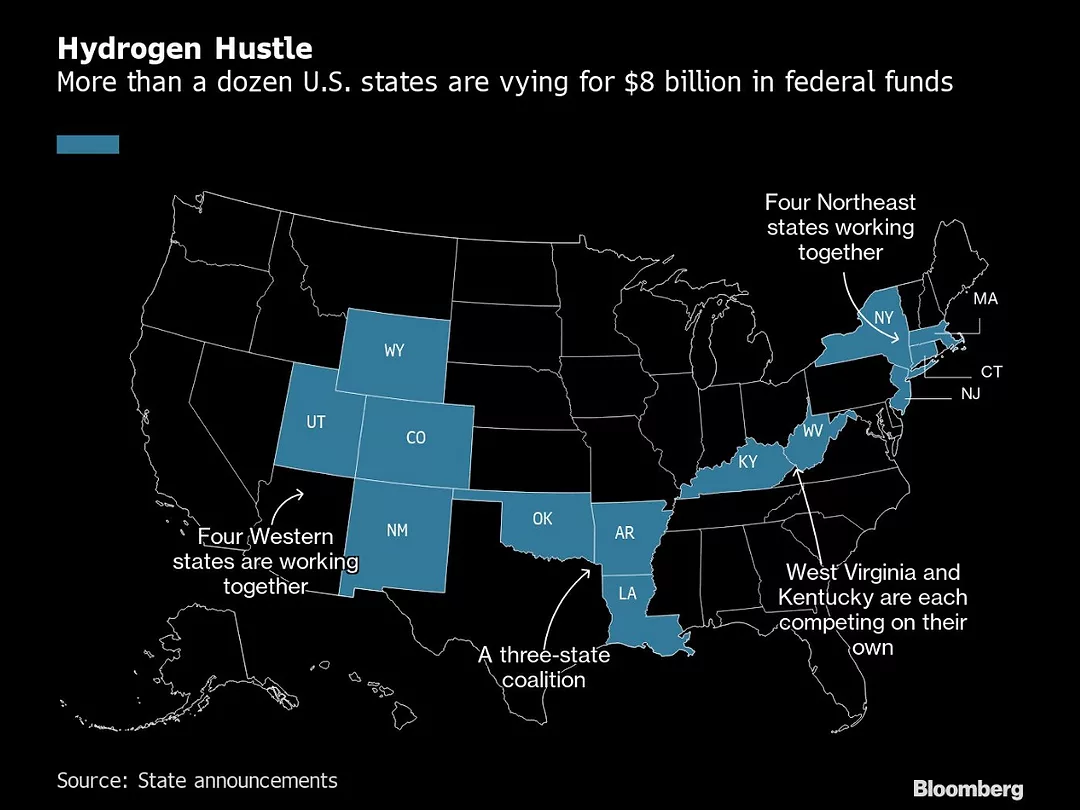
A hydrogen economy that runs factories and power plants on the clean-burning fuel may be years down the road, but that hasn’t stopped U.S. states from jockeying for a share of the $8 billion in federal funds earmarked for so-called hydrogen hubs.
President Joe Biden’s bipartisan infrastructure plan, which became law in November, includes funding to build at least four hydrogen hubs — places where the gas can be produced and used in a self-reinforcing cycle. Two must be in regions with abundant natural gas reserves, a provision that helped secure backing from U.S. Senator Joe Manchin of West Virginia. The hubs, intended to test different ways to produce and use the gas, are a key piece of Biden’s efforts to wean industry off fossil fuels and fight climate change.
Hydrogen is emerging as one of the cleanest options to power industries that typically rely on fossil fuels, since burning the gas can generate electricity without spewing climate-warming carbon dioxide into the atmosphere. Companies worldwide are exploring hydrogen as a fuel for long-haul trucks, factories, trains, ships and even airplanes, though many efforts are in their early stages. Establishing hydrogen hubs could provide the jolt needed for the gas to gain ground in the country.
“We’re pretty excited about the potential of a lot of industries to switch over to hydrogen: steel, trucking, shipping,” said Bryan Fisher, a managing director at RMI, a nonprofit research group focused on the clean energy transition. “It makes all the sense in the world, if we’re trying to start a hydrogen economy, to be able to match production and demand in a specific region.”
States are announcing their interest in the money — sometimes working together, sometimes on their own. They haven’t filed formal applications yet, much less worked out the details of what they’d do with the money, and the pool of contenders is likely to grow. There are already some potential heavy hitters in what could become a crowded field. And the carve-out for natural gas could pit fossil-fuel states — usually allies on federal energy issues — against one another as they vie for funding.
All Together Now
Many of the states in the race have decided to join efforts in regional partnerships rather than go it alone. Their approaches tend to be based on available resources.
New York, for example, formed an alliance with Massachusetts, New Jersey and Connecticut last month. Their announcement focused squarely on “green” hydrogen — hydrogen stripped from water using renewable energy. The process emits no greenhouse gasses, either when the fuel is produced or used. Hydrogen can also be stripped from natural gas, but since none of the four states is a big gas producer their plan to use solar power and offshore wind to supply energy for a hub makes sense. New York is also home to one of the main companies specializing in green hydrogen — Plug Power Inc., based near Albany — which is already building a hydrogen production plant between Rochester and Buffalo.
More on the hydrogen economy:
Russia’s War Supercharges Push to Make New Green Fuel
Watch: When Will Electric Trucks Fulfill Their Promise?
'Lots of Money' to Be Made in Shipping’s Future Fuels
Watch: Decarbonizing Freight Movement in North America
Another partnership that includes Arkansas, Louisiana and Oklahoma would use existing infrastructure to form the basis of its hub. Hydrogen is already produced in the region using natural gas. The hydrogen output is used there in some manufacturing processes, such as lowering sulfur content of fuels from refineries. To qualify for the federal money, the carbon dioxide released by stripping hydrogen from gas will need to be captured and stored, most likely underground. The three states want to use hydrogen to decarbonize heavy industry and transportation.
A third alliance involving Colorado, New Mexico, Utah and Wyoming also seems to be taking an “all-of-the-above” approach. The sprawling combination of states includes plenty of natural gas and renewables, particularly wind power, and their agreement to seek funding highlights both.
Going It Alone, For Now
Some states are gearing up to compete on their own, at least for the moment. One example is West Virginia, whose Democratic Senator Joe Manchin was a driving force behind the idea of having some of the hubs based in gas-producing regions. Manchin and his Republican counterpart, Senator Shelley Moore Capito, helped establish a working group for the state to pursue the funding. Kentucky set up a working group, too.
There’s always the chance they’ll join a partnership. In February, a coalition of businesses that includes Equinor ASA, Mitsubishi Power, Marathon Petroleum Corp. and United States Steel Corp. said they would help work on a hub that would knit together Ohio, Pennsylvania and West Virginia. Here, too, the focus would be on hydrogen produced from the region’s ample supply of natural gas, with the fuel used in heavy industry.
Wild Cards
Oil and gas powerhouse Texas seems to have all the key ingredients needed for a hydrogen hub. Its petrochemical industry along the Gulf coast already produces and uses hydrogen, and the state’s natural gas fields contain the raw material for more. A consortium of oil companies led by Exxon Mobil Corp. is already exploring the potential for a system to capture and store carbon dioxide in the region. Other businesses have reported plans for a major green hydrogen project at Corpus Christi. And the non-profit civic group Center for Houston’s Future has proposed a hub around that city. So far, however, Texas hasn’t declared its intention to compete for the federal money.
Neither has California. The utility Southern California Gas Co. in February proposed building a green hydrogen system called the Angeles Link that could serve as the basis of a hub in the Los Angeles area, with the fuel taking the place of natural gas in up to four power plants. SoCalGas is also part of HyDeal LA, an effort to drive down the cost of green hydrogen that also includes the city’s municipal utility. Two Los Angeles city council members proposed applying for the federal money. But so far, the state hasn’t.
Popular Stories





SupplyChainBrain 2026 ESG Guide: ESG — The Supply Chain’s Biggest Secret
VIEW THE LATEST ISSUECase Studies


Visit Our Sponsors |
|
|
| |
|
|
|
|
|
|
|
|
|
|
|
|
|
|
|
|
|
|
|
|
|
|
|
|
|
|
|
|