
Trump Announces Vietnam Trade Deal with 20% Import Tariff
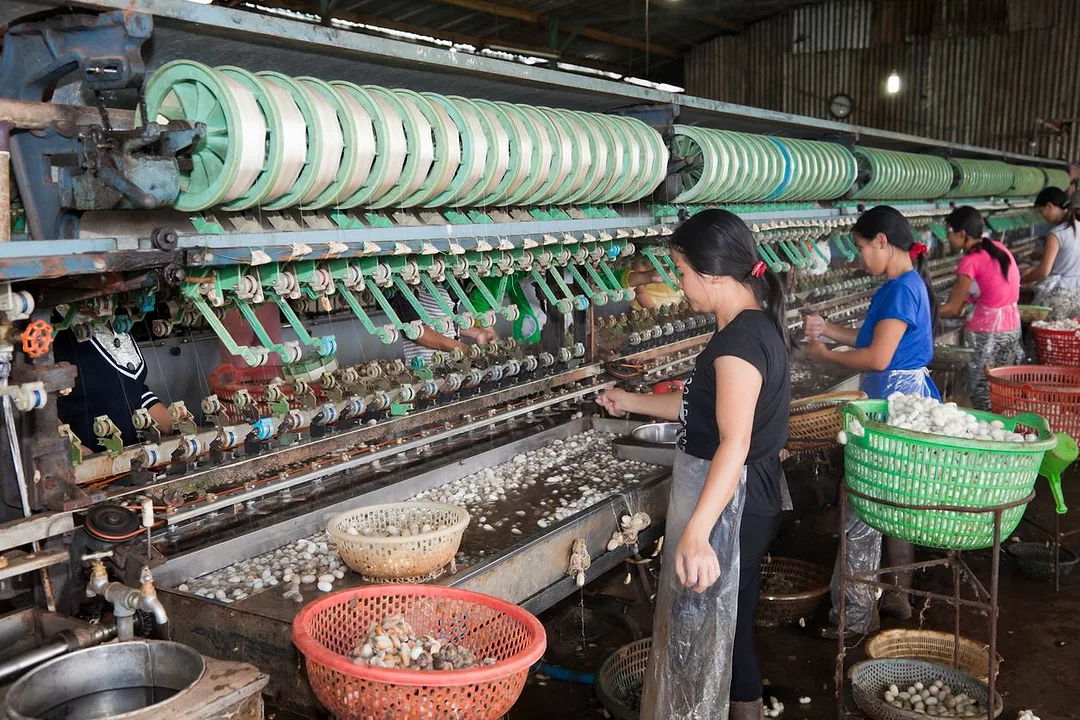
Vietnamese women working in silk factory, Dalat, Vietnam. Photo: iStock/fototrav
President Donald Trump said he had reached a trade deal with Vietnam following weeks of intense diplomacy between the nations and ahead of a deadline next week that would have seen higher tariffs imposed on the country’s imports.
A 20% tariff will be placed on Vietnamese exports to the U.S., with a 40% levy on any goods deemed to be transshipped through the country, Trump said in a social-media post on July 2. Trump said that Vietnam had agreed to drop all levies on U.S. imports.
“In other words, they will “OPEN THEIR MARKET TO THE UNITED STATES,” meaning that, we will be able to sell our product into Vietnam at ZERO Tariff,” Trump wrote. The president said he had secured the deal after discussions with Communist Party chief To Lam.
Vietnam’s Ministry of Foreign Affairs said in a statement that Trump pledged to continue cooperating “in resolving issues affecting bilateral trade relations” during the leaders’ call July 2, and that To Lam proposed that the U.S. recognize Vietnam as a “market economy and remove export restrictions on certain high-tech products.”
The deal with Vietnam would be just the third announced following agreements with the U.K. and China, as trading partners race to cut deals with the U.S. ahead of a July 9 deadline. Trump had imposed a 46% duty on Vietnam as part of his initial rollout of so-called reciprocal tariffs in early April that were levied on dozens of countries, but were then pared back to 10% to allow time for negotiations.
Vietnam posed a particular challenge for the Trump administration, as some of the president’s top advisers view the nation as a strategic partner in efforts to counter China in Asia. At the same time, its exports have become staples for American consumers.
Read More: How Tariffs Are Reshaping Global Supply Chains in 2025
The Southeast Asian nation has seen its sales to U.S. markets surge in recent years, partly because manufacturers shifted production there from China. It’s a major supplier of textiles and sportswear, hosting factories for companies such as Nike Inc., Gap Inc. and Lululemon Athletica Inc.
Vietnam was the sixth-biggest supplier of U.S. imports last year, sending goods worth almost $137 billion, according to Census Bureau data. Its trade surplus with the U.S. was the third-largest globally on a country basis, behind only China and Mexico. Shipments in May jumped 35% as firms sought to get goods onto vessels as quickly as possible ahead of the deadline.
The S&P 500 rose after Trump’s post, with shares in furniture stocks and apparel makers recording gains. ON Holding, Nike and Lululemon all jumped to hit session highs.
Vietnam’s stock benchmark gained as much as 0.5% on July 2, to the highest level since April 2022. The Vietnamese dong slid as much as 0.3% to 26,234 per dollar in early trading, a fresh record low, after the central bank set its daily reference rate at the weakest since at least 2005.
Some U.S. officials wanted to calibrate tariffs for Vietnam and others in Southeast Asia to ensure they’re sufficiently lower than what’s imposed on China, to encourage production to leave that country.
The higher 40% rate announced July 2 would be imposed on goods deemed to be “transshipping” — where components from China and possibly other nations are routed through Vietnam or subject to only minimal final assembly before being exported to the U.S.
That’s been a major concern for Trump’s top trade advisers, including Peter Navarro, who described Vietnam as “essentially a colony of communist China” during an April interview with Fox News.
Full details of what goods would be subject to that higher rate were not immediately available.
U.S. exports to Vietnam were worth just $15 billion last year. Trump touted the prospect of a boost in auto sales as a result of the deal.
“It is my opinion that the SUV or, as it is sometimes referred to, Large Engine Vehicle, which does so well in the United States, will be a wonderful addition to the various product lines within Vietnam,” he wrote on Truth Social.
Boosting U.S. auto exports to Vietnam will be an ambitious goal, since even the cheaper and more compact American-made SUVs may prove expensive by comparison with competitors from other countries. Also, Vietnam is a relatively poor country — with per-capita incomes of around $4,500, roughly one-twentieth of the U.S., according to the International Monetary Fund. That limits the size of the auto market in a region where motorcycles remain far more widespread.
Although Trump shared the broad contours of the agreement, the White House has not yet released a term sheet or published any kind of proclamation codifying the arrangement. And some of the details could still be in development. The U.S. and U.K. first announced their own trade deal in early May, but it wasn’t until mid-June that Trump signed an executive order implementing the accord. And even then, key details have been set aside to be addressed later.
While Trump and his team initially envisioned holding concurrent negotiations with dozens of trading partners, the president and his advisers have suggested in recent weeks that they will just focus talks with major economies and unilaterally issue levies on smaller countries or those that don’t reach agreements.
The deal with Vietnam was struck after weeks of discussions during which the U.S. pressured the country to get tougher on trade fraud, ensure stricter enforcement against the transshipment of Chinese products, and also pushed for the removal of non-tariff barriers.
Vietnam offered to remove all tariffs and repeatedly promised to purchase more American goods. Senior Vietnamese officials flew to the U.S. to rally support and sign deals, including for $3 billion of agricultural goods. The trade minister also wooed executives from Nike, Gap and others to encourage them to get behind negotiation efforts.
Officials in the country also touted the Trump Organization’s plans to develop a $1.5 billion luxury resort complex, a project that will feature five-star hotels, golf courses and residential estates spanning more than 990 hectares.
The president’s son, Eric Trump, attended a groundbreaking event for the project in May, where he was joined by Vietnamese Prime Minister Pham Minh Chinh.
Popular Stories





SupplyChainBrain 2026 ESG Guide: ESG — The Supply Chain’s Biggest Secret
VIEW THE LATEST ISSUECase Studies


Visit Our Sponsors |
|
|
| |
|
|
|
|
|
|
|
|
|
|
|
|
|
|
|
|
|
|
|
|
|
|
|
|
|
|
|
|