
EU Warns Trump’s Tariff Threat Is Danger to Transatlantic Trade

A container vessel navigates through the Port of Rotterdam. Photographer: Pierre Crom/Getty Images
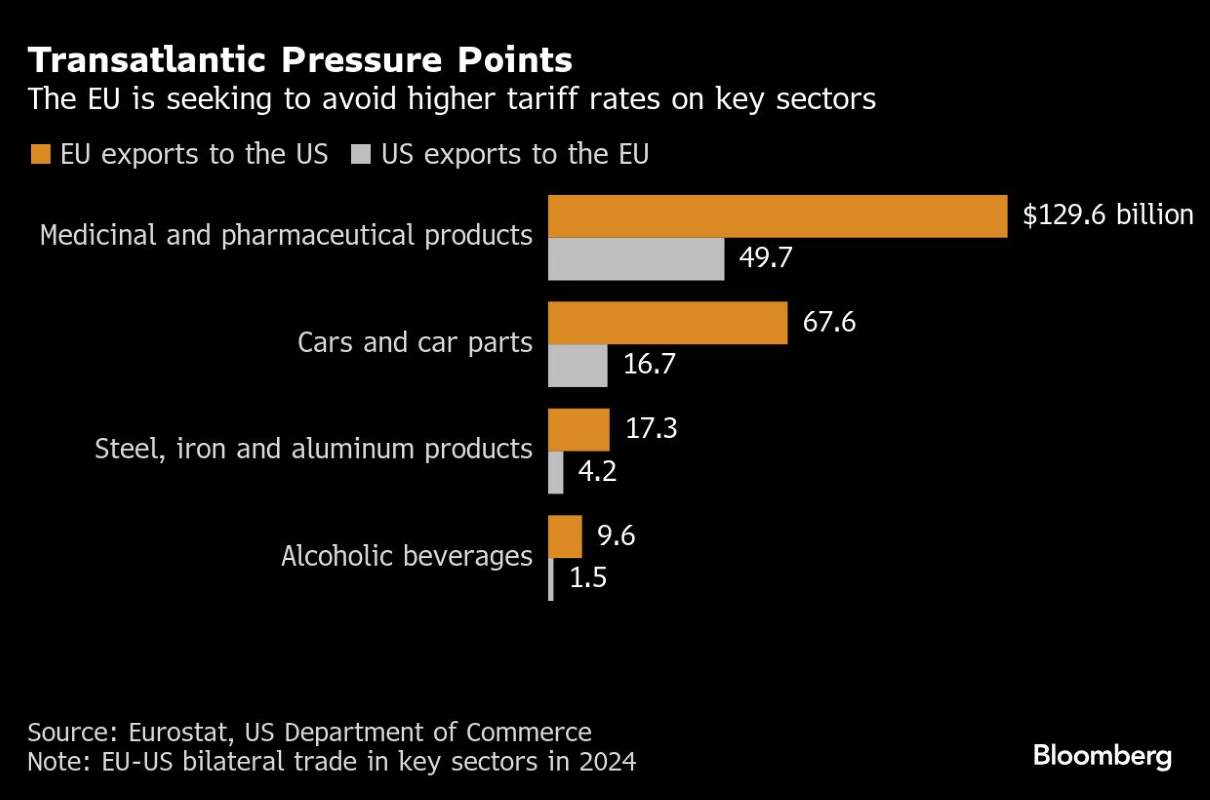
Donald Trump’s proposed 30% tariff on European Union goods is “effectively prohibitive” to transatlantic trade and could warrant retaliation, the bloc’s chief negotiator said.
Briefing reporters in Brussels on July 14 before a gathering of trade ministers, Maros Sefcovic warned that counter measures may be on the table as an option to strike back against the U.S. president’s levies.
“The current uncertainty caused by unjustified tariffs cannot persist indefinitely,” he said. “Therefore we must prepare for all outcomes, including — if necessary — well-considered, proportionate countermeasures to restore the balance in our transatlantic relationship.”
The trade commissioner for the EU is set to speak with American counterparts later on July 14, following Trump’s warning of tariffs of 30% on its exports to the U.S. starting on August 1.
Sefcovic’s remarks point to the danger of escalation in a standoff over bilateral ties that Brussels officials assess to be the world’s most significant for commerce and investment.
“We feel a huge responsibility for the biggest trading relationship on this planet,” Sefcovic said, stressing that the EU wants a negotiated solution. “We’re showing this enormous patience, enormous creativity to find the solutions,” he added.
Pressure to change tactics is mounting, not least from France. In a toughening of tone, Economy Minister Laurent Saint-Martin, said that the bloc should now be open to a more robust response.
“The priority is for the EU to remain united,” he said. “But obviously the situation since Saturday should lead us to change method. We must present in a concrete and clear way the capacity of the EU to put counter measures on the table, to retaliate.”
He also noted that any action could include the option of hitting services, and deployment of the anti-coercion instrument, the EU’s most powerful trade tool. That measure has never been used until now.
The EU is set to extend a suspension of tariffs on €21 billion ($24.5 billion) of U.S. steel and aluminum products, in a sign that Brussels wants to avoid an immediate escalation.
The bloc has another retaliatory package ready on about €72 billion of goods, as well as some export controls, which will be discussed by member states July 14.
Ministers attending the Brussels gathering expressed both surprise and resolve in the wake of Trump’s tariff threat issued on July 12.
“The U.S.A is taking a risk,” said Finnish Foreign Trade Minister Ville Tavio, warning that any counter measures would hit the U.S. economy. “The talks cannot be one-sided,” he added.
Danish Foreign Minister Lars Lokke Rasmussen told reporters the EU must strike a balance between avoiding escalation and showing “readiness to respond.”
“We want an agreement with the U.S., but it must be a fair deal — we are 450 million citizens in the European customs union, which gives us a lot of leverage,” Rasmussen said. “But if you want peace you have to prepare for war, and I think that’s where we are.”
In the meantime, the EU is preparing to step up engagement with countries hit by Trump’s tariffs, following a slew of new threats to the bloc and other U.S. trading partners, according to people familiar with the matter.
Contacts with nations including Canada and Japan could include the potential for coordination, said the people, who spoke on condition of anonymity because deliberations on the matter are private.
EU Commission President Ursula von der Leyen will speak with Canadian Prime Minister Mark Carney on July 14, a Brussels official said.
Popular Stories




100 Great Supply Chain Partners 2026: The Secret to Supply Chain Success
VIEW THE LATEST ISSUECase Studies


Visit Our Sponsors |
|
|
|
|
|
|
|
|
|
|
|
|
|
|
|
|
|
|
|
|
|
|
|
|
|
|
|
|
|
|
|
|
|
|
|
|
|
|
|
|
|
|
|
|
|
|
|
|
|
|
|