
Carney’s Tariff Shift Helps Business and Creates a Political Headache
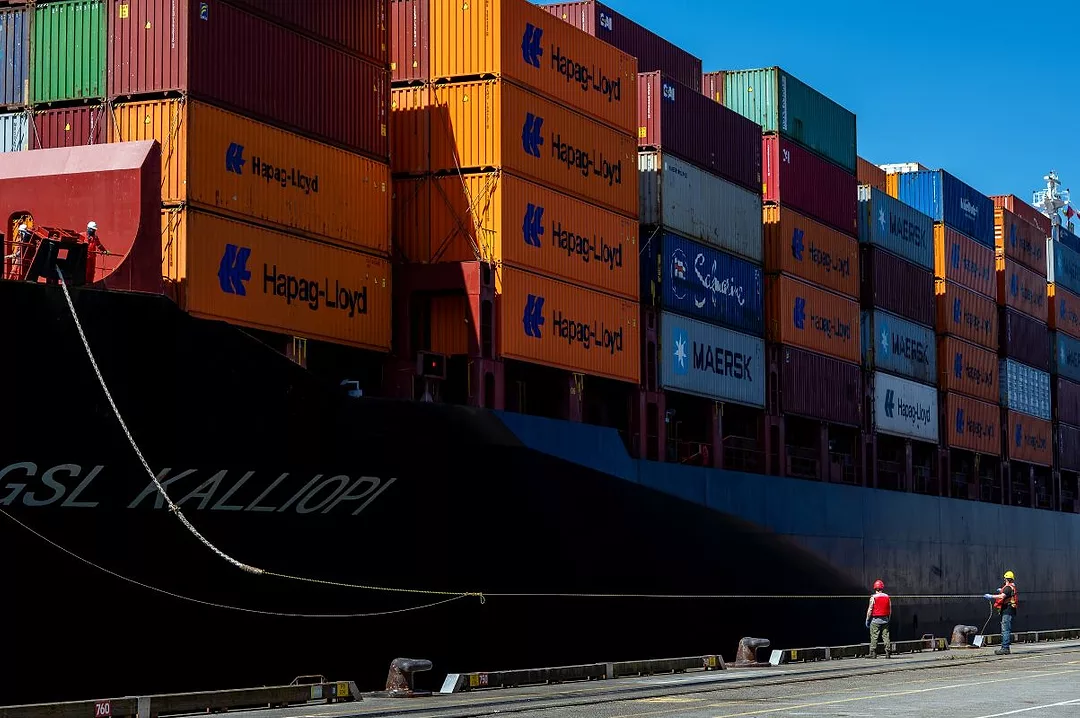
A container ship at the Fairview Container Terminal in the Port of Prince Rupert in Prince Rupert, British Columbia, Canada. Photographer: James MacDonald/Bloomberg
Prime Minister Mark Carney’s decision to remove many tariffs on imports from the U.S. comes after a series of warnings from businesses and analysts that the levies were inflicting economic damage on Canada.
On August 22, Carney announced the end of 25% retaliatory tariffs imposed by his predecessor, Justin Trudeau, on a wide range of food and other consumer goods. Those items will be tariff-free as of September 1, as long as they comply with the conditions of the U.S.-Mexico-Canada Agreement, the continental trade deal that came into effect in 2020.
On top of being an irritant to the U.S. in trade negotiations, the counter-tariffs were hurting Canadian companies and increasing the likelihood of firms raising prices. That was teeing up a political liability for Carney by exacerbating cost-of-living challenges.
It’s “definitely good news” for some small businesses, according to Corinne Pohlmann, executive vice-president of advocacy at the Canadian Federation of Independent Business. She said support for counter-tariffs among the lobby group’s members had fallen in the last six months to about 50-50 now.
Canada’s tariffs were one of the biggest headwinds to domestic small enterprises from the trade war, according to a poll published by CFIB on August 20. It found one in five firms saying they’d have to make drastic moves if nothing changed in the trade war, and that steel and aluminum tariffs are causing harm to smaller Canadian companies.
Dropping retaliatory tariffs should also “help quell any lingering concerns at the Bank of Canada about tariff-induced inflation,” Royce Mendes, Desjardins’ head of macro strategy, said in a note. Policymakers have kept the door open to further rate cuts to support the economy.
While higher prices could still pass through to Canadian consumers and businesses because of global tariffs and changing supply chains, the reduction in Canada’s levies removes at least some uncertainty for the central bank.
At 1.7%, headline inflation is below the Bank of Canada’s 2% target, but core inflation measures are around 3%.
“This is certainly good news, especially for consumers impacted by the higher costs caused by tariffs,” Per Bank, chief executive officer of supermarket chain Loblaw Cos., said in a post on LinkedIn. But “just as it took time for tariffs to start impacting goods based on the inventory we had on hand, it will also take time for tariff-related pricing to come off what we have in-stock.”
‘Hard Line’
The revenue that Canada has reaped from its tariffs has been relatively small. The government collected C$2.5 billion ($1.8 billion) from U.S. counter-tariffs on a net basis between March and the first week of August, according to data provided to Bloomberg by the Department of Finance. While helping offset lower corporate and sales tax receipts, they were not transforming the fiscal picture.
But Carney’s move is politically tricky. The former central banker won an April election by pledging to stand up against U.S. President Donald Trump’s tariffs and aggressive rhetoric. Polling by the Angus Reid Institute published August 1 showed support for a “hard line” approach was actually growing among Canadians, with 59% favoring dollar-for-dollar tariffs.
In certain sectors, such as steel, some firms and organizations have called for retaliation, saying they’ve been put at a disadvantage. Canada’s 25% import tax on U.S. steel and aluminum is still in place, but the U.S. tariff on those metals is 50%.
Carney made the argument on August 22 that, despite Trump’s recent escalation on tariffs, the U.S. had affirmed its commitment to trade in North America by keeping an exemption for goods shipped in compliance with the terms of USMCA. That carve-out gives Canada a lower overall tariff rate than other U.S. trading partners.
Canada has a deal with the U.S. that’s “better than that of any country,” with an average tariff rate of 5.6%, the prime minister said. “Canada and the United States have re-established free trade for the vast majority of our goods.”
The saga has underscored the importance of the USMCA for Canada. With the trade accord up for review next year, Carney has had to weigh the political imperative to hit back against the risk of enraging Trump to the point of losing that exemption.
Canada was also out on a limb internationally: China is the only other government of a large economy to punch back with counter-tariffs. The U.S. granted Mexico a 90-day negotiation extension at that same time as it increased tariffs on non-USMCA goods from Canada on August 1.
“Few other countries followed suit” in retaliating, Carney acknowledged on August 22.
Many of Ottawa’s counter-tariffs didn’t make sense, especially in the case where there were few alternatives to U.S. products, said William Pellerin, an international trade lawyer and partner at McMillan LLP in Ottawa.
“If Canada’s argument to the United States is that tariffs hurt the importers and importing countries, then Canada can’t have it both ways,” he said. “It has to acknowledge that a tariff is a tax on consumers. We’ve been saying that to the U.S. and it has to also be true in Canada.”
Popular Stories





100 Great Supply Chain Partners 2026: The Secret to Supply Chain Success
VIEW THE LATEST ISSUECase Studies


Visit Our Sponsors |
|
|
|
|
|
|
|
|
|
|
|
|
|
|
|
|
|
|
|
|
|
|
|
|
|
|
|
|
|
|
|
|
|
|
|
|
|
|
|
|
|
|
|
|
|
|
|
|
|
|
|