
Trump’s Tariffs Leave U.S. Business Tied Up in Costly Red Tape
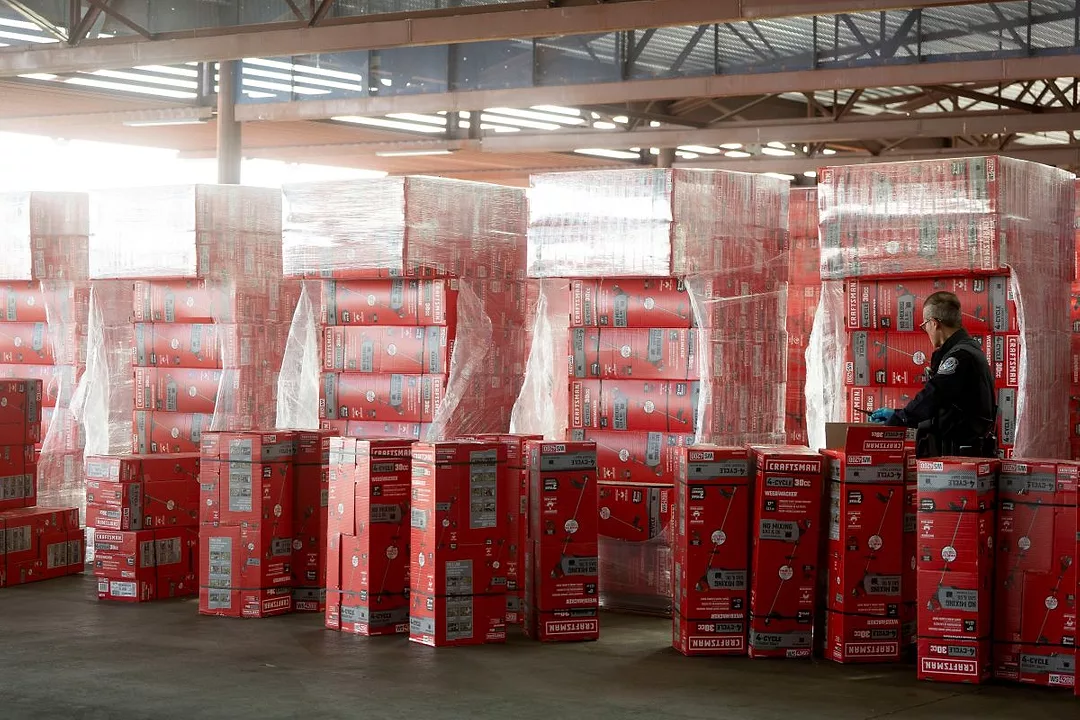
A U.S. Customs and Border Protection agent inspects boxes of tools at a port of entry in Nogales, Arizona. Photographer: Rebecca Noble/Bloomberg
Donald Trump promised to slash red tape for business. His tariff regime has gotten American companies increasingly tangled up in it.
The president’s ever-changing trade rules are piling up mountains of extra work for firms trying to follow them. Smaller ones in particular are struggling to cope with unprecedented requirements to trace paper trails for every widget and gadget, showing what’s in them and where they came from.
The bureaucratic burden is a less-discussed consequence of Trump’s move to hike import taxes to a hundred-year high. America Inc., which broadly cheered his election win, is already bristling at the direct cost of tariffs. Uncertainty around their on-again, off-again rollout is a drag on investment plans, too. The challenges of compliance add another layer of hurt.
One business owner who has experienced it all is David Zampierin, the founder of Idaho-based Zamp Racing, which makes helmets, suits and other kit for auto-racing drivers.
He spent July glued to a screen tracking a shipment from China, then realized it wouldn’t arrive before Trump’s trade truce with Beijing was due to expire. His solution: Park the stuff in a bonded warehouse in South Korea, then wait and see. When Trump extended the truce into November, Zampierin immediately ordered his goods to be shipped.
“Even though the pandemic was crazy, there was kind of a certainty there. Now it’s more about the confusion,” he said. “I’ve been doing this for 40 years. And it’s never been this complicated.”
Take the administration’s widening of steel and aluminum duties to include hundreds of categories of consumer items and manufacturing inputs, from motorcycles to baby gear. Importers must be able to document not just the value of metals contained in the goods, but also where the steel was poured and the aluminum smelted, according to customs broker Pete Mento.
Even when a product like deodorant sprays or shampoo doesn’t contain any listed metals, importers can be required to submit documents that prove it.
In the case of aluminum, if importers can’t prove the origin, customs officials will assume it’s from Russia – which has the highest rate — and charge 200%. Russia is likely the ultimate source of metal used in many products that arrive via third countries, but some suppliers don’t want to share the information, or perhaps even have it in the first place.
“It’s death by a thousand papercuts,” said Shannon Bryant, president of trade compliance advisory service Trade-IQ.
Every goods entry under the requirement takes “at least one to three hours of work on the low end,” while more complex cases – like figuring out the metal content in a shipment of motorbike parts – could take 10 hours or more, according to Hugo Pakula, chief executive of Tru Identity, an AI automation platform for global trade.
It’s a far cry from Trump’s campaign-trail promises last year to unleash U.S. business by scrapping burdensome rules. Since taking office, he’s crowed about his progress.
“Countries as they get older, they develop a lot of red tape,” the president said in May at an investment conference in Saudi Arabia. “We’re getting rid of it at record levels.”
To be sure, the administration has slashed plenty of regulations, including on the environment, finance, labor and diversity. And Trump has taken other steps to help business, like the tax-law provisions that allow deductions and full expensing for capital investments.
The White House did not respond to requests for comment.
What’s more, domestic manufacturers have cheered some of the president’s tariffs as a shield against foreign competition – a major purpose of Trump’s policy, which aims to revive U.S. manufacturing and reduce dependence on imports.
Those are longer-term objectives. In the meantime, U.S. business has been hoping for more clarity over the near future, and Trump’s August 1 deadline for global tariff rates was expected to provide some. But since then he’s only expanded his plans — doubling levies on India to 50% and threatening fresh charges on furniture imports. New tariffs on pharmaceuticals, semiconductors and other key industrial goods are in the pipeline too.
Adding to the confusion, a federal appeals court ruled that Trump’s country-specific tariffs broke the law. The White House has appealed to the Supreme Court and is seeking an expedited ruling.
Policy zigzags can add to the bureaucratic burden. Every time the rules change, some companies that already placed orders – and have shipments en route to the U.S. – are left unsure whether they’ll be subject to the new rates, or qualify for what’s known as an “on the water” exemption.
Compliance costs fall particularly hard on small businesses. Even in relatively straightforward cases, ensuring that paperwork is all in order adds to the workload – and larger companies are better equipped to respond by staffing up, said John Arensmeyer, who runs the Small Business Majority, a nonprofit that represents some 85,000 companies.
Smaller firms also tend to lack the global networks that make it easier to switch suppliers in response to tariff shifts. And last week’s shutdown of the so-called “de minimis” exemption, which allowed tariff-free entry for packages worth $800 or less, was another blow. It means more forms to fill, as well as taxes to pay.
“Larger companies will very rarely be looking to import products valued less than the previous de minimis threshold,” said James Knightley, chief international economist at ING. More broadly, with everyone looking to offset new tariff costs, “small operations are likely to have less fat to trim” and risk a bigger hit to profits, he said.
On the other end, U.S. Customs and Border Protection faces challenges of its own in enforcing the complex new tariff regime. The agency is using artificial intelligence and data mining to examine changes over time and compare one company’s reports with another’s. These tools are proving effective at spotting potential non-compliance, according to Cindy Deleon, a former CBP auditor who now runs Houston-based consultancy Deleon Trade LLC.
“Customs is definitely moving at light speed to maximize their intelligence,” said Deleon. “That’s what they should be doing.” As for companies, she said, many “are just grossly unprepared. They don’t see the red flags.”
There’s also the Entry Summary Review process, in which CBP can identify compliance issues early on and seek documents from the importer or broker before issuing a formal Request for Information. Those initial reviews can sometimes lead to CBP issuing bills.
Popular Stories


.webp?height=100&t=1782273749&width=150 "037_a_roadmap_for_the_ai_journey_v1-(540p).png")


SupplyChainBrain 2026 ESG Guide: ESG — The Supply Chain’s Biggest Secret
VIEW THE LATEST ISSUECase Studies


Visit Our Sponsors |
|
|
| |
|
|
|
|
|
|
|
|
|
|
|
|
|
|
|
|
|
|
|
|
|
|
|
|
|
|
|
|