.webp?height=100&t=1782792122&width=150 "005_veteran_winemaker_gallo_embarks_on_an_ai_journey_v2-(540p).jpg")
U.S. Seizes Sanctioned Oil Tanker Off the Coast of Venezuela
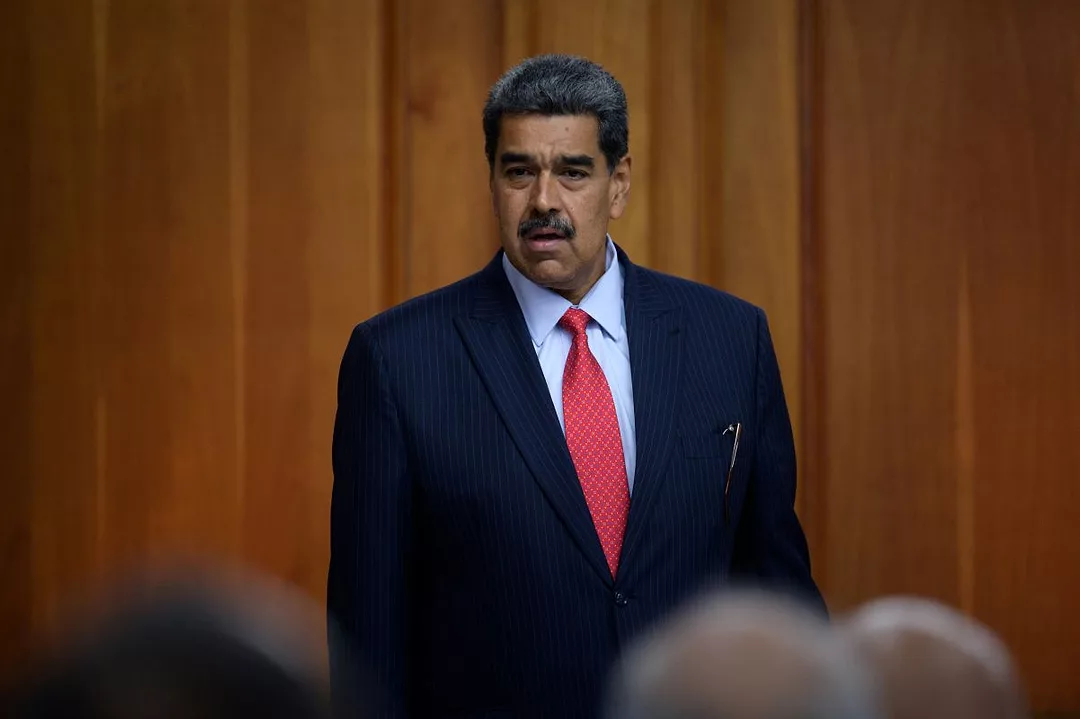
Nicolás Maduro, President of Venezuela. Photo: Bloomberg
U.S. forces have intercepted and seized a sanctioned oil tanker off the coast of Venezuela, according to people familiar with the matter, a move that marks a serious escalation of tensions between the two countries.
The U.S. conducted a “judicial enforcement action on a stateless vessel” that was last docked in Venezuela, according to a senior Trump administration official.
President Donald Trump confirmed the seizure later on December 10. “As you probably know, we’ve just seized a tanker on the coast of Venezuela — large tanker, very large, largest one ever seized, actually,” Trump said at the White House. “And other things are happening.”
State oil company Petroleos de Venezuela SA (PDVSA) and Venezuela’s oil and information ministries didn’t immediately reply to requests for comment.
International oil prices moved higher on news of the seizure, with Brent crude climbing as much as 0.8% in London trading.
Seized Tanker
The captured vessel was identified as the Skipper, according to people familiar with the matter and a Guyanese official. The very-large crude carrier, which is 20 years old, was sanctioned by the U.S. in 2022 under its former name Adisa for supporting Iranian oil exports.
The vessel purportedly sails under the Guyana flag, but the country’s Maritime Administration has denied any connection with the tanker.
A VLCC is a massive ship that has the capacity to carry around 2 million barrels of oil. The US had concluded the vessel was bound for Cuba, according to people with knowledge of the matter, though it would be unusual for a boat of that size to travel from Venezuela to Cuba, based on historical shipping patterns.
US officials have long suspected Venezuelan President Nicolás Maduro’s regime of selling sanctioned crude via Cuba illegally in order to benefit from the profits while making the sales harder to trace.
The U.S. action may make it much harder for Venezuela to export its oil, as other shippers are now likely to be more reluctant to load its cargoes. Most Venezuelan oil goes to China, usually through intermediaries, at steep discounts owing to sanctions risk. Brent futures edged higher after the news.
A few hours later, U.S. Attorney General Pam Bondi posted a video on X showing heavily armed forces descending to the ship’s deck from a Black Hawk helicopter, in a standard commando-style tactic called “fast roping.”
“For multiple years, the oil tanker has been sanctioned by the United States due to its involvement in an illicit oil shipping network supporting foreign terrorist organizations,” she wrote.
Today, the Federal Bureau of Investigation, Homeland Security Investigations, and the United States Coast Guard, with support from the Department of War, executed a seizure warrant for a crude oil tanker used to transport sanctioned oil from Venezuela and Iran. For multiple… pic.twitter.com/dNr0oAGl5x
— Attorney General Pamela Bondi (@AGPamBondi) December 10, 2025
It was unclear from the video whether the personnel involved were members of the Coast Guard or U.S. special operations forces.
Venezuela in a statement labeled the seizure a “blatant theft” and an “act of piracy,” adding the country would defend its sovereignty and natural resources “with absolute determination.”
“The true reasons for the aggression against Venezuela have finally been revealed,” the statement read. “It was always about our natural resources, our oil.”
“The U.S. seizing a Venezuelan tanker is a clear escalation from financial sanctions to physical interdiction — it raises the stakes for Caracas and anyone facilitating its exports,” said Jorge Leon, head of geopolitical analysis at Rystad Energy. “This kind of action adds a geopolitical floor to prices: Even modest volumes can move sentiment when the risk is about sea lanes and state-to-state escalation.”
The Trump administration has ramped up pressure on Venezuelan President Nicolás Maduro, whom it has accused of presiding over a narcotrafficking operation. The Pentagon has conducted more than 20 strikes against purported drug-trafficking vessels in waters near Venezuela and Colombia, killing more than 80 suspects. President Donald Trump has suggested numerous times that the U.S. could strike on land and that Maduro’s “days are numbered.”
The Maduro government has characterized U.S. actions as a grab for Venezuela’s oil reserves, among the biggest in the world. The tanker seizure is coming to light on the same day María Corina Machado, who leads the Venezuelan opposition to Maduro, was awarded the Nobel Peace Prize.
In recent months, Maduro has called on Venezuela’s citizens to unite against what he said were U.S. threats and to enlist in the citizen militia. He has also deployed troops, ships, aircraft and drones to the border with Colombia, some states along the coast and an island.
PDVSA, the state oil company, works with a handful of international partners including Houston-based Chevron Corp. to drill in many parts of the country. Under the current arrangement, Chevron receives a percentage of the oil produced by its joint ventures with PDVSA. A license issued by the U.S. Treasury exempts the U.S. company from sanctions.
Earlier on December 10, Chevron chief executive officer Mike Wirth said in an interview with Bloomberg TV that his company is in discussions with the Trump administration about remaining in compliance with sanctions in Venezuela.
Popular Stories



SupplyChainBrain 2026 ESG Guide: ESG — The Supply Chain’s Biggest Secret
VIEW THE LATEST ISSUECase Studies


Visit Our Sponsors |
|
|
|
|
|
|
|
|
|
|
|
|
|
|
|
|
|
|
|
|
|
|
|
|
|
|
|
|
|
|
|
|
|
|
|
|
|
|