SCB FEATURE
ESG: The Supply Chain’s Biggest Secret
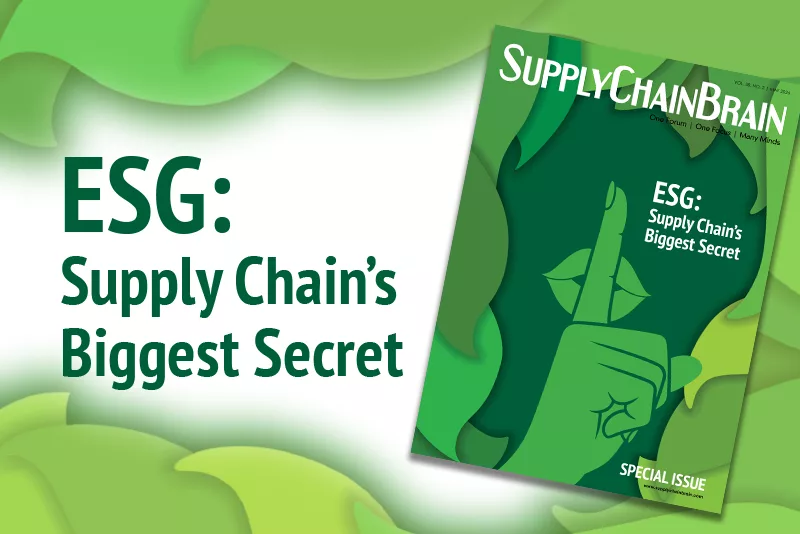
Editors' Note: This is the introduction to the 2026 edition of SupplyChainBrain's annual special issue focusing on environmental, social and governance topics in global supply chains.
 Don’t tell anyone, but ESG isn’t dead.
Recent political developments suggest that environmental, social and governance initiatives are ailing, if not moribund. There’s been a marked decrease in corporate image-burnishing commercials professing a “commitment” to sustainability and human-centered values. Bottom-line profit and maximization of shareholder return, coupled with a fear of being labeled as overly “woke,” appear to be the order of the day.
The reality is something quite different. While some of the hype around corporate social responsibility might indeed have quieted, actual efforts toward that end continue. You might say we’ve gone from an era of greenwashing to one of greenhushing.
We made a similar observation last year, in our previous annual issue dedicated to ESG in global supply chains. We argued for relevance then. We see urgency now.
Regulations are only getting tighter and more numerous, especially in the European Union, mandating a new level of compliance and oversight. The requirement that businesses report their “Scope 3” carbon emissions has them scrambling to acquire visibility across multi-tier supply chains. So does the looming prospect of a “digital product passport,” containing detailed data about a product’s origin, durability and sustainability. Meanwhile, supplies of certain critical raw materials are becoming increasingly constricted, whether due to government action or depletion of natural resources.
Progress toward sustainability and alternative fuel sources is being seen in some unlikely places. Oil-rich Saudi Arabia, of all nations, is making major investments in solar power. So is China, which dominates the global market for electric vehicles. Along with India, it’s host to the world’s largest operating solar projects. The United Arab Emirates and Egypt are also in the mix.
The recent conflicts in the Middle East and Ukraine only serve to underscore the volatility and unpredictability of fossil fuels. And while oil and natural gas aren’t going away as dominant sources of energy anytime soon, many nations and businesses realize that they can’t depend on them indefinitely. Tapping renewable resources is essential.
Add to this raging conversation the emergence of artificial intelligence, as both problem and solution: the first, because the wave of new AI data centers requires massive amounts of energy; the second, because AI’s ability to make sense of huge amounts of data could equip supply chains with deep insights into their environmental and social impact. It’s no surprise that so many of the articles in this year’s special issue focus on this topic.
Beyond the wonders (or horrors) of AI, we cover the usual broad spectrum of ESG-related subjects in these pages. As we revisit the topic from year to year (and, on SupplyChainBrain.com, from day to day), we witness the frustrations, disagreements, backpedaling and empty promises on one hand, and optimism, innovation and progress on the other. But it’s vital that we keep the subject front and center, unshackled from the ADHD-nature of the general news cycle, which has the tendency to bury important stories in favor of the outrage of the moment. (It feels like we’ve heard less in recent months about the plight of ethnic Uyghurs in China’s Xinjiang Province, for example.) For our part, we’re grateful that so many industry experts and thought leaders are willing to contribute their insights to our continuing coverage of all aspects of ESG.
So let’s not keep it a secret, OK?
Popular Stories




100 Great Supply Chain Partners 2026: The Secret to Supply Chain Success
VIEW THE LATEST ISSUECase Studies


Visit Our Sponsors |
|
|
|
|
|
|
|
|
|
|
|
|
|
|
|
|
|
|
|
|
|
|
|
|
|
|
|
|
|
|
|
|
|
|
|
|
|
|
|
|
|
|
|
|
|
|
|
|
|
|
|