• Advertise
  • Contact Us
  • Supplier Directory
  • SCB YouTube
  • About Us
  • Login
  • Subscribe
  • Logout
  • My Profile
  • LOGISTICS
    • Air Cargo
    • All Logistics
    • Facility Location Planning
    • Freight Forwarding/Customs Brokerage
    • Global Gateways
    • Global Logistics
    • Last Mile Delivery
    • Logistics Outsourcing
    • LTL/Truckload Services
    • Ocean Transportation
    • Parcel & Express
    • Rail & Intermodal
    • Reverse Logistics
    • Service Parts Management
    • Transportation & Distribution
  • TECHNOLOGY
    • All Technology
    • Artificial Intelligence
    • Cloud & On-Demand Systems
    • Data Management (Big Data/IoT/Blockchain)
    • ERP & Enterprise Systems
    • Forecasting & Demand Planning
    • Global Trade Management
    • Inventory Planning/ Optimization
    • Product Lifecycle Management
    • Robotics
    • Sales & Operations Planning
    • SC Finance & Revenue Management
    • SC Planning & Optimization
    • Supply Chain Visibility
    • Transportation Management
  • GENERAL SCM
    • Business Strategy Alignment
    • Customer Relationship Management
    • Education & Professional Development
    • Global Supply Chain Management
    • Global Trade & Economics
    • Green Energy
    • HR & Labor Management
    • Quality & Metrics
    • Regulation & Compliance
    • Sourcing/Procurement/SRM
    • SC Security & Risk Mgmt
    • Supply Chains in Crisis
    • Sustainability & Corporate Social Responsibility
  • WAREHOUSING
    • All Warehouse Services
    • Conveyors & Sortation
    • Lift Trucks & AGVs
    • Order Management & Fulfillment
    • Packaging
    • RFID, Barcode, Mobility & Voice
    • Warehouse Automation
    • Warehouse Management Systems
  • INDUSTRIES
    • Aerospace & Defense
    • Apparel
    • Automotive
    • Chemicals & Energy
    • Consumer Packaged Goods
    • E-Commerce/Omni-Channel
    • Food & Beverage
    • Healthcare
    • High-Tech/Electronics
    • Industrial Manufacturing
    • Pharmaceutical/Biotech
    • Retail
  • THINK TANK
  • WEBINARS
    • On-Demand Webinars
    • Upcoming Webinars
    • Webinar Library
  • PODCASTS
  • WHITEPAPERS
  • VIDEOS
Home » NASA Lays Out Roadmap for Permanent Moon Base

NASA Lays Out Roadmap for Permanent Moon Base

A man in a suit standing at a NASA-emblazoned podium, in front of a screen depicting the moon, which reads "We have returned"

NASA Administrator Jared Isaacman delivering remarks on the agency's planned moon base. Photo: YouTube

May 26, 2026
Nick Bowman, Senior Editor

NASA has unveiled its historic plans to establish a permanent base on the surface of the moon over the next decade.

NASA, the U.S. National Aeronautics and Space Administration, initially teased its moon base ambitions in late March, when it pledged $20 billion for a series of manned and unmanned missions, all with the stated aim of gathering data on lunar landing systems, and to establish a sustainable human presence on the moon. In a May 26 news conference, NASA Administrator Jared Isaacman shared the full timeline the agency has laid out for its planned lunar base.

"The grand return [to the moon] is close at hand, and we will not slow down," he said. "We are moving with the confidence and purpose to accomplish the missions that only NASA is capable of achieving."

Read More: The Supply Chain Math Behind Elon Musk's Moon Base Ambitions

NASA's plans for a lunar base are divided into three distinct phases, with the first running through 2029, focused on testing technologies on the lunar surface, learning more about what it takes for humans to survive there long-term, and to scout out locations for the base itself. The second phase through 2032 will then hone in on assembling permanent infrastructure and establishing logistics operations, with the final phase centered around a goal to establish a sustained human presence. For that last phase, NASA will need to ensure that humans can survive on a lunar surface with one-sixth the gravity of Earth, no atmosphere, and constant exposure to dangerous radiation, solar storms and meteor strikes.
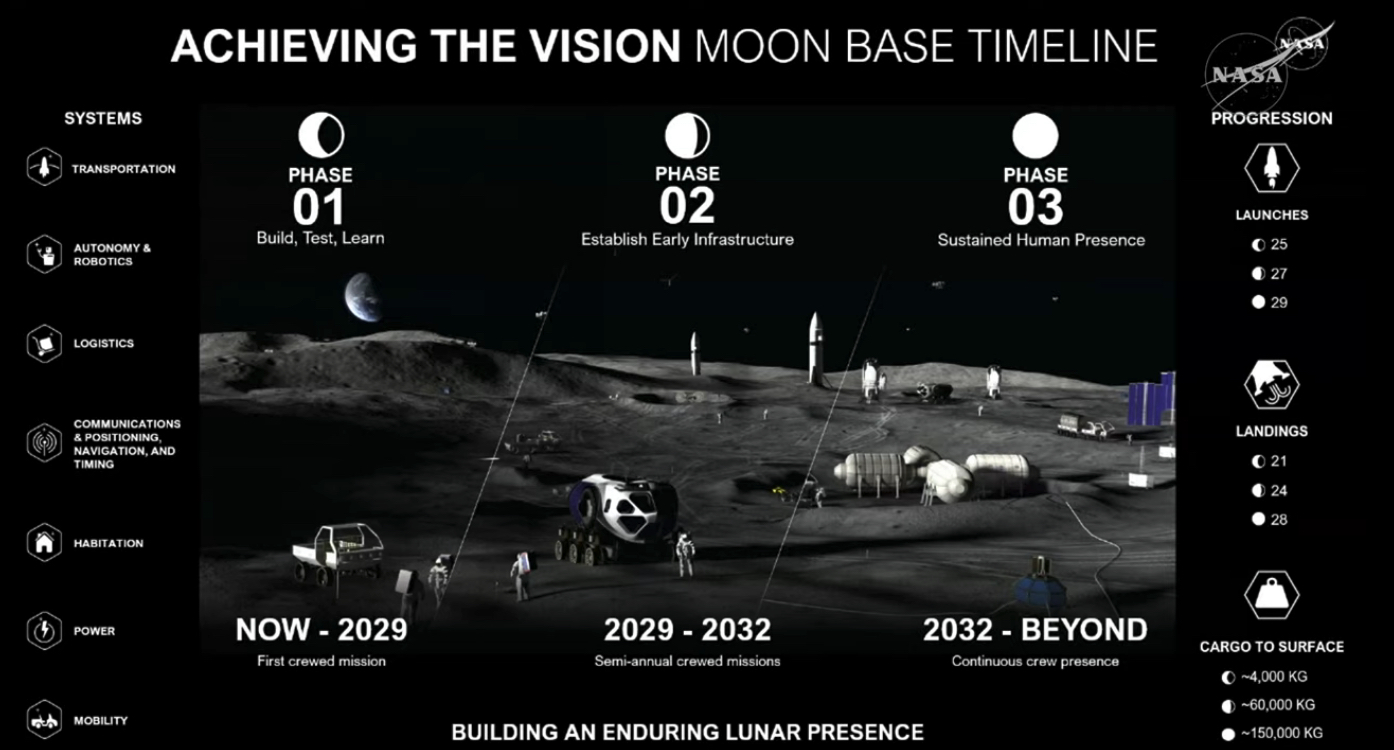

Phase 1 will start with a trio of launches scheduled for 2026. The first — dubbed Moon Base I — will use the first privately funded lunar lander in history. As part of that mission, Blue Origin's Mark I lander will deliver multiple payloads to the Shackleton Ridge at the moon's south pole, recognized as a critical area for exploration given that it offers near-constant solar illumination and easy access to nearby dark craters believed to contain water ice. 

Next will be the the Moon Base II mission, which will deliver the largest ever commercial payload to the lunar surface, with Astrobotic Technology's Griffin lander set to carry more than 500 kilograms of cargo. That cargo will help NASA develop the technologies needed to support lunar terrain vehicles, autonomous operations, and logistics processes for transporting equipment to and from the moon.

The Moon Base III mission will then deliver equipment to study how the lunar surface evolves over time, and how future infrastructure might perform in the moon's harsh conditions. NASA will also look to uncover the mystery behind "lunar swirls," strange bright patterns on the moon believed to be linked to localized magnetic fields that may shield parts of the lunar surface from solar radiation.

Through all of this, the larger overarching goal is to ensure that getting to the moon becomes a "high reliability endeavor," said Moon Base Program Executive Carlos Garcia-Galan. In total, Phase 1 alone will include 25 launches, 21 landings, and the transportation of four metric tons of cargo to the lunar surface.

In early 2028, NASA will also be sending humans to moon's surface for the first time since 1972, as part of its Artemis IV mission. Astronauts will land somewhere on the moon's south pole, where they'll collect geological samples, run experiments, and test out the manned technology the agency will hope to eventually build on for its lunar base down the line.

However, it's unclear how potential cuts to NASA from the Trump administration might play into the agency's ambitious roadmap. A proposed 2027 fiscal year budget from President Trump seeks to cut NASA's discretionary budget by 23%, with the deepest cuts targeted at the very science programs the agency would need to establish a presence on the moon in the first place. And although U.S. House and Senate committees have since pushed back on those cuts, the situation underscores the tenuous nature of NASA's ability to fund a sweeping lunar base program.

    RELATED CONTENT

    RELATED VIDEOS

    Logistics Technology Global Supply Chain Management Sourcing/Procurement/SRM Aerospace & Defense
    • Related Articles

      Williams-Sonoma Lays Out Roadmap in Case of Trump Tariffs

      NASA Sets Goal to Establish Moon Base Over Next Decade

      The Supply Chain Math Behind Elon Musk's Moon Base Ambitions

    • Related Directories

      ProcureAbility

    Nick Bowman, Senior Editor

    The Issues Already Shaping 2028's West Coast Port Labor Talks

    More from this author

    Subscribe to our Daily Newsletter!

    Timely, incisive articles delivered directly to your inbox.

    Featured Product

    Popular Stories

    • TWO WORKERS IN HI-VIS VESTS AND HARDHATS CONSULT A BANK OF COMPUTER SCREENS

      How a Poor Hiring Process Leads to High Turnover in Supply Chain

      HR & Labor Management
    • HANDS TYPE ON A KEYBOARD UNDER A SUPER IMPOSED DIGITIZED MAP OF THE WORLD, ALONG WITH IMAGES OF A SHIP, A SHOPPING CART AND OTHER SYMBOLS OF INTERNATIONAL LOGISTICS

      Five Demand-Forecasting Mistakes Supply Chain Leaders Are Rethinking

      Technology
    • The outside of Oracle Corporation's corporate headquarters located in Silicon Valley. Photo: iStock.com/Sundry Photography

      Oracle Cuts 21,000 Jobs, More to Come From AI

      Technology
    • 037_a_roadmap_for_the_ai_journey_v1-(540p).png

      Watch: A Roadmap for the AI Journey

      Artificial Intelligence
    • GIST-webinar-LWASC-Ep2.png

      Million Dollar Baby Planning Meets Supply Chain Agility: A Conversation with Julia Bedanova

    Digital Edition

    2026 esg cover main scb q2 2026 cover

    SupplyChainBrain 2026 ESG Guide: ESG — The Supply Chain’s Biggest Secret

    VIEW THE LATEST ISSUE

    Case Studies

    • Recycled Tagging Fasteners: Small Changes Make a Big Impact

    • A GRAPHIC SHOWING MULTIPLE FORMS OF SHIPPING, WITH A HUMAN STANDING AT THE CENTER, TOUCHING A SYMBOLIC MAP OF THE WORLD

      Enhancing High-Value Electronics Shipment Security with Tive's Real-Time Tracking

    • A GRAPHIC OF INTERLACING HONEYCOMBED ELEMENTS REPRESENTING GLOBAL BUSINESS TRANSACTIONS

      Moving Robots Site-to-Site

    • JLL Finds Perfect Warehouse Location, Leading to $15M Grant for Startup

    • Robots Speed Fulfillment to Help Apparel Company Scale for Growth

    Visit Our Sponsors

    4flow Arkieva Blue Yonder
    Carton Cloud CoEnterprise Dassault
    Duravant E2Open General Logistics Systems
    Hy-Tek iGPS Korber
    Lyngsoe Procurability Quinyx
    SAP Sikick Systech
    S&P Global Mobility TADA TransImpact
    US Bank Werner Enterprises WSI
    • More From SCB
      • Featured Content
      • Video Library
      • Think Tank Blog
      • SupplyChainBrain Podcast
      • Whitepapers
      • On-Demand Webinars
      • Upcoming Webinars
    • Digital Offerings
      • Digital Issue
      • Subscribe
      • Manage Email Preferences
      • Newsletters
    • Resources
      • Events Calendar
      • 2026 Event Coverage
      • SCB's Great Supply Chain Partners
      • Supplier Directory
      • Case Study Showcase
      • Supply Chain Innovation Awards
      • 100 Great Partners Form
    • SCB Corporate
      • Advertise on SCB.COM
      • About Us
      • Privacy Policy
      • Contact Us
      • Data Sharing Opt-Out

    All content copyright ©2026 Keller International Publishing Corp All rights reserved. No reproduction, transmission or display is permitted without the written permissions of Keller International Publishing Corp

    Design, CMS, Hosting & Web Development :: ePublishing