
UPDATED
US-Canada Bridge Fight Rages: Opening Delayed, Invites Voided
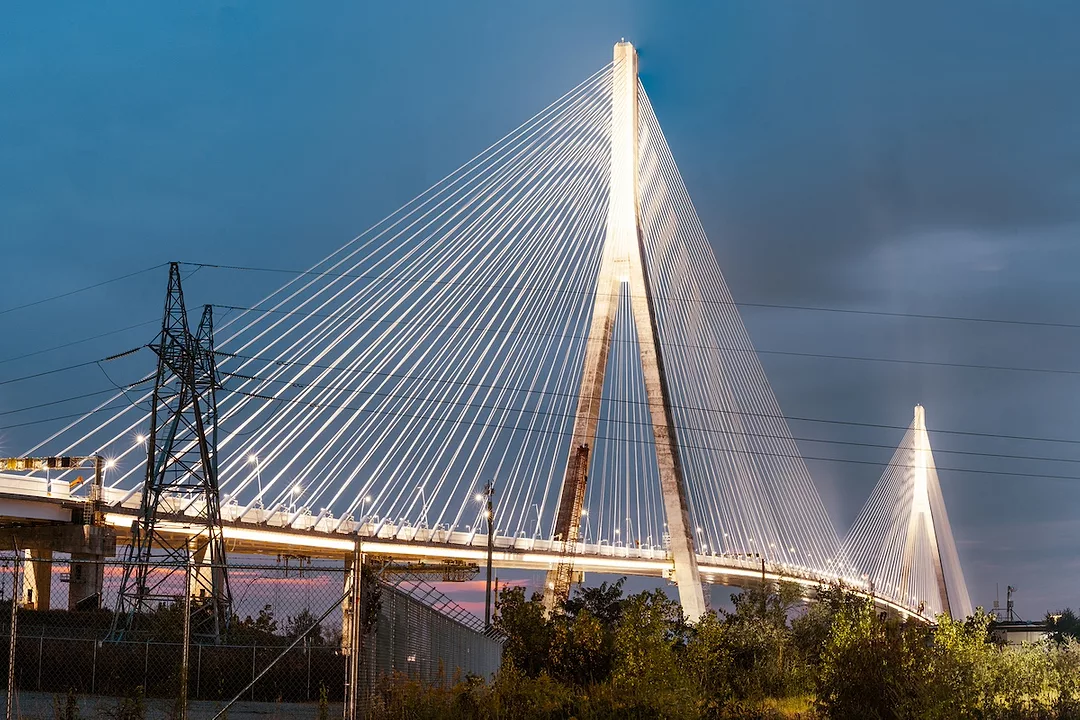
Photo: iStock / Steven_Kriemadis
The U.S. and Canada are delaying the opening of a new C$6.4 billion ($4.6 billion) bridge connecting Michigan and Ontario, which President Donald Trump has previously threatened to block.
Invitations had been sent for a June 12 ribbon-cutting ceremony, according to people familiar with the matter, who asked not to be named because they weren’t authorized to speak publicly. But that event won’t go ahead.
“As we work towards an opening date, we are taking a collaborative approach, reflecting our shared ambition for this trade corridor,” Chuck Andary, interim chief executive officer of the Windsor-Detroit Bridge Authority, said in a statement on June 11. “Canada and the United States have agreed to delay the opening of the bridge, taking the necessary time to resolve any outstanding issues.”
The fracas over the bridge is a glaring symbol of the rift that has developed during Trump’s second term between the U.S. and Canada, two longstanding allies that share the world’s longest undefended border, and conduct almost $900 billion of annual trade with each other.
The Gordie Howe International Bridge between Detroit and Windsor, Ontario, was paid for by Canadian taxpayers under a deal that sees Canada and Michigan share ownership. The idea was to smooth the way for commercial trade and tourism. Construction began during Trump’s first term in the White House.
Trump’s tariffs have particularly hurt the Canadian auto industry, which is centered in southern Ontario and in Windsor. From the city’s waterfront, you can see the headquarters of General Motors Co. across the Detroit River. Chrysler parent Stellantis NV has a major factory in Windsor, and Ford Motor Co. makes engines there.
“Although we would all like the Gordie Howe Bridge to open, Canada need not fall on bent knee to make it happen,” Windsor Mayor Drew Dilkens said in a social media post on June 11 that reflects how many Canadians feel about dealing with the U.S. under Trump.
Under the terms of the bridge deal, Canada paid for the construction and will collect the tolls until its costs are recouped. After that, the revenue is to be shared with Michigan.
But in February, Trump said on Truth Social that he wouldn’t allow it to open until the U.S. was “fully compensated for everything we have given” Canada, “and also, importantly, Canada treats the United States with the Fairness and Respect that we deserve.”
That post dragged the bridge into the wider trade war Trump has ignited since being reelected. In the same post, he complained about Canada’s provincial liquor agencies boycotting U.S. booze, import controls on dairy, and Prime Minister Mark Carney’s dealings with China.
Building Bridges
The symbolism of the not-yet-opened bridge is obvious to anyone who has followed its history.
“Years of collaboration to build something that was a long-term vision and a long-term investment, and it’s hard not to feel like it’s the politics of the day getting in the way,” said Laurie Trautman, director of the Border Policy Research Institute at Western Washington University.
In a spirit of fraternal U.S.-Canada ties, the new six-lane, 1.5-mile Gordie Howe bridge was named after a late Canadian hockey player who was a star for the Detroit Red Wings, and its towers are designed to resemble a hockey stick being swung for a slap shot, according to supplier ArcelorMittal SA.
It will create the two largest ports of entry on the U.S.-Canada border, and the bridge authority calls it the “largest binational infrastructure project in North America today.”
Trump hasn’t mentioned the bridge recently, but on June 9 a White House official, speaking on condition they not be identified discussing private matters, said the president’s position on it hadn’t changed. The White House didn’t immediately respond to a request for comment on June 11.
In a hint of behind-the-scenes wrangling, Carney said on June 9 that the bridge would open this week, then backtracked a day later. “There’s no big drama,” he said. “If it takes a little longer, it’ll take a little longer. But this will benefit Canadians, Americans, business, tourists, residents for decades and decades to come.”
Taking a Toll
Michigan got “a great deal” on the financing of the bridge, a spokesperson for Governor Gretchen Whitmer said in a statement. “We haven’t paid a dime, yet we will reap significant economic benefits for decades. This project is a powerful example of bipartisan and international cooperation, and the governor looks forward to attending the ribbon‑cutting ceremony when it happens.”
The U.S. ambassador to Canada, Pete Hoekstra, a Michigander, voiced doubts in April that the U.S. side will ever see a cut of revenue, because cost overruns and lower cross-border traffic might mean construction expenses aren’t paid off.
Fewer Canadians are traveling to the U.S., partly in protest over Trump’s tariffs and his rhetoric about making their country a U.S. state. The number of Canadians returning from U.S. destinations by car or air in May was almost 30% lower than two years earlier, before Trump took office, according to Statistics Canada data.
More than commuters or tourists, though, the Gordie Howe bridge was built to reinforce a crucial trade corridor between the two countries, especially for the tightly integrated automotive industry. That relationship is also in flux, as Trump is using tariffs to disrupt auto imports as a strategy for getting more auto-assembly jobs in the U.S.
Currently, the main connection for commercial trucks between Detroit and southern Ontario is the aging Ambassador Bridge, which is privately owned by the Moroun family of Michigan. They have lobbied against the new bridge, and met with U.S. Commerce Secretary Howard Lutnick before Trump’s February intervention.
It’s “obviously a disappointment” that the opening is delayed, said Stephen Laskowski, president of the Ontario Trucking Association. “This is a situation that is just not good for business on both sides of the border.”
The new bridge profoundly modernizes cross-border trade, Laskowski said by phone. It means trucks will no longer have to haul freight through 10 traffic lights in downtown Windsor, instead connecting directly to highways on either side. It removes the risk of the current bridge being a sole point of failure. And it integrates agricultural inspection points, X-ray scanners for security, and allows the transit of hazardous materials.
“Last, but definitely not least,” his members expect to save between C$20,000 and C$100,000 a month in tolls, he said.
Popular Stories





100 Great Supply Chain Partners 2026: The Secret to Supply Chain Success
VIEW THE LATEST ISSUECase Studies


Visit Our Sponsors |
|
|
|
|
|
|
|
|
|
|
|
|
|
|
|
|
|
|
|
|
|
|
|
|
|
|
|
|
|
|
|
|
|
|
|
|
|
|
|
|
|
|
|
|
|
|
|
|
|
|
|