.webp?height=100&t=1783959879&width=150 "014_how_ai_is_transforming_the_transportation_back_office_v1-(540p).jpg")
SCB FEATURE
The Issues Already Shaping 2028's West Coast Port Labor Talks
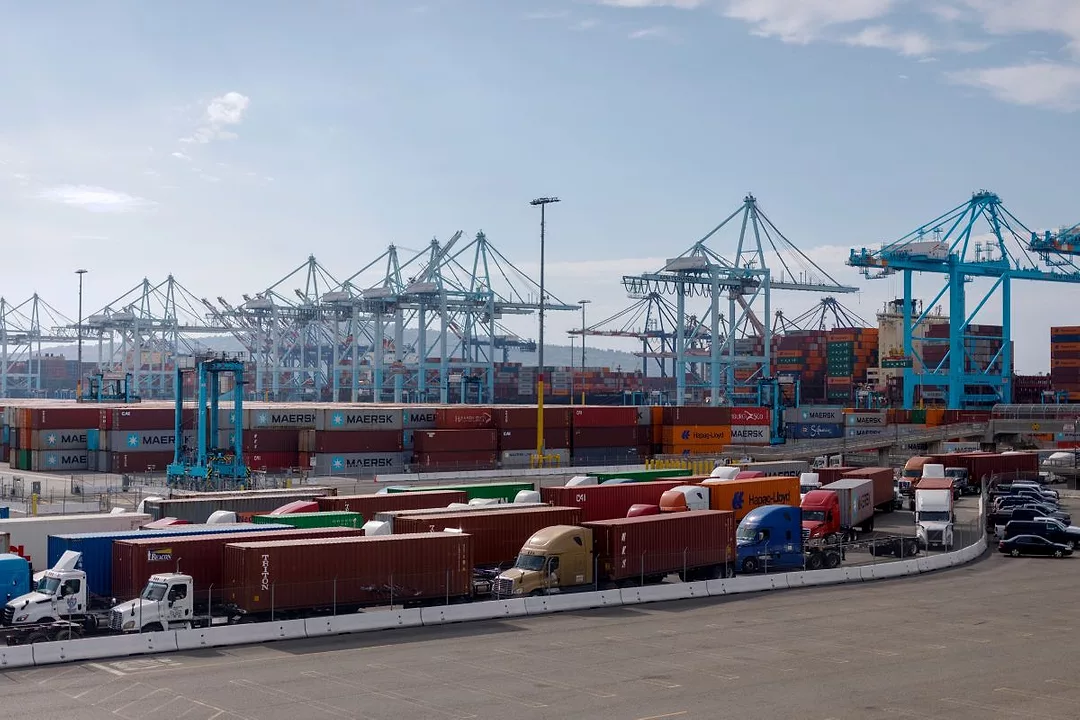
Tractor trailers carrying shipping containers at the Port of Los Angeles. Photographer: Eric Thayer/Bloomberg
The next contract negotiations between West Coast dockworkers and port employers might not expire until 2028, but the ongoing debate over automation, foreign ownership at port terminals, and the future of U.S. ports is already underway.
Speaking at the Agriculture Transportation Coalition's annual meeting in Tacoma, Washington on May 19, International Longshore and Warehouse Union (ILWU) President Bobby Olvera Jr. argued that decisions made by waterfront employers over the next two years will determine whether the parties enter bargaining with momentum or mistrust.
"There's a lot of work to do," Olvera cautioned.
During the last round of talks, numerous West Coast ports were briefly shut down by a labor slowdown, as part of a rocky 13-month negotiation process that laid bare deep divisions between the two sides. Today, many of the issues that dominated the previous talks — automation, employer-union trust and the competitive position of West Coast ports — are once again resurfacing years before the contract's expiration in 2028.
Among the most contentious issues is automation, which has long been a flashpoint between the union and their Pacific Maritime Association (PMA) employers. During talks that spanned 2022 and 2023, the two sides sparred over the role of automated cargo-handling technology at West Coast ports, with the ILWU arguing that automation threatened their jobs, while the PMA contended that the technology was necessary to remain competitive with other ports around the world. In the end, the two sides largely agreed to preserve the existing framework governing automation, leaving many of the most contentious questions surrounding the technology to be resolved on a case-by-case basis.
Read More: Strike at U.S. Ports Brings Debate Over Automation Front and Center
That discussion also bled over into labor talks on the East Coast in 2024, where automation was similarly a central sticking point. In that instance, the dispute led to a two-day strike across the region's ports, further underscoring how divisive the issue has become at a time when ports are facing mounting pressure to improve efficiency and handle growing cargo volumes.
A Lack of Trust
Automation isn't the only issue that will likely define the tenor of talks in 2028, with Olvera accusing the PMA of allowing foreign interests to gain increasing influence over terminals at West Coast ports.
"We allowed our public ports to be bought out from underneath us," Olvera claimed. "These foreign shipping lines don't care about our ports — it's all profit-generating."
Up and down the West Coast, a sizable share of terminal operations are controlled by subsidiaries of foreign shipping lines and operators, including Denmark's APM Terminals, Switzerland's MSC, France's CMA CGM and Germany's Hapag-Lloyd among others. For Olvera, the issue is not simply ownership, but whether the growing influence of global shipping companies has changed whose interests are being prioritized at U.S. ports.
However, questions around trust may prove just as important as automation and foreign ownership, with Olvera arguing that recent disputes between the union and PMA have strained labor-management relations during the current contract term. That includes ongoing fights over work jurisdiction at automated terminals, where labor and management have continued to disagree over which jobs should be performed by ILWU members, and which can be assigned to outside workers or contractors.
"The trust button has been reset," Olvera said. "Any trust earned in previous contracts, no one should rely on that today."
Taken together, the concerns paint a picture of a union that sees the next contract as a referendum on who will shape the future of the West Coast waterfront: labor, terminal operators or global shipping companies. The question now is whether the two sides can find common ground on those issues before they once again sit down at the bargaining table.
In a written response, the PMA stated that it is "focused each day on promoting strong and efficient West Coast ports that support the nation's supply chain, and sustain thousands of jobs at port terminals and millions of jobs throughout the U.S. economy."
Popular Stories


.webp?height=100&t=1784001702&width=150 "013_what's_really_needed_for_'lights-out'_capability_v1-(540p).png")


SupplyChainBrain 2026 ESG Guide: ESG — The Supply Chain’s Biggest Secret
VIEW THE LATEST ISSUECase Studies


Visit Our Sponsors |