.webp?height=100&t=1784835632&width=150 "LSG26_LTAgentEdgeImage_DB-1313-1 (1).png")
Mercedes Seeks to Soften Bill to Ban China-Linked Carmakers
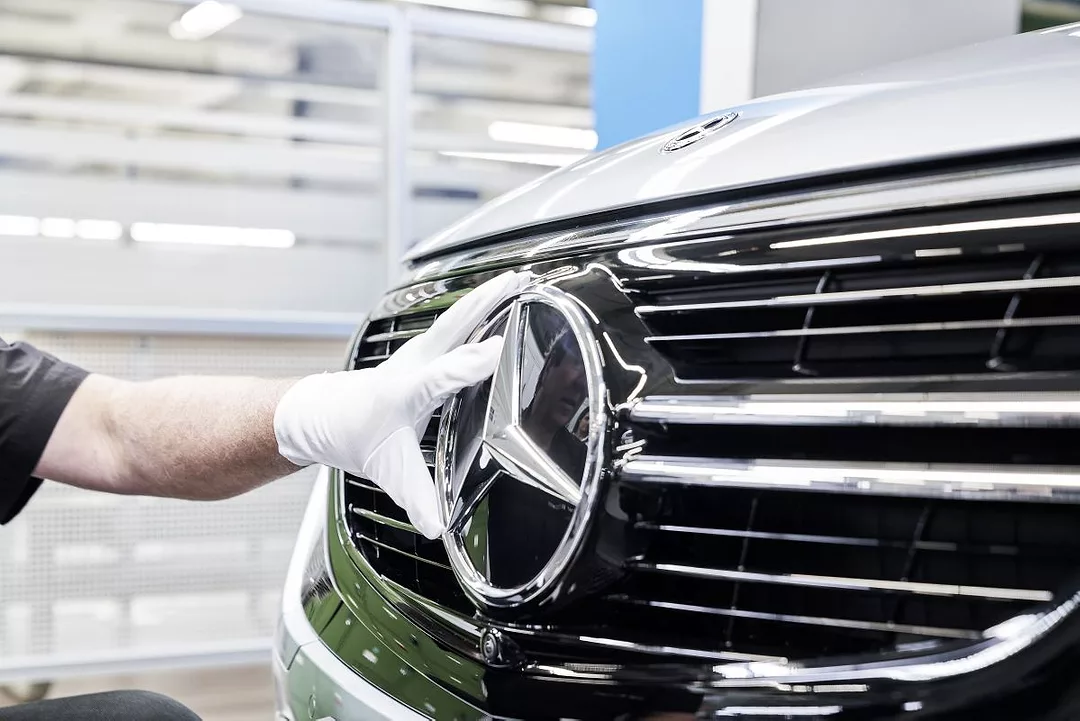
An employee fits a Mercedes-Benz AG star badge in Bremen, Germany. Photo: Bloomberg
Mercedes-Benz Group AG is pushing to water down a proposed law that would ban the company from the U.S. over its partial Chinese ownership, according to people familiar with the matter, the latest flashpoint in wrangling over how the U.S. will respond to the global expansion of China’s auto industry.
The bipartisan Senate bill introduced in April by Michigan’s Elissa Slotkin and Ohio’s Bernie Moreno would prohibit the sale of connected vehicles by automakers that are more than 15% owned by Chinese entities. That threshold would ensnare Mercedes, which is nearly 20% owned by Chinese entities.
Mercedes is seeking to raise the threshold for permitted Chinese ownership to 25%, among other potential changes, said the people, who asked to not be identified because the discussions are private. That would equal the ownership cutoff that the bill would impose on other companies such as suppliers of connected parts or software.
Lawmakers are also discussing exchanging a numerical threshold for a more qualitative test that weighs potential national security risks, some of the people said. If adopted, that would likely be more favorable to the German automaker than the current proposal, those people said.
Mercedes declined to specifically address the legislation. No single shareholder owns more than 10% of its stock, and no stockholder has direct representation on its board or authority over its operational decisions, the company said. Its shares were roughly flat in early trading in Frankfurt.
“Mercedes-Benz continues to support legislation designed to protect US national security. Mercedes-Benz also remains committed to ensuring that any legislation does not impact our operations,” the company said in a statement.
The legislation is set to be considered in the Senate Committee on Commerce, Science, and Transportation, which delayed a hearing on the bill initially planned for mid July. The wrangling over the bill’s scope continued ahead of a July 22 hearing.
U.S. lawmakers are seeking to seal off the domestic market from a global flood of low-priced Chinese EV exports that are eroding market share for European automakers in their home countries, threatening jobs and corporate profits. That goal is complicated by the vast reach of China’s investment into the global auto industry.
For Mercedes, the proposed legislation represents a potential risk in one of its largest markets that’s becoming even more important as business in China deteriorates. The automaker’s global car deliveries fell 8% in the second quarter, dragged down by a 30% slump in China as a prolonged property crisis and intensifying competition from local manufacturers weakened demand for luxury vehicles.
Mercedes performed markedly better in North America, where sales jumped 13% despite U.S. import tariffs. The automaker earlier this year announced plans to invest another $4 billion into its Alabama plant through 2030.
Social Media
The House Select Committee on China took aim at Mercedes in a social media post on July 16, saying the manufacturer “is actively lobbying the Senate in opposition” to the bill.
“All Americans should be watching as this German-based, Chinese-owned company tries to tell U.S. lawmakers how to set the rules for our own country,” the Republican-led panel posted on X.
Lawmakers in the House have also introduced a similar version of the Senate bill that calls for a ban on car companies that have more than 15% Chinese ownership.
The Senate bill would effectively ban companies immediately unless they’re already operating in the U.S., as Mercedes is, in which case the restrictions would take effect in 2030. That would give Mercedes roughly three years to come into compliance.
The deliberations over the bill remain fluid and, while it is gaining momentum, the legislation is far from assured to become law, the people said.
Volvo Car AB would also be captured by the proposed threshold. However, the bill includes a grandfathering provision that would save the company by effectively extending a pact it already made with the U.S. government to continue operations, the people said.
Both Volvo and Mercedes share a connection through Chinese billionaire Li Shu Fu. Li holds nearly 10% of Mercedes through an investment vehicle, while Li’s Zheijiang Geely Holding Group Co. is the controlling shareholder of Volvo.
Another near-10% of Mercedes’ stock is owned by China’s BAIC Motor Corp. The state-owned carmaker is also a major joint venture partner for Mercedes in China making models such as the E-Class sedan and EQE SUV.
Lawmakers reviewing the bill are also weighing a sort of safe harbor provision that could allow companies to self report if they exceed any ownership threshold inadvertently, some of the people said, though another said the issue is fluid.
Mercedes consistently ranks among the most popular luxury brands in the U.S. The automaker employs thousands of people in the country and has assembled vehicles since the 1990s at its Alabama site. It also has a plant in South Carolina.
Popular Stories
.webp?height=100&t=1784574541&width=150 "025_supply_chain_changes_that_aren't_getting_enough_attention_v1-(540p).png")
.webp?height=100&t=1784491177&width=150 "030_ai_in_the_warehouse-_real_use_cases_v1-(540p).png")

.webp?height=100&t=1785190724&width=150 "A6118AFB-596E-43F5-A2E9-7E54027E747F (2).jpg")

SupplyChainBrain 2026 ESG Guide: ESG — The Supply Chain’s Biggest Secret
VIEW THE LATEST ISSUECase Studies


Visit Our Sponsors |