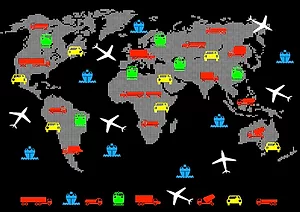
Challenge: With 19,000 employees and operations in the Americas, Asia-Pacific, Europe, Africa and Middle East, the company had nine different trade management systems and suffered from poor coordination and consistent policy implementation. They needed a truly global integrated import / export trade compliance solution to support our high volume transactions.
Resilinc Corp. has joined with the International Consortium for Organization Resilience (ICOR) to create a management course on supply-chain resiliency.
Ask any food industry executive to cite his or her greatest concern, and the answer will almost always be the same: product safety. But the list doesn't stop there. Like any other business sector, food manufacturers are grappling with a number of challenges, many of them related to the age of the internet and social media.
Nelson Cabrera, director of business development at Lilly and Associates, provides first-hand information on the operation of Panama's Colon Free Zone.
The many operational differences between domestic and international transportation has historically meant separate and distinct management of these two sectors. Research shows that today's shippers, however, believe there are efficiencies to be gained by managing both domains on a single platform.
As tainted-food scandals go, it wasn't so bad. The discovery early this year of unlabeled horse meat in European food products wasn't for the most part a safety issue. It was a violation of cultural norms, to be sure, as well as a truth-in-packaging problem. Most of all, it was a supply-chain failure.