• Advertise
  • Contact Us
  • Supplier Directory
  • SCB YouTube
  • About Us
  • Login
  • Subscribe
  • Logout
  • My Profile
  • LOGISTICS
    • Air Cargo
    • All Logistics
    • Facility Location Planning
    • Freight Forwarding/Customs Brokerage
    • Global Gateways
    • Global Logistics
    • Last Mile Delivery
    • Logistics Outsourcing
    • LTL/Truckload Services
    • Ocean Transportation
    • Parcel & Express
    • Rail & Intermodal
    • Reverse Logistics
    • Service Parts Management
    • Transportation & Distribution
  • TECHNOLOGY
    • All Technology
    • Artificial Intelligence
    • Cloud & On-Demand Systems
    • Data Management (Big Data/IoT/Blockchain)
    • ERP & Enterprise Systems
    • Forecasting & Demand Planning
    • Global Trade Management
    • Inventory Planning/ Optimization
    • Product Lifecycle Management
    • Robotics
    • Sales & Operations Planning
    • SC Finance & Revenue Management
    • SC Planning & Optimization
    • Supply Chain Visibility
    • Transportation Management
  • GENERAL SCM
    • Business Strategy Alignment
    • Customer Relationship Management
    • Education & Professional Development
    • Global Supply Chain Management
    • Global Trade & Economics
    • Green Energy
    • HR & Labor Management
    • Quality & Metrics
    • Regulation & Compliance
    • Sourcing/Procurement/SRM
    • SC Security & Risk Mgmt
    • Supply Chains in Crisis
    • Sustainability & Corporate Social Responsibility
  • WAREHOUSING
    • All Warehouse Services
    • Conveyors & Sortation
    • Lift Trucks & AGVs
    • Order Management & Fulfillment
    • Packaging
    • RFID, Barcode, Mobility & Voice
    • Warehouse Automation
    • Warehouse Management Systems
  • INDUSTRIES
    • Aerospace & Defense
    • Apparel
    • Automotive
    • Chemicals & Energy
    • Consumer Packaged Goods
    • E-Commerce/Omni-Channel
    • Food & Beverage
    • Healthcare
    • High-Tech/Electronics
    • Industrial Manufacturing
    • Pharmaceutical/Biotech
    • Retail
  • THINK TANK
  • WEBINARS
    • On-Demand Webinars
    • Upcoming Webinars
    • Webinar Library
  • PODCASTS
  • WHITEPAPERS
  • VIDEOS
Home » Blogs » Think Tank » The Potential Impact of a Carbon Levy on Shipping Costs

Think Tank
Think Tank RSS FeedRSS

The Potential Impact of a Carbon Levy on Shipping Costs

Hydrogen Fuel
An employee adjusts a valve on the cold box for liquid hydrogen (LH2) production. Photo: Bloomberg.
November 20, 2020
James Morgan and James Campbell, SCB Contributors

The year 2020 has been one of unexpected change for the maritime space. On Jan. 1, the International Maritime Organization (IMO) began enforcing a new regulation (IMO 2020) that caps the allowable sulfur content of all global fuel oil used in ships from its former level of 3.5% m/m (mass/mass) to 0.5% m/m.

The action led to a flood of traders chartering vessels for floating storage, and high volatility in charter prices. Between March and May of 2020, one-year very large crude carrier (VLCC) rates increased 100%. The spot rate was even more volatile, with the TD1 route (Arabian Gulf to U.S. Gulf Coast) seeing over a 500% increase.
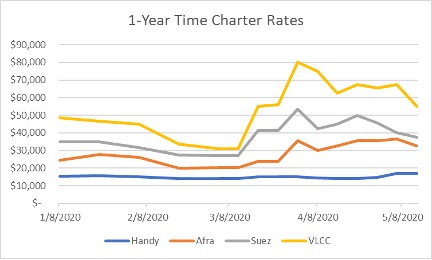
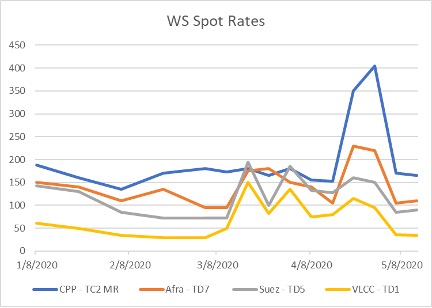
Morgan 1Morgan 2

(Source: Alibra Shipping Limited)

The most recent wave of change came in the form of a proposal to the IMO from Trafigura, introducing a carbon level of between $250 per metric ton and $300/mt of CO2 equivalent on shipping fuels. 

What would the impact of this proposal be to the oil industry if this carbon levy were instituted? According to Reuters, in 2018, the shipping industry was responsible for over 1 billion tons of CO2 emissions. Based on statistics from the United Nations Conference on Trade and Development, crude oil accounts for 17% of maritime cargo. This would imply that crude oil shipping is responsible for roughly 179,520,000 tons of CO2 emissions.

In 2018, 1.886 billion tons, or 13,824 million barrels (bbls) of crude oil, were transported via ship. Considering that the proposal has an undefined benchmark at which the levy would be applied, it’s not exact math, but even if only 20% were applied, a VLCC voyage would have cost up to $1.5 million more. Given today’s VLCC rates, a 30-day voyage only costs about $900,000 for freight only.


2018 Shipping Data

Total Emissions

1,056,000,000 tons

Crude Oil Share of Shipping

17%

Crude Oil Shipping Emissions

179,520,000 tons

Crude Oil Shipped (tons)

1,886,000,000 tons

Crude Oil Shipped (bbls)

13,824,380,000 bbls


Potential Impact

@ $250/ton

@ $300/ton

20% Levy Cost per BBL

$ 0.65

$ 0.78

VLCC Impact at 20%

$ 1,298,575

$ 1,558,290


(Source: Opportune LLP)

In 2019, there were about 7,400 crude oil tankers in use globally, of which only about 175 are LNG-fueled vessels (just under 2.5%). The Trafigura proposal would impact 97% of the oil tanker fleet, and give any owners or charters of LNG-fueled vessels a significant competitive advantage in the market. While these levies will be assessed to the ship owner, it’s all but certain that they will be passed along to any charterers. Ultimately, freight rates will be market driven, so this levy would be an additional hurdle for those owners using fuel with greater emissions. All of this results in increased cost to the end consumer.

Steering Toward Renewables

More energy companies are turning their focus to clean and renewable energy options. Companies like BP, Shell, and Total have invested close to $10 billion in renewable energy projects. While these investments have low initial returns, a proposal of a levy on high-carbon fuels, while providing subsidies for low-carbon fuels, may be a bit like Robin Hood — robbing from traditional fuel oils to pay for their replacements and ultimate demise. It’s also interesting to note that the company proposing the high-carbon fuel levy recently announced plans to invest $2 billion into renewable energy projects.

What Are the Options for Low-Carbon Fuels?

  • LNG: Liquified natural gas (LNG) is a proven and available commercial solution. In recent years, both Shell and ExxonMobil have invested in projects to provide LNG bunker fuels. There are currently more LNG-fueled ships under construction than there are in production, but it’s still a small percentage of total shipping capacity. While LNG has been hailed as the best fuel to meet the IMO 2020 regulations, there are concerns about how “green” LNG really is. 
  • Hydrogen: Shell recently published a report suggesting that liquid hydrogen was advantageous over other potential zero-emission fuels. 
  • Biofuel: In September, ExxonMobil completed a successful sea trial using marine biofuel oil. Both hydrogen and biofuel offer promise, but it hasn’t been as fully developed as LNG, so there’s still research to be done.

Regardless of the decision related to the carbon levy proposal, history has shown that the maritime industry will face new challenges each year. New regulatory changes will come, and with them a continued need for companies to be able to timely and accurately track and report their voyages, fuel usage and emissions. What will the next wave be?

James Morgan and James (Jay) Campbell are directors in the Process & Technology practice of Opportune LLP, a global energy business advisory firm.


Logistics Global Logistics Ocean Transportation Regulation & Compliance Sustainability & Corporate Social Responsibility Chemicals & Energy

RELATED CONTENT

RELATED VIDEOS

Subscribe to our Daily Newsletter!

Timely, incisive articles delivered directly to your inbox.

Featured Product

Popular Stories

  • 005_veteran_winemaker_gallo_embarks_on_an_ai_journey_v2-(540p).jpg

    Watch: Veteran Winemaker Gallo Embarks on an AI Journey

    Artificial Intelligence
  • SCB_Q326_Made4Net_Top5_THUMB.jpg

    Five Costly WMS Selection Mistakes Warehouse Leaders Keep Making

    Logistics
  • A UNIFORMED OFFICER STANDS NEAR A HIGHWAY WITH TRUCKS ON IT

    U.S. Customs Ramps Up AI Investment in Push to Sharpen Enforcement

    Artificial Intelligence
  • A MAP OF THE STRAIT OF HORMUZ SHOWING DOZENS OF BLUE DOTS DISTRIBUTED THROUGHOUT THE WATERWAY

    Traffic Flows Through Hormuz Despite Shock Ship Attack

    Global Gateways
  • On Demand Webinar 4flow Thu Jun 25 2026.png

    How Mars uses 4flow's AI platform for Logistics optimization

    Webinars

Digital Edition

2026 esg cover main scb q2 2026 cover

SupplyChainBrain 2026 ESG Guide: ESG — The Supply Chain’s Biggest Secret

VIEW THE LATEST ISSUE

Case Studies

  • Recycled Tagging Fasteners: Small Changes Make a Big Impact

  • A GRAPHIC SHOWING MULTIPLE FORMS OF SHIPPING, WITH A HUMAN STANDING AT THE CENTER, TOUCHING A SYMBOLIC MAP OF THE WORLD

    Enhancing High-Value Electronics Shipment Security with Tive's Real-Time Tracking

  • A GRAPHIC OF INTERLACING HONEYCOMBED ELEMENTS REPRESENTING GLOBAL BUSINESS TRANSACTIONS

    Moving Robots Site-to-Site

  • JLL Finds Perfect Warehouse Location, Leading to $15M Grant for Startup

  • Robots Speed Fulfillment to Help Apparel Company Scale for Growth

Visit Our Sponsors

4flow Arkieva Blue Yonder
Carton Cloud CoEnterprise Dassault
Duravant E2Open EPG
General Logistics Systems GEP Hy-Tek
iGPS Korber Lyngsoe
Procurability Quinyx SAP
Sikick Staples Systech
S&P Global Mobility TADA Tive
TransImpact US Bank Werner Enterprises
WSI
  • More From SCB
    • Featured Content
    • Video Library
    • Think Tank Blog
    • SupplyChainBrain Podcast
    • Whitepapers
    • On-Demand Webinars
    • Upcoming Webinars
  • Digital Offerings
    • Digital Issue
    • Subscribe
    • Manage Email Preferences
    • Newsletters
  • Resources
    • Events Calendar
    • 2026 Event Coverage
    • SCB's Great Supply Chain Partners
    • Supplier Directory
    • Case Study Showcase
    • Supply Chain Innovation Awards
    • 100 Great Partners Form
  • SCB Corporate
    • Advertise on SCB.COM
    • About Us
    • Privacy Policy
    • Contact Us
    • Data Sharing Opt-Out

All content copyright ©2026 Keller International Publishing Corp All rights reserved. No reproduction, transmission or display is permitted without the written permissions of Keller International Publishing Corp

Design, CMS, Hosting & Web Development :: ePublishing