
Fake-Meat Startups Rake in Cash Amid Food Supply Worries
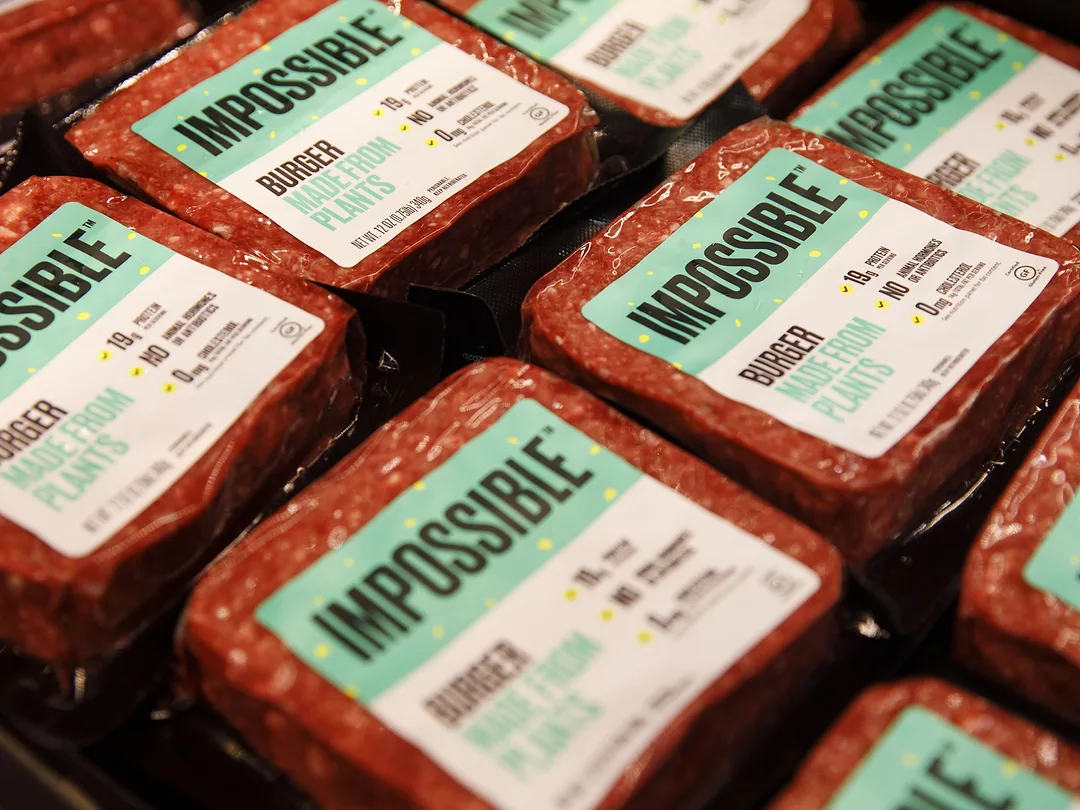
With meat-processing workers falling victim to the coronavirus, shuttering plants and slowing supply, Americans are starting to see poorly stocked aisles where once beef and pork were plentiful. At the same time, the link between industrial meat production and deadly human viruses has become more widely understood.
The global crisis, in other words, is turning into a big opportunity for the plant-based protein sector.
Beyond Meat, one of the bigger names in food technology, saw its shares jump 49% last month. Meanwhile, venture capitalists have been pouring money into smaller companies, some focused on lab-grown meat analogues as well as plant-based substitutes. In mid-April, U.S. sales of these products were double that of the same period last year.
“The thesis of alternative proteins is strengthened by COVID-19,” said private equity veteran Jeremy Coller, a longtime vegan. “We see this as a massively growing and important sector.” Coller, founder of Coller Capital, formed asset manager collaborative FAIRR to push companies toward greater food sustainability because of the risks — so clearly illustrated by the current recession — to the global financial system. Its members currently manage $20.4 trillion.
The annual retail food market grew only 2.2% in 2019, according to industry trade groups. By comparison, plant-based foods were up 11.4%, as estimated by the Plant Based Foods Association. Plant-based meats saw 18% retail growth, with refrigerated versions like Impossible Foods burgers, Beyond Meat sausages and Tofurkey deli slices making up the majority of the increase.
The big meat processors — Tyson, Smithfield, Hormel Foods — were already investing in plant-based alternatives when the pandemic arrived. Even as the Trump administration tries to keep traditional U.S. meat plants open, the pandemic is providing a tremendous boost to consumer interest in alternative products.
In Europe, Barcelona-based Novameat is moving quickly to capitalize on the moment. It uses tissue engineering and bio-printing technologies to produce meat alternatives. Founder and CEO Giuseppe Scionti said his company recently pivoted to developing pork substitutes, given supply issues in the U.S. and Brazil. We “wanted to demonstrate that our technology is highly adaptable to work with a variety of ingredients, to mimic different types of plant-based meats,” he said. With pork texture and appearance already sorted, Scionti said he expects “to have the taste hacked before this summer.”
But nowhere is the potential for meat alternatives more significant than in China, the starting point of the pandemic. It has seen its food supply hit by all manner of viruses, most recently African swine fever, an epidemic that decimated commercial hog farms starting in 2018. China feeds 20% of the world’s population on just 7% of the world’s farmland.
“Food security is an issue that is top of mind for the Chinese government,” said Bruce Friedrich, executive director of the Good Food Institute, a nonprofit that promotes meat, dairy and egg alternatives.
In China, plant-based dairy has long been a staple, along with the basic protein alternatives like tofu, but it’s been slower to innovate in the faux or cell-based meat space. However, in a post-coronavirus world, China could move more swiftly on this front, and U.S. companies may be the ones helping propel it. In February, PepsiCo acquired Baicaowei, a Chinese snack company that launched a plant-based sausage made from soy and konjac, for $705 million.
“Our investment activities haven’t slowed down” because of the pandemic, said Matilda Ho, founder and managing director of Bits x Bites, a food-tech venture capital firm in Shanghai. “We believe this recent uncertainty might just be a pivotal moment for the still nascent food-tech sector in China.”
Vectr Ventures, a Hong Kong-based early venture fund, took co-lead on Plantible Foods $4.6 million seed round, which closed late March. Vectr partner Alan Chan said his $1.6 million investment in the San Diego-based startup was a way to “focus on Asia’s population growth, urban migration and food,” all weighty issues made more urgent by the pandemic.
“There has to be an efficient utilization of things we can grow to feed everyone,” Chan said.
Plantible is part of a new generation of U.S. companies jumping into this space. It began raising funds in December to grow lemna, or duckweed — a small, aqueous plant that’s almost 45% protein and regenerates its biomass every 48 hours. The final product is a flavorless protein that could eventually star in your next burger, as a dairy alternative or egg white substitute. When scaled, said co-founder Tony Martens, it could enable a continuous production process that makes its supply chain “climate-change proof.”
Chris Kerr of New Crop Capital, a fund which focuses on replacing animals in the food system, recently invested in Starfield, a Chinese developer of plant-based proteins. He calls plant-based foods “a mega trend that will not go away.” But still, he remains cautious about which food tech companies should be funded. “The biggest risk is funding a bridge to nowhere,” he said.
There are other investors who are holding back. Leah Volger, principal at early-stage venture capital fund Manta Ray, said she doesn’t “necessarily see a shift in our strategy.” Nonetheless, Manta Ray has invested in Berkeley, California-based Climax Foods, founded by Oliver Zahn, an astrophysicist who worked for both Impossible Foods and Google. Zahn plans to use computer science to comb through the plant kingdom looking for better, cheaper food combinations.
Several other food-tech companies have been successful in raising money during the first quarter. They include Seattle-based Rebellyous Foods, which in March raised $6 million in a funding round led by Fifty Years, a San Francisco-based seed fund. Rebellyous currently makes plant-based chicken nuggets as proof-of-concept for what it touts as a cheaper, more efficient manufacturing process.
Live Kindly, a collective of food-based brands, closed a venture round for $200 million in March. And Israel-based InnovoPro, a maker of chickpea protein, raised $15 million in a recent series B.
In the long run, said Fifty Years founding partner Seth Bannon, the pandemic “will cause way more capital to flow into the space, as the world wakes up to the very real threat of zoonotic diseases.”
Popular Stories





100 Great Supply Chain Partners 2026: The Secret to Supply Chain Success
VIEW THE LATEST ISSUECase Studies


Visit Our Sponsors |
|
|
|
|
|
|
|
|
|
|
|
|
|
|
|
|
|
|
|
|
|
|
|
|
|
|
|
|
|
|
|
|
|
|
|
|
|
|
|
|
|
|
|
|
|
|
|
|
|
|
|