
AI Boom Has European Buyers Paying Extra to Secure Gas Turbines
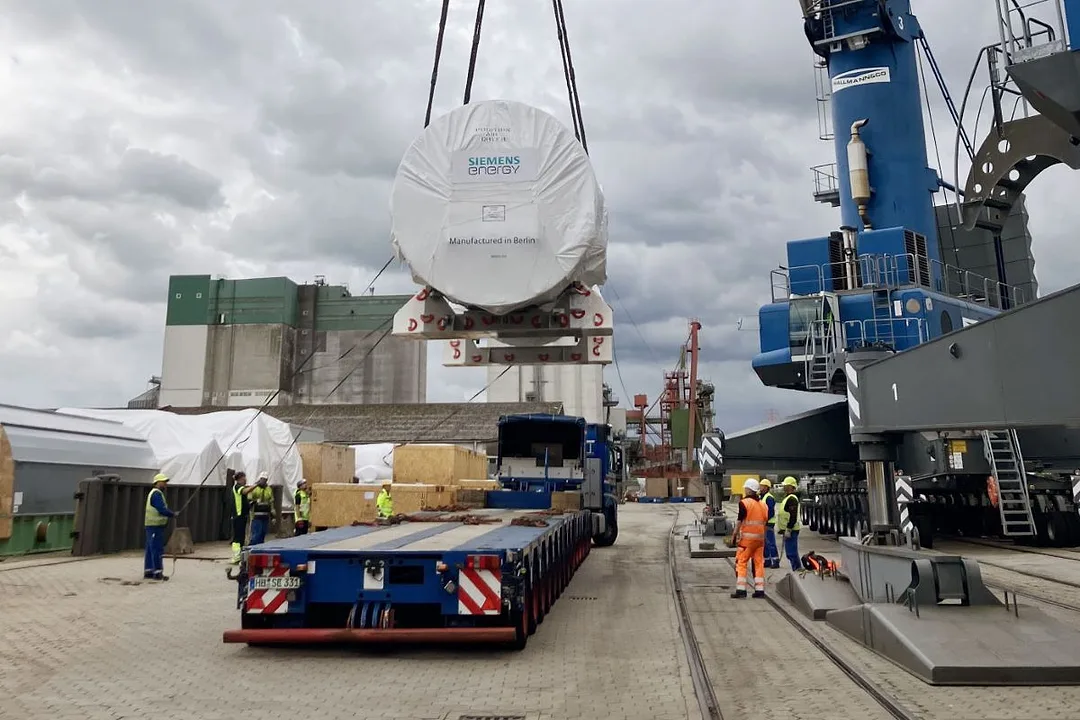
A Siemens Energy gas turbine being loaded onto a truck in Hamburg for further delivery. Photographer: Marilen Martin/Bloomberg
Europe’s race to secure power for data centers and electrification projects is becoming so intense that customers are now paying to secure a spot in production queues for gas turbines, according to Siemens Energy AG.
“Demand is now so high that customers in Europe are willing to pay reservation fees,” Chief Executive Officer Christian Bruch told reporters. The company is one of the world’s three dominant manufacturers of gas turbines, alongside GE Vernova Inc. and Mitsubishi Power Ltd.
The practice first emerged in the U.S. in recent years as technology companies rushed to secure generation capacity for energy-hungry data centers, and has since spread to Europe and the Middle East. Since data centers in Europe face long wait times to be connected to the power grid, some are considering building their own power generation as a quicker option to begin operations.
Customers seeking to reserve manufacturing slots for about six months typically pay between 10% and 15% of a turbine’s purchase price, according to the head of Siemens Energy’s gas services unit Karim Amin. It can take several months or even years for production to be completed.
With turbine manufacturers largely booked through the end of the decade, those payments have become a way for buyers with urgent projects to secure a place in the queue. Siemens Energy’s conversion rate is above 90%, meaning most reservations eventually are turned into contracts.
The squeeze is increasingly relevant for countries that need gas-fired plants to back up power grids which rely more heavily on intermittent renewables. In Germany, the government plans to start holding long-delayed auctions as of September to support the construction of 9 gigawatts of new gas-fired plants. The economy ministry’s draft law governing those tenders is set to be discussed in parliament late on June 11.
Siemens Energy is in talks with several prospective bidders for those auctions. The company declined to specify how much the costs of medium-large gas turbines have risen in recent years.
Siemens Energy could have allocated more of its manufacturing capacity to data-center customers willing to pay more to speed up delivery, but the company says it deliberately held back capacity for utilities and national power programs to avoid becoming too dependent on one source of demand.
“No business grows all the time,” said Amin. “The most important thing for us is that we are managing our capacity to fulfill this demand, and we are creating the service business that will stay with us.”
Data centers currently account for about 25% of Siemens Energy’s turbine demand, while roughly 60% comes from conventional applications such as utilities. The company wants to keep that balance, and is looking to ensure that current orders continue generating revenues for decades. Its roughly 87 gigawatt of recent orders should generate about €35 billion ($40.3 billion) in service business over more than 20 years, according to Amin.
Popular Stories




100 Great Supply Chain Partners 2026: The Secret to Supply Chain Success
VIEW THE LATEST ISSUECase Studies


Visit Our Sponsors |
|
|
|
|
|
|
|
|
|
|
|
|
|
|
|
|
|
|
|
|
|
|
|
|
|
|
|
|
|
|
|
|
|
|
|
|
|
|
|
|
|
|
|
|
|
|
|
|
|
|
|