
Rail Workers Angry Over Schedules Are Voting on Polarizing Deal to Avoid Strike
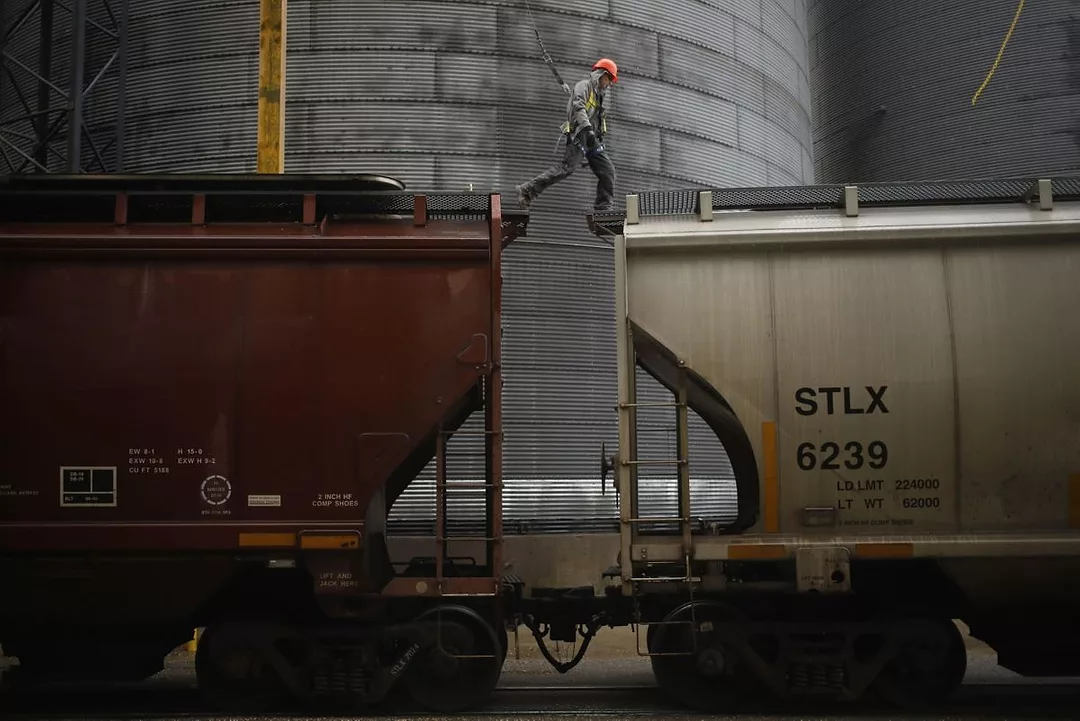
A worker walks across the top of a railroad grain hopper car at the Kokomo Grain Co. Inc. transloading facility in Edinburgh, Indiana. Photo: Bloomberg
Working on the railroad means never knowing when you’ll have time off. That’s the main grievance of workers who are poised to cast their votes in a pivotal test of a White House-brokered labor deal.
While the tentative agreement forces U.S. railroads to address scheduling rules for the first time, angry conductors and engineers say it doesn’t go far enough, jeopardizing the pact that Labor Secretary Marty Walsh helped negotiate in September. A no-vote by the two largest rail unions on November 20 could lead to a crippling rail walkout in early December unless Congress steps in.
In addition to rules about their schedules, the 115,000 employees, represented by 12 unions across more than 30 railroads, are also upset about working short-handed during the pandemic with wages frozen at 2019 levels. Railroaders also resented management attempts to raise employee costs for health benefits and reduce train crews to one person from two.
“It’s a contentious time between the employees and the railroads. The anger is palpable,” said Dennis Pierce, national president of the engineers union, in an interview. “We’ve been trying to improve some of the quality-of-life issues.”
A no-vote by either the unit of the Sheet Metal, Air, Rail and Transportation Workers that represents the conductors and yardmasters or the Brotherhood of Locomotive Engineers and Trainmen may force Congress to intervene to avoid a rail shutdown that would snarl the supply chain during the busy December holidays.
Results of the ratification votes are expected to be announced on November 21. Those two unions make up about half of the rail workers.
Three smaller unions, which make up about a quarter of the rail workers, already have voted against ratification, while seven have adopted the contract. If the engineers and conductors approve the pact as most of the other unions have already done, that may be enough to precipitate a negotiated resolution for the three that rejected it. If the three still hold out, they could trigger a walkout.
If a strike does occur, depending on which scenario unfolded, it could come sometime between December 4 and December 9. The railroads likely will begin limiting rail traffic as much as a week before a strike date to ensure there’s no stranded cargo left on the tracks.
Work-Life Balance
Rail work wasn’t immune to the demand for a better work-life balance that swept across the nation during the pandemic.
Railroads, including CSX Corp. and Union Pacific Corp., were surprised when they struggled to rehire workers in the summer of 2020 after letting them go during the initial sharp downturn in April that year. They also found it difficult to recruit new conductors and engineers. People were no longer willing to work without definitive days off.
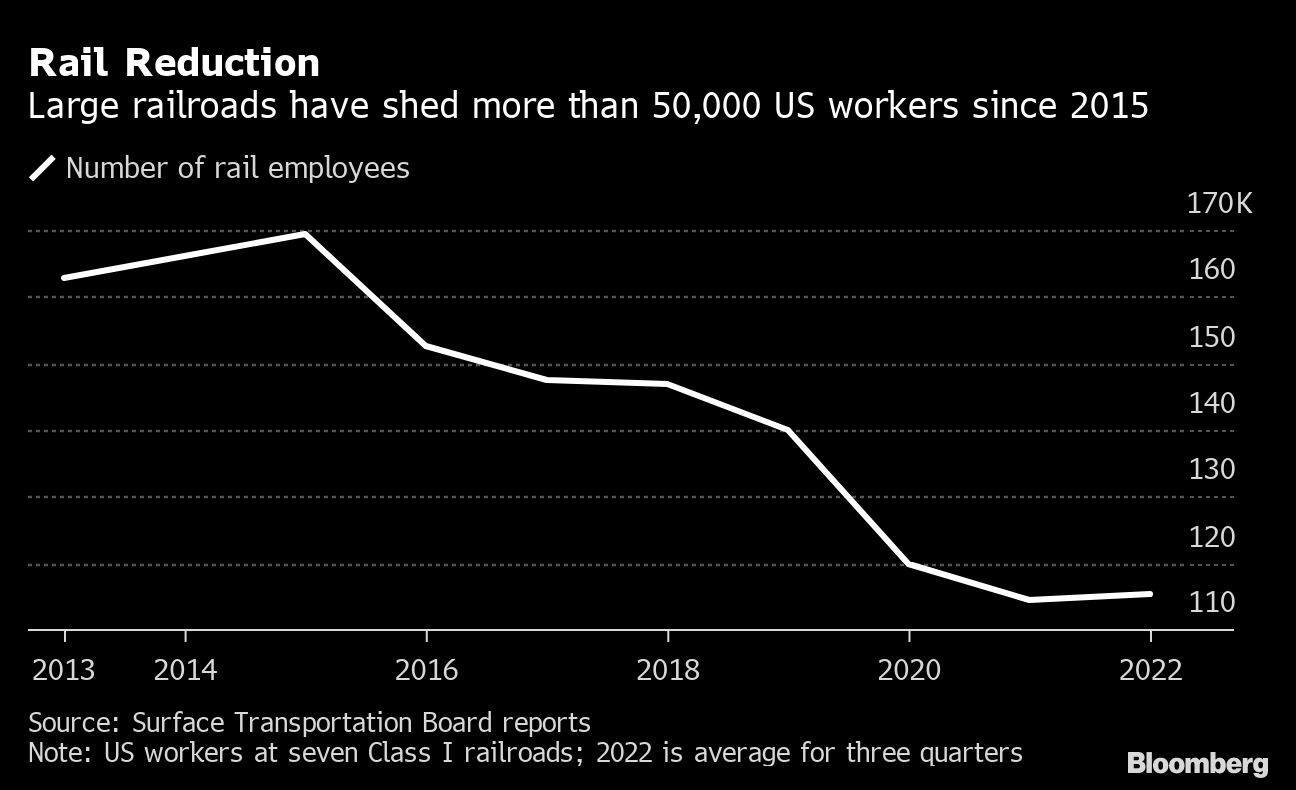
Rail service suffered from a lack of crews. Those who remained on the job were being asked to work extra to make up for the shortfall, pouring salt into the wound after the seven large railroads had shrunk their U.S. workforces by more than 50,000 people since 2015 to reduce costs.
The conventional wisdom had always been that, when a railroad furloughs workers, 90% would return to the job if they were called up within six months, CSX Chief Financial Officer Sean Pelkey said in a November 9 presentation at a Baird industrial conference. The jobs, after all, are well-paid with engineers making just north of $100,000 and yard workers taking home more than $70,000 plus good health and pension benefits.
That’s not how it worked out. In 2020, only about 50% decided to return to work, he said.
Avoiding Furloughs
That new dynamic, where even six-figure jobs can’t draw people back to work, is going to make railroads think twice before letting go of workers even temporarily. “The first lever is not going to be furlough,” Pelkey said.
CSX would likely slow down hiring during future business slumps and let attrition whittle the workforce, Pelkey said. Conductors could be moved into engineer training, which takes about six months, to occupy them while riding out any drop in freight demand, he said.
The railroads are also experimenting with providing schedules that would give workers definite days off. About 60% of Union Pacific’s train, engineer and yard workers don’t have scheduled days off. A pilot program in Kansas that began November 1 could change that. The experimental schedule provides 11 days on and four days off, giving conductors and engineers fixed dates for their time off during each 15-day period.
“We hope to gain a better understanding of how to best implement a work-rest balance more broadly throughout our system, while acknowledging there may not be a one-size-fits-all approach,” Kristen South, a Union Pacific spokeswoman, said in an e-mail response to questions. “We are working closely with union leaders on this project, which is in its infancy.”
The Breakthrough
While the labor agreement negotiated in September didn’t provide a direct decision on scheduled days off, it at least set a pathway for union locals to negotiate such deals, backed by the prospect of binding arbitration.
That’s a first for the unions, Pierce said. Under the agreement, the railroads also can negotiate automated scheduling and worker pools, with arbitration as a backstop.
If the railroads and unions can’t agree on scheduling proposals, the issue will go to a binding three-person arbitration panel in which each side choses an arbitrator and a third is picked by mutual agreement.
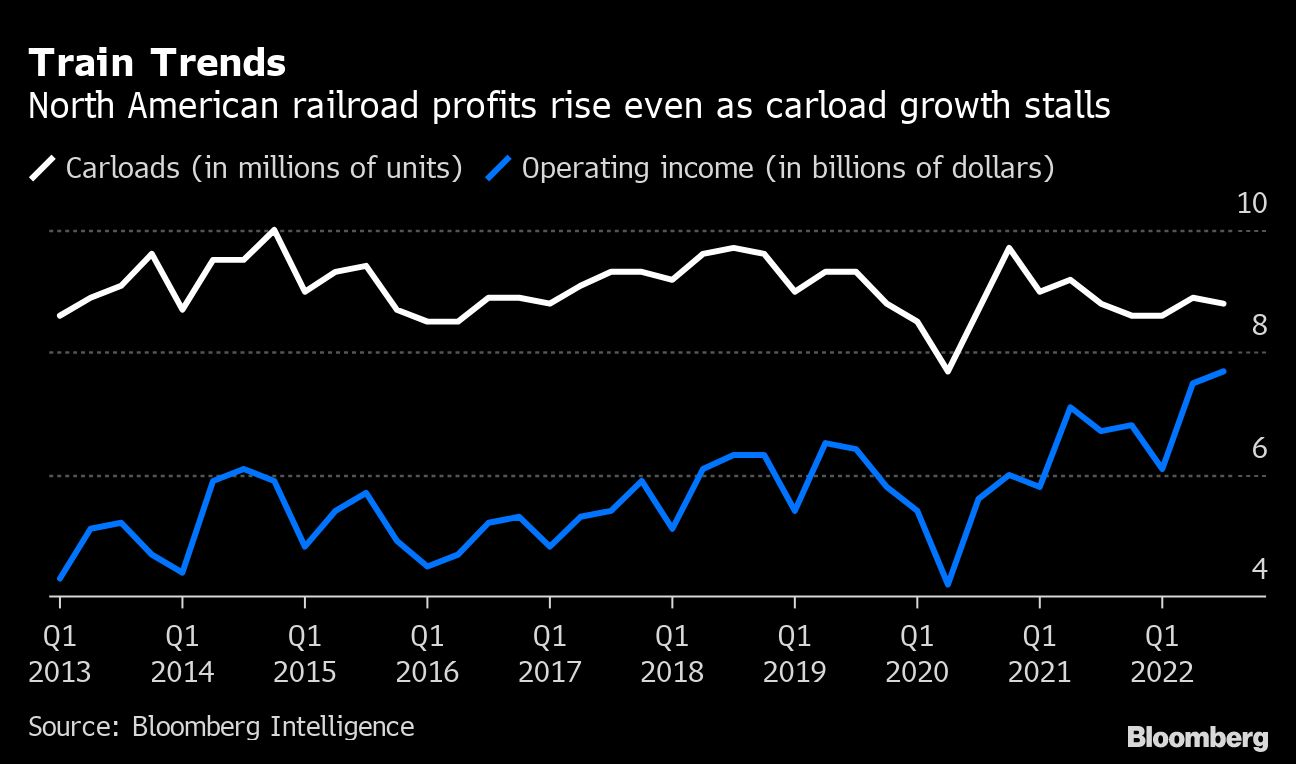
The labor agreement also gives workers a 24% raise over five years and bonuses totaling $5,000 while adding one day a year of personal leave. The dispute, though, is less about the money than work rules.
Any strike would likely be short-lived. Under the Railroad Labor Act, Congress has the option of intervening to either extend the talks or to impose a solution, probably based on the agreement brokered by the labor secretary in September.
Instead of coming out in favor or against the agreement, union leaders are laying out all the facts and letting the membership decide, Pierce said. Getting the railroads to negotiate work rules is an achievement, he said.
“We’re never going to fix it all overnight, but we’ve got to start somewhere,” Pierce said. “If it fails, it’ll be because of the anger that the employees have for the employer.”
Popular Stories





100 Great Supply Chain Partners 2026: The Secret to Supply Chain Success
VIEW THE LATEST ISSUECase Studies


Visit Our Sponsors |
|
|
|
|
|
|
|
|
|
|
|
|
|
|
|
|
|
|
|
|
|
|
|
|
|
|
|
|
|
|
|
|
|
|
|
|
|
|
|
|
|
|
|
|
|
|
|
|
|
|
|