• Advertise
  • Contact Us
  • Supplier Directory
  • SCB YouTube
  • About Us
  • Login
  • Subscribe
  • Logout
  • My Profile
  • LOGISTICS
    • Air Cargo
    • All Logistics
    • Facility Location Planning
    • Freight Forwarding/Customs Brokerage
    • Global Gateways
    • Global Logistics
    • Last Mile Delivery
    • Logistics Outsourcing
    • LTL/Truckload Services
    • Ocean Transportation
    • Parcel & Express
    • Rail & Intermodal
    • Reverse Logistics
    • Service Parts Management
    • Transportation & Distribution
  • TECHNOLOGY
    • All Technology
    • Artificial Intelligence
    • Cloud & On-Demand Systems
    • Data Management (Big Data/IoT/Blockchain)
    • ERP & Enterprise Systems
    • Forecasting & Demand Planning
    • Global Trade Management
    • Inventory Planning/ Optimization
    • Product Lifecycle Management
    • Robotics
    • Sales & Operations Planning
    • SC Finance & Revenue Management
    • SC Planning & Optimization
    • Supply Chain Visibility
    • Transportation Management
  • GENERAL SCM
    • Business Strategy Alignment
    • Customer Relationship Management
    • Education & Professional Development
    • Global Supply Chain Management
    • Global Trade & Economics
    • Green Energy
    • HR & Labor Management
    • Quality & Metrics
    • Regulation & Compliance
    • Sourcing/Procurement/SRM
    • SC Security & Risk Mgmt
    • Supply Chains in Crisis
    • Sustainability & Corporate Social Responsibility
  • WAREHOUSING
    • All Warehouse Services
    • Conveyors & Sortation
    • Lift Trucks & AGVs
    • Order Management & Fulfillment
    • Packaging
    • RFID, Barcode, Mobility & Voice
    • Warehouse Automation
    • Warehouse Management Systems
  • INDUSTRIES
    • Aerospace & Defense
    • Apparel
    • Automotive
    • Chemicals & Energy
    • Consumer Packaged Goods
    • E-Commerce/Omni-Channel
    • Food & Beverage
    • Healthcare
    • High-Tech/Electronics
    • Industrial Manufacturing
    • Pharmaceutical/Biotech
    • Retail
  • THINK TANK
  • WEBINARS
    • On-Demand Webinars
    • Upcoming Webinars
    • Webinar Library
  • PODCASTS
  • WHITEPAPERS
  • VIDEOS
Home » Big Food Brands Struggling to Kick Junk Addiction, Survey Finds

Big Food Brands Struggling to Kick Junk Addiction, Survey Finds

A BORED LOOKING CHILD LIFTS A SPOON OF SUGAR CUBES TO HIS MOUTH, FROM A HUGE BOWL OF SUGAR CUBES

Photo: iStock.com/ClarkandCompany

March 6, 2023
Bloomberg

The bulk of food and drinks sold by four out of five global producers across three major markets are unhealthy, according to a survey, with Kraft Heinz Co. coming out worst.

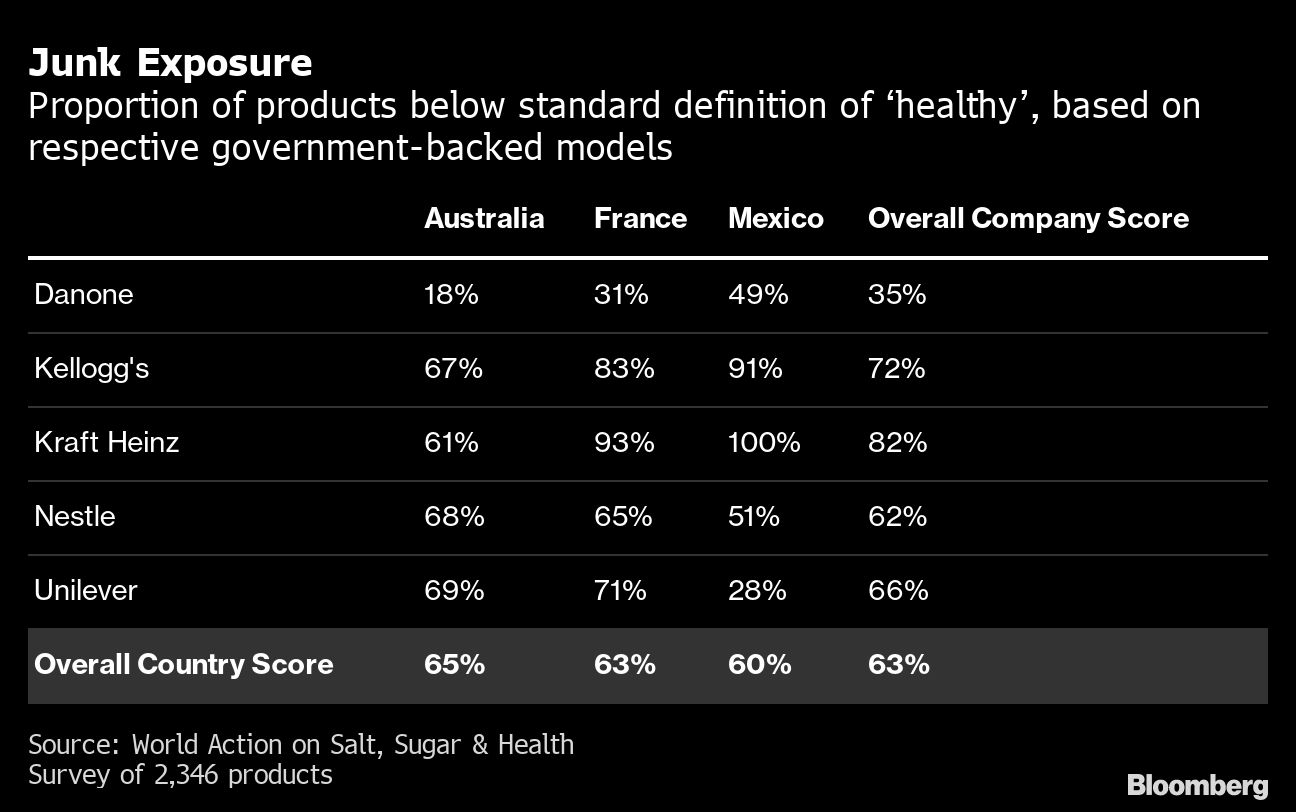
The analysis conducted by the World Action on Salt, Sugar & Health, an NGO, selected 2,346 products sold by Danone, Kellogg Co., Kraft Heinz, Nestlé SA and Unilever Plc in Australia, France and Mexico. It ranked them on the basis of the most widely used standards — Health Star Rating, Nutri-Score and Warning Labels. Apart from Danone, all others sold a greater proportion of unhealthy food.

“Improving the nutritional content of food and drink by reformulating recipes with less salt, sugar and saturated fat is by far the most important strategy that any company should make to improve public health,” Mhairi Brown, policy and public affairs lead with WASSH, said in a statement. “However, by relying solely on industry’s willingness and without government enforcement, we are unlikely to see a meaningful shift.”
JUNK FOOD MARCH 2023.png
Producers are under pressure to make their portfolios healthier because obesity is already a public health crisis in countries like the U.S., and on the rise in the developing world. The worldwide economic impact of excess body weight will more than double to $4.27 trillion in 2035 from 2020 levels, as prevalence of the condition continues to rise, according to a report funded by pharmaceutical company Novo Nordisk. It sells anti-obesity drug Wegovy.

Read more: Eli Lilly Plans Manufacturing Expansion as Obesity Drug Demand Soars

Reducing the salt and sugar content of their foods could also insulate company revenues from laws restricting the sale and marketing of junk food. A greater emphasis on environmental, social and governance among investors is an added motivation for making portfolios healthier.

Four-fifths of Kraft Heinz products didn’t meet health standards across the three markets, with its entire sample in Mexico failing to make the grade. Some 72% of the products surveyed that were made by Kellogg’s didn’t meet the health criteria. The Crunchy Nut Cheerios maker last year failed to legally challenge regulations that would ban it from advertising its sugary cereals in the U.K.

Activia yogurt maker Danone bucked the trend. Only 35% of products scored below the standard definitions of healthy. Earlier this week, it promised that at least 90% of products by volume of sales in the U.K. and Ireland will not be high in sugar, salt or fat, as defined by the government policy. 

A Unilever spokesperson said the company is committed to giving consumers healthier choices and termed the findings of the survey incomplete and misleading as they were based on a small subset of their portfolio. Kraft Heinz is committed to reducing sugar and salt in its products, while noting that there isn’t a globally aligned model yet for judging how healthy food items are, according to its spokesperson. 

Kellogg spokesperson Kris Bahner said the cereal maker was continuing to make its portfolio more nutritious. A Nestle spokesperson declined to comment.

The selection of products was based on the lines mentioned on companies’ country websites and major retailers, the report said.

Groups like ShareAction, an investor campaign group which supported the research, have been calling on companies to be more transparent about the healthiness of their portfolios to help investors scrutinize their offerings and evaluate the threat of potential anti-junk-food legislation on sales.

Danone and Unilever report on their portfolios content according to government-approved nutrition models while Nestlé committed to the same in its 2022 annual report, but the others are yet to follow suit, making it harder to get a full picture for comparison. 

“Food manufacturers must be more transparent and disclose what proportion of their sales can be classed as ‘healthier’,” Holly Gabriel, a campaigner at ShareAction said. “This disclosure must be followed with meaningful targets to grow the proportion of sales coming from healthier food and drink.”

    RELATED CONTENT

    RELATED VIDEOS

    Sustainability & Corporate Social Responsibility Food & Beverage
    • Related Articles

      Most 'Customer Experience' Officers Haven't Used Big Data to Improve Strategy, Survey Finds

      Traceability a Priority for Food Service Execs, But Cost-Cutting Tops Corporate Agendas, Survey Finds

      Methods to Enhance Customer Experience Is Continuing Focus of Retailers, Survey Finds

    Bloomberg

    Airbus Delays XLR Deliveries to IndiGo as War Hits Suppliers

    More from this author

    Subscribe to our Daily Newsletter!

    Timely, incisive articles delivered directly to your inbox.

    Featured Product

    Popular Stories

    • A TRUCK WITH ITS CONTAINER DOOR OPEN SITS UNDER A SIGN THAT READS INTERNATIONAL BORDER COMMERCIAL TRUCKS

      Importers Into Mexico Can No Longer Delay Complying With New Customs Declaration Law

      Data Management (Big Data/IoT/Blockchain)
    • 018_how_3pls_can_get_started_with_ai_v1-(540p).png

      Watch: How 3PLs Can Get Started With Automation

      Logistics Outsourcing
    • An employee in a warm suit crouches down to get boxes of food ready for shipping at a warehouse

      Packaging Optimization Is Boosting Cold Chain Growth

      Air Cargo
    • A FIGURE IN CAMOUFLAGE LOOKS THROUGH A SCOPING DEVICE AT A SHIP IN THE DISTANCE, BELCHING SMOKE

      Strait of Hormuz Ship Transits Are Rising Thanks to U.S. Help

      Global Gateways
    • Heat Haze Distorts Video of Semi-Trucks Driving Down an Interstate Surrounded by Mountains on a Sunny Day

      The Biggest Challenges Facing Logistics Operators This Summer

      Logistics

    Digital Edition

    2026 esg cover main scb q2 2026 cover

    SupplyChainBrain 2026 ESG Guide: ESG — The Supply Chain’s Biggest Secret

    VIEW THE LATEST ISSUE

    Case Studies

    • Recycled Tagging Fasteners: Small Changes Make a Big Impact

    • A GRAPHIC SHOWING MULTIPLE FORMS OF SHIPPING, WITH A HUMAN STANDING AT THE CENTER, TOUCHING A SYMBOLIC MAP OF THE WORLD

      Enhancing High-Value Electronics Shipment Security with Tive's Real-Time Tracking

    • A GRAPHIC OF INTERLACING HONEYCOMBED ELEMENTS REPRESENTING GLOBAL BUSINESS TRANSACTIONS

      Moving Robots Site-to-Site

    • JLL Finds Perfect Warehouse Location, Leading to $15M Grant for Startup

    • Robots Speed Fulfillment to Help Apparel Company Scale for Growth

    Visit Our Sponsors

    4flow Arkieva Blue Yonder
    Carton Cloud CoEnterprise Dassault
    Duravant E2Open General Logistics Systems
    Hy-Tek iGPS Korber
    Lyngsoe Procurability Quinyx
    SAP Sikick Systech
    S&P Global Mobility TADA TransImpact
    US Bank Werner Enterprises WSI
    • More From SCB
      • Featured Content
      • Video Library
      • Think Tank Blog
      • SupplyChainBrain Podcast
      • Whitepapers
      • On-Demand Webinars
      • Upcoming Webinars
    • Digital Offerings
      • Digital Issue
      • Subscribe
      • Manage Email Preferences
      • Newsletters
    • Resources
      • Events Calendar
      • 2026 Event Coverage
      • SCB's Great Supply Chain Partners
      • Supplier Directory
      • Case Study Showcase
      • Supply Chain Innovation Awards
      • 100 Great Partners Form
    • SCB Corporate
      • Advertise on SCB.COM
      • About Us
      • Privacy Policy
      • Contact Us
      • Data Sharing Opt-Out

    All content copyright ©2026 Keller International Publishing Corp All rights reserved. No reproduction, transmission or display is permitted without the written permissions of Keller International Publishing Corp

    Design, CMS, Hosting & Web Development :: ePublishing