.webp?height=100&t=1784121195&width=150 "018_what's_holding_back_ai_initiatives-_v1-(540p).png")
SCB FEATURE
Eradicating Slave Labor Starts with a More Transparent Supply Chain
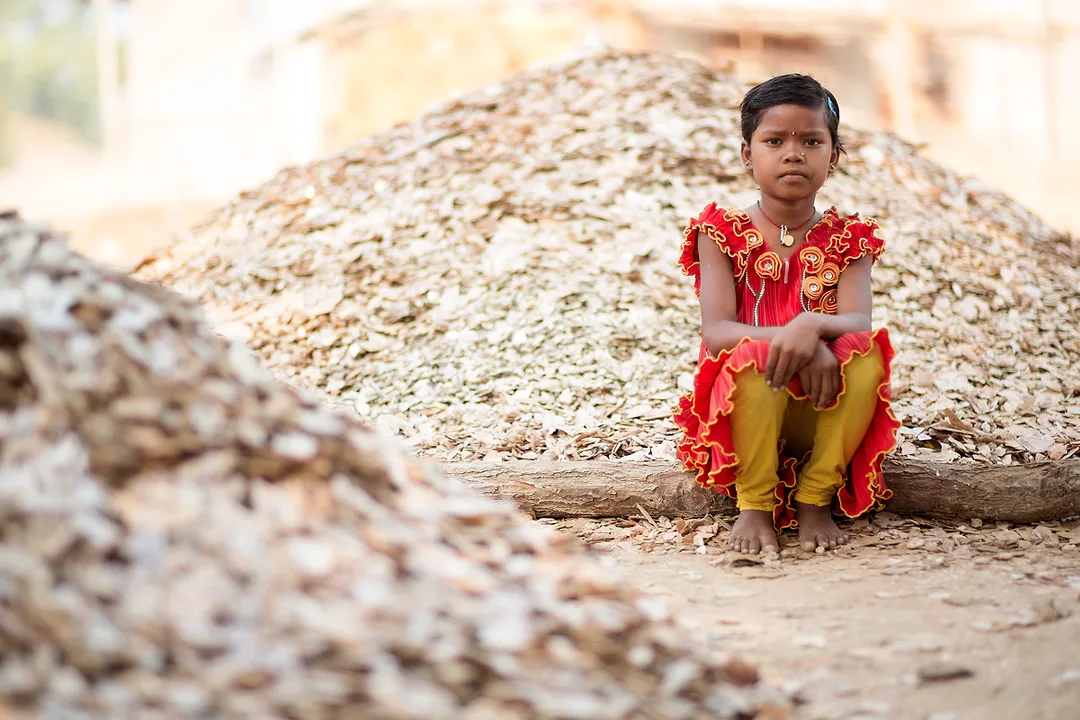
Young girl mining mica in Jharkhand, India. Child labor is widely used in the collection of mica used in cosmetics such as eye shadow. Photo: Michael Duffy, copyright FRDM.
How many slaves work for you? For most, that sounds like a crazy question — the answer would appear to be none. But a visit to SlaveryFootPrint.org reveals, with deceptively friendly graphics, how much slave labor has been involved in making the products and services you consume, depending on your demographics and lifestyle.
Justin Dillon set up the site at the invitation of the Obama administration, back in 2012, and he’s impressed with the progress made in ten years. The site not only raised consumer-level awareness of the darker side of globalization; it was also part of a push for government action, which in turn has led to better practices by businesses.
“In this particular change, consumers showed up first, which is the fuel for politics and for governments to act. And then government causes businesses to act,” says Dillon, CEO & Founder of FRDM, a software company that offers to find and fix risks in supply chains.
People power alone is not enough, however. “I think consumers have done their bit and continue to do so. But what they want they can’t have right now. And that is transparent supply chains. They want to know you’re not using children going into mines in Congo, or families being thrown into boats to go fishing for shrimp and never see land.”
Until recently, Dillon says, most companies simply haven’t been interested in offering that type of transparency. Now, they are beginning to realize the urgent need to do so. Legislation has helped, including the Uyghur Forced Labor Prevention Act (UFLPA), passed in December 2021 in the U.S., and the Regulation proposed by the European Commission in September 2022, that would prohibit products made with forced labor from being imported into or exported from the European Union, or otherwise made available on the EU market. Seven of the eight G7 countries have also passed regulations requiring companies to address forced labor in their supply chains, with similar laws pending in other countries. Technology, also, offers tools to do what before seemed impossibly daunting — dig into the layers upon layers of suppliers in a typical supply chain.
“I realized the supply chain is how you fix this — not governments, not laws. And we went to big companies and asked how far back they could see, and it was… nothing. There was no desire for transparency,” says Dillon. Consulting firm Deloitte found as recently as 2018 that fewer than 6% of companies had visibility into their supply chain beyond tier one suppliers.
Now, Dillon says, companies are realizing that there is a solid business case for mapping their supply chains. “And, by the way, it’s not just for forced labor. It’s emissions. It’s China plus one [the business strategy to avoid investing only in China]. And so on. The business case for understanding what’s going on in the supply chain is a board-level issue,” he says. Further, activist investors like those at a recent Volkswagen shareholder meeting have begun calling for companies to clean up their supply chains to avoid human rights abuses.
The bite is already being felt. Almost $1.4 billion worth of goods with suspected ties to slave labor were seized at the U.S. border between June 1, 2022, and July 6, 2023, based on the UFLPA. FRDM says those seizures are expected to at least double over the next 12 months.
“CBP is just getting started, and it has huge political support, so they’re feeling ten feet tall and bullet proof, so that number is going to go up,” Dillon says. Dillon says affected companies can lose millions of dollars while their goods are in custody, and also face potentially critical disruptions to their supply chains. “It’s an operational risk, not just reputational and legal.”
“The burden is now on businesses to understand what is fair play, and there’s technology that can help with that. What’s missing is some companies are not making the most of it. Some are just handing it over to the lawyers and putting themselves in peril, because the CBP doesn’t care what your Zero Tolerance Policy is,” Dillon warns.
It's tempting to panic, Dillon admits. His advice is firstly to take a calm, realistic view of the problem. “This is as much an art as it is a science, and it won’t be done overnight,” he says. “You need to challenge your mentality about how you go about fixing these things. There’s no silver bullet or box to check. From the board down, you need to get comfortable with the fact that this is a multi-year effort. You’ll get better. Some shipments will be detained and when they are, you’ll be ready.”
Secondly, recognize that the risks you’re looking for are probably not with your tier one suppliers, so you need to figure out how to get a clearer view of tier two, three and four suppliers, and deeper still.
Third, he says, it’s important to realize that your suppliers are your greatest advocates in this scenario. “Most suppliers are good,” says Dillon. “They are showing up in the market to do the same type of things you are. Yes, some are cutting corners, and those need to be highlighted and moved out of the system. But that needs to be done economically. Removal of a contract is an unbelievably motivating thing.”
It’s possible to present suppliers who are not following the rules to collaborate on improving their practices, Dillon agrees. “Remediation is the most powerful tool.”
A big mistake would be to remain complacent because your company doesn’t import goods or materials from countries associated with slave labor. As a recent U.S. Department of Labor report revealed, forced and child labor is everywhere, including meat-packing plants in Nebraska. “The rest of the world needs to see we’re not just the imperialists pointing our fingers everywhere; that we have our own issues. Wherever you have vulnerable groups, you have these issues,” Dillon says.
Read more: DoL Photos Show Children Illegally Working in U.S. Slaughterhouse
“The bottom line is the ongoing exploitation of human beings and how it rolls up into supply chains. What we need to do is start connecting the dots. Because we all agree. Everything is in place to have a massive movement in this. But, also, everything is there to spend a whole generation missing this and not fixing the problem,” Dillon says. The numbers of humans subjected to forced labor conditions are going up right now, not down. “Fixing supply chains is this rudimentary, boring thing that has an enormous impact,” Dillon says.
At the root, the message in the supply chain industry is clear, Dillon says: “We are not invisible, and we do not have impunity any more.”
Popular Stories

.webp?height=100&t=1784491177&width=150 "030_ai_in_the_warehouse-_real_use_cases_v1-(540p).png")


SupplyChainBrain 2026 ESG Guide: ESG — The Supply Chain’s Biggest Secret
VIEW THE LATEST ISSUECase Studies


Visit Our Sponsors |