.webp?height=100&t=1783959879&width=150 "014_how_ai_is_transforming_the_transportation_back_office_v1-(540p).jpg")
SCB FEATURE
AI and Robotics Take Root in Modern Agriculture
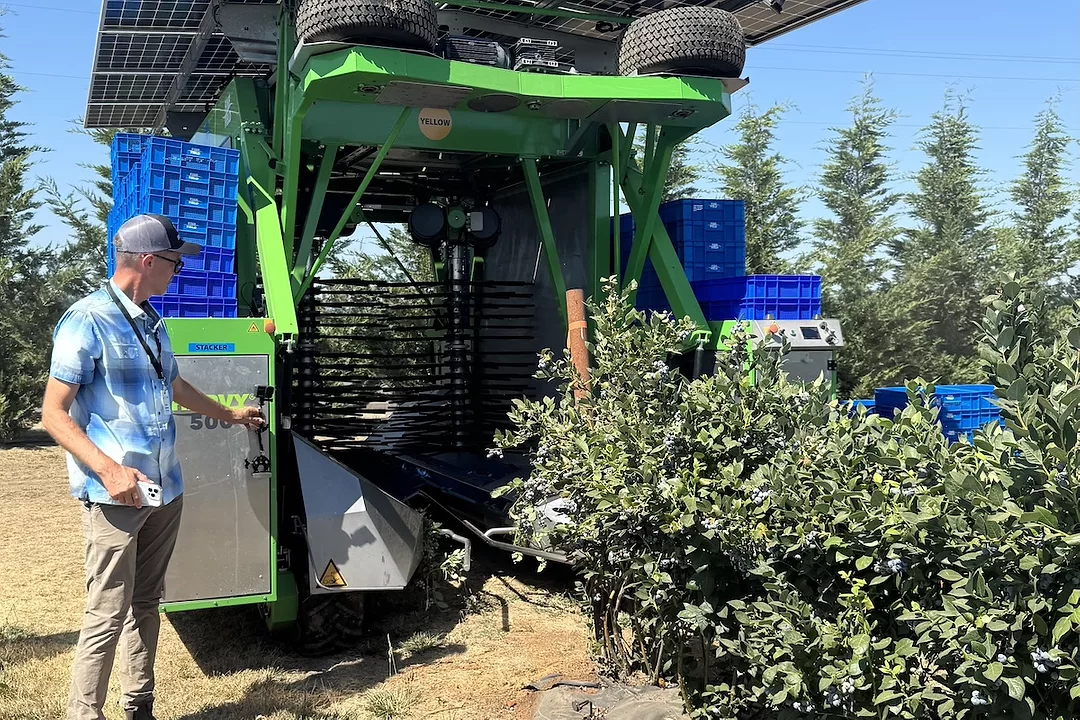
Innov8.ag CEO Steve Mantle an agtech data services and automation provider, inspects a FineField Harvy 500 being used for a late-season harvest at an Oregon blueberry farm. Photo: Courtesy of Innov8.ag.
Traditionally, agriculture conjures images of workers tilling fields and picking crops. But as climate change has led to longer dry seasons, strained water supplies and reduced yields, farmers have turned to a wide range of modern technologies that are anything but traditional.
"Today we know that robotics and automation can actually influence yield, soil health, and the quality of water, and also allow you to replace herbicides," says Liron Cohen-Yanay, the CEO of agtech company Agripass.
While robotic systems that harvest crops are hardly a new concept, the industry has proven to be one in which it is tough to survive in the long term. At least six robotic harvesting companies declared bankruptcy between 2021 and 2025, driven by high development costs, unpredictable field conditions, and the challenges of convincing growers to invest in machines that are costly, seasonal, and often less reliable than human labor. Even so, others have found success by focusing on machines that perform simple tasks related to a single crop — for example, FineField's robotic blueberry picker, Harvy 500, which runs on solar power and has proven capable of achieving close to hand-harvest quality — or any number of specialized machines produced by agtech giant Oxbo.
Others still have focused on machinery that treats soil before a crop is ever planted, using technology known as adaptive selective tilling (AST). Over the years, Cohen-Yanay explains, farming methods like tillage — where soil is loosened and broken up to bury weeds — have caused fields to absorb less water and yield fewer crops. And while tillage can be an effective way to keep weeds at bay and prepare smooth beds of soil for new seeds, it can siphon moisture, erode soil, and release carbon stored in roots and crop residue into the atmosphere.
To address those challenges, AST uses 3D terrain mapping and real-time sensors to uproot and turn over soil only when and where it's needed, rather than plowing a whole field the same way on a set schedule. AST also takes into account a host of factors, in order to target areas that need to be tilled, including soil moisture and compaction, weed pressure, crop residues and nutrient needs. Agripass estimates that AST can lead to a 10-time reduction in greenhouse gas emissions, help soil beds retain more water, and even eliminate the need for harmful pesticides.
Elsewhere, scientists in Washington state have been searching for ways to address water scarcity in the Yakima River Basin, where persistent drought conditions have forced local authorities to cut water allotments by as much as 40% in 2025. At a so-called "smart orchard" in Mattawa, Washington, Washington State University researchers ran trials in 2024 where they used precision automated irrigation systems to generate targeted watering schedules for apple trees. Those systems were built from a formula created by irrigation software platform SWAN Systems, which factored in data from soil moisture sensors, weather stations, GPS imagery and local weather forecasts. By the end of the study, the precision irrigation system used 52% less water than traditional watering schedules, produced 21% higher yields, and came with a 232% bump in water use efficiency.
"That's a good quantifiable example of where a grower was able to improve and differentiate their quality for their buyers, while also being more sustainable and using less water," says Steve Mantle, the CEO of agtech data services company Innov8.ag.
More than 150 miles east of Mattawa resides an Anabaptist communal farming group known as the Spokane Hutterite Brethren, who share hundreds of tons of surplus potato crops with their neighboring communities each year. Although Hutterites are selective with their uses of technology, Innov8.ag's Mantle has worked with them on digital soil mapping, in order to identify areas across tens of thousands of acres of farmland where lime — which comes from crushed limestone and is used to reduce the acidity of soil — should be applied. And by using that mapping to focus on "hot zones" instead of indiscriminately applying lime everywhere, Mantle says that the Hutterites have been able to improve their yields, both in quality and in quantity.
Although the soil mapping technology Innov8 uses comes from Canada's Soil Optix, it was originally developed in the Netherlands for mining exploration before it was adapted for agricultural purposes. In practice, soil mapping involves sensors that detect gamma rays that naturally emit from soil, and from that the technology can map the variability of texture, acidity, organic matter, and macro and micro-nutrients across large swathes of farmland. Those maps in turn give farmers a clear picture of what’s happening beneath the surface, and help them to decide exactly where to treat the soil so they can grow healthier crops and reduce waste.
Mantle points out that technology, beyond improving soil health, is increasingly being used to ease the heavy financial and physical labor demands of farming. According to the U.S. Department of Agriculture, labor costs accounted for up to 40% of upfront expenses for specialty crop farmers in 2020, making investments in automation, digital monitoring, and precision equipment a critical way for growers to stay competitive. To that end, Mantle has worked with growers on systems where workers in fields can drop totes full of what they've picked onto a digital scale, and swipe a badge with a personalized RFID chip. The scale can then track where exactly the most fruits or vegetables were picked, and deduce how efficient individual workers were on a particular day.
With that data in hand, a grower can pair their most efficient pickers with those who might be struggling, "and work to rise the tide to help them be more productive," Mantle says. In one instance, he adds, a grower was able to save more than $4,000 a day by having the most efficient 80% of their pickers work an extra 10 minutes a day, while the less productive pickers helped more with other tasks like weeding.
By reducing the need for repetitive manual work and allowing farmers to focus their labor where it’s most valuable, these tools can not only help lower costs, but also improve consistency and quality across harvests. For farmers, the path forward isn’t about choosing between tradition and technology; it’s about using the best of both to stay resilient in the face of growing global climate risks. From water and soil to labor and yields, every smart tool that eases pressure today helps ensure there’s a harvest tomorrow.
"It goes straight to the bottom line of growers," Mantle says. "We're introducing data that can be used for traceability, and to understand where your yield is coming from within the field on a year-over-year basis."
Popular Stories


.webp?height=100&t=1784001702&width=150 "013_what's_really_needed_for_'lights-out'_capability_v1-(540p).png")


SupplyChainBrain 2026 ESG Guide: ESG — The Supply Chain’s Biggest Secret
VIEW THE LATEST ISSUECase Studies


Visit Our Sponsors |