
SCB FEATURE
Report From TPM26: The Iran War Dominates Discussion of Container Shipping Outlook
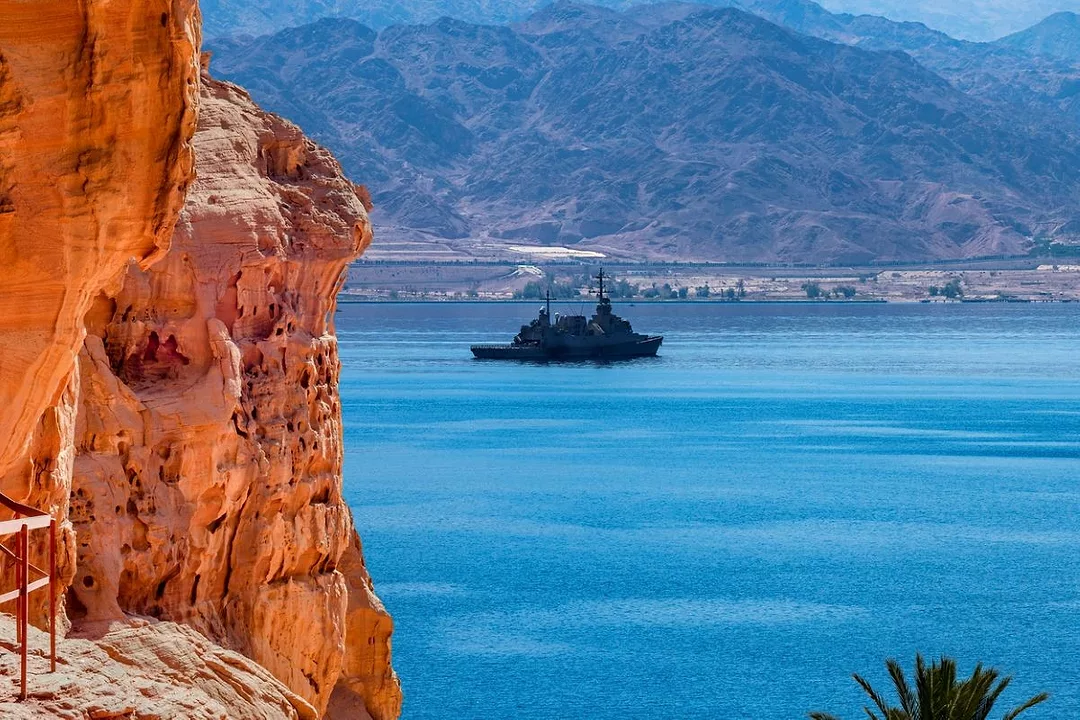
A Navy ship patrols the Red Sea. Photo: iStock/gorsh13
When they signed up to attend TPM26 in Long Beach, California this week, registrants were expecting to discuss many of the familiar crises confronting international container shipping. They had no idea what would end up being the event’s dominant topic.
Forty-eight hours before convening of the annual conference presented by S&P Global, now in its 22nd year, the U.S. and Israel launched multiple missile attacks on military, nuclear, commercial and residential sites throughout Iran. Within hours, the conflict had escalated to include more than 14 countries and territories across the Middle East, bringing ocean shipping and other modes of transportation on several key routes to a complete halt.
TPM attendees, a mix of top carrier executives, third-party logistics providers and beneficial cargo owners, could only speculate about the ultimate impact of the nascent war on global commerce, transportation and geopolitics — not to mention the human cost.
Jeremy Nixon, chief executive officer of Ocean Network Express (ONE), a joint venture of Japanese container lines Nippon Yusen Kaisha, Mitsui O.S.K. Lines and K Line, called the conflict “another Black Swan event.” By day three, some 750 ships were backed up at the shuttered Strait of Hormuz, 350 on either side, including around 100 containerships. That’s the only passage for commercial shipping from the Persian Gulf into the Gulf of Oman and the open sea. The blockage is affecting shipments of around 15 million barrels of oil per day, noted TPM26 keynote speaker Janet Yellen, former U.S. Treasury Secretary and Federal Reserve chair.
Among the war’s immediate impacts to global commerce and transportation was a 13% rise in the price of oil, to a peak of $82 a barrel. Nixon told TPM26 that oil could rise to $100 a barrel should the conflict last more than a few weeks, and producers are forced to curtail output.
Just how severely freight rates and transit times would be affected in the long run was anyone’s guess, although major container lines passing through the region said they would continue indefinitely to bypass the Red Sea and sail around the Cape of Good Hope, adding between seven and 12 days to sailings, to avoid another outbreak of missile attacks by Houthi combatants in Yemen.
The Houthis, widely considered to be a proxy for Iran, are under heavy pressure from allies to resume their attacks on Red Sea shipping in the wake of the Iran conflict, said Hisham Al-Omeisy, a consultant who serves as senior Yemen adviser and head of the PfR Steering Group at the European Institute of Peace. “A lot of people are waiting for them to attack,” he said during a TPM26 session, while noting that the Houthis also had reason to hold back while calculating the potential impact of such a move on their political influence in the region. Al-Omeisy said they might prefer to continue extracting financial concessions (some would call it extortion) from regional players and certain shipping companies, in exchange for not attacking their vessels — although he declined to state whether such payments are currently being made, and by whom.
Intense speculation over the Iran war did not crowd out discussion at TPM26 about the more general prospects for global container transportation in the coming year. A common theme was the way in which geopolitical events have replaced traditional considerations of profit and market share, which have steered carrier decisions on freight rates and capacity for decades.
“You can’t look at the industry from a classic supply-and-demand standpoint anymore,” said Nixon. Now, carriers are being buffeted by multiple conflicts in Europe, Asia and the Middle East, along with seesawing tariffs and other trade restrictions that are disrupting longtime sourcing patterns.
They’re forced to adjust service routes accordingly, while being stymied by inadequate port infrastructure the world round. Europe’s main ports “have no berths left for new services,” Nixon said, even as carriers build ever-larger containerships to take advantage of unit economies. The lines also complain that labor productivity at many world ports, especially in the U.S., isn’t sufficient to work the big ships.
Paul Gruenwald, global chief economist at S&P Global Ratings, invoked the term “geoeconomics” to describe how governments today “use their economic strength to exert influence on other countries [and] various forms of dominance.”
What economists used to consider “disruptions” caused by trade disputes have become so common, they present a permanent state of international affairs, Gruenwald said. “Tariffs and sanctions are no longer disruptions. These are policy tools now.” The day-to-day reality of global business consists of “countries projecting power and using instruments previously thought to be unsavory,” he added.
Trine Nielsen, head of global ocean freight with logistics services provider Flexport, said shipping industry “downcycles” today are another animal entirely. “It’s a new state of normal, driven by a friction economy.”
That’s hardly a welcome message for shippers, who have watched container lines rack up record profits in recent years, while cargo owners have been subjected to “blank” sailings, cargo left at the docks, and stubbornly high freight rates.
What shippers want most today, Nixon said, is service stability — “dependability more than speed.” But the global forces that continue to roil international shipping are making that wish increasingly tough to grant.
Popular Stories




SupplyChainBrain 2026 ESG Guide: ESG — The Supply Chain’s Biggest Secret
VIEW THE LATEST ISSUECase Studies


Visit Our Sponsors |
|
|
|
|
|
|
|
|
|
|
|
|
|
|
|
|
|
|
|
|
|
|
| |
|
|
|
|
|
|
|
|
|
|
|
|
|
|
|