Most warehouses today are operating systems provided by multiple vendors. Akash Gupta, CEO of GreyOrange, talks about the need for orchestration of all those applications.
Having both automated vehicles and human-operated forklifts within the same facility can cause problems if they're not properly managed, says Nicola Tomatis, CEO of Bluebotics.
Warehouse automation has advanced rapidly in recent years, but sizable gaps remain, especially when it comes to handling bulky, irregular goods that fall outside the scope of most systems.
Gina Chung, vice president of corporate development with Locus Robotics, tells how the concept of robots-to-goods is playing out in today's warehouses, and where it's going.
What's driving companies to invest in warehouse automation today? Tony Rivers, chief executive officer of Peak Technologies, describes how they're coping with the tech evolution.
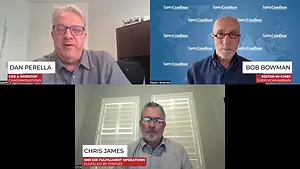
A look at how supply chains can bring together data, planning and execution, with Christine Barnhart, head of industry engagement with Miebach, and Andrew Driscoll, commercial lead-life sciences with OMP.
Jeff Burnstein, president of the Association for Advancing Automation, explains why his organization is pushing for adoption of a National Robotics Strategy in the U.S.
Meijer, the Midwest grocery chain, strives to stay ahead of the curve in charting the progress of artificial intelligence and material handling automation, says domain architect Randy McClary.
The warehouse model is under intense pressure, and operations need to fundamentally change, says Sarah Hollinger, vice president software implementation with Hy-Tek Intralogistics.