RSS
RSS
.webp?height=100&t=1782792122&width=150 "005_veteran_winemaker_gallo_embarks_on_an_ai_journey_v2-(540p).jpg")
For many years, pharmaceutical companies have struggled to track products through the supply chain. This drawback has made it easy for counterfeiters to introduce fake drugs into the market.
To counteract the problem, a new system for tracking and tracing drugs is needed. Researchers believe blockchain can provide the technological foundation for such a system, because it can track legitimate drugs and help prevent the circulation of fake ones.
Counterfeit drugs are defined by the World Health Organization as those that “are manufactured fraudulently, mislabeled, [of] low quality, hiding the source detail or identity, and [not following] the defined standard.”
While such drugs may include some genuine ingredients, they can also contain toxic ingredients at the production level. If consumed, they can cause serious health problems.
Sometimes the makers of counterfeit medications use the logos of reputable companies to get their products into the market. Although a worldwide problem, this practice disproportionately affects developing countries.
Counterfeit drugs are distributed throughout a highly complex network, making them difficult to detect and remove. To prevent their distribution, a system is needed that can trace and track drug delivery at every stage. Blockchain is the latest innovation that promises to achieve this objective.
Blockchain was originally created to serve as the transaction log for Bitcoin. It provides a distributed ledger for the storage of data records, which are arranged in multiple “blocks.” The data collected includes the time, date, price, and participants involved in each transaction. When one block changes, all the pieces update accordingly, ensuring up-to-date information for every transaction.
When applied to the pharmaceutical supply chain, blockchain offers an electronic ledger by which everyone in the network can see and validate information.
To create a secure drug supply-chain management system, designers proposed the use of blockchain with Hyperledger fabric. This software is capable of monitoring and tracking all parts of the drug-delivery process. It can configure multiple world state databases to maintain a set of current values. When applied to the pharmaceutical world, it enables medicines to be accurately traced regardless of where they are in the world.
To combat counterfeit drugs, researchers have proposed a blockchain and machine learning-based drug supply-chain management and recommendation system (DSCMR). It’s important to distinguish between these two complementary components — in the drug-management system, users can track the drug at every step, make orders, update orders, and more, while the recommendation system identifies the best medicine for pharmaceutical customers through the use of N-gram and LightGBM machine learning-based modules.
With the drug supply-chain management system, users can perform transactions such as checking drug information, tracking and tracing orders, and updating records. Users can include patients, doctors, manufacturers, distributors, pharmacies, and hospitals. Data related to various users is stored within the blockchain, which is demonstrated in this image.
Each user is provided with a web application by which they can perform transactions and communicate with the blockchain network, as well as track the status of delivery. To ensure security throughout the pharmaceutical supply chain, all users must receive permission to check the complete details of drugs. They use the client application to log in and perform their respective transactions.
To submit a transaction proposal, users must make a request using their credentials. If deemed valid, the request is sent to peer nodes in the system to be reviewed and approved. These nodes examine the proposal and grant approval if it fulfills the smart contract criteria. They also validate the results of the transactions and record them in the ledger. Once this action has been completed, the ledger updates all data for everyone to see. The proposed procedure can be seen here.
For the drug-recommendation system, a public review dataset based on reviews of drug users was created to train the system and predict the most effective drugs available in the industry. Review data includes information about side effects, benefits, and comments from customers received in the client application mentioned earlier.
The recommendation system is also able to train itself through the N-gram model, by recognizing new reviews and updating the results accordingly. This is shown in this figure.
The use of smart contracts limits the number of individuals involved in a given transaction. A smart contract provides parties with a means to exchange information, property, or even money without the use of a third-party agent or broker. Typically, it consists of lines of computer code that enforce the agreement.
In the proposed network, Java and Node.JS were used to write smart contracts. They are stored in the distributed ledger of the blockchain, where they are protected against tampering or possible deletion.
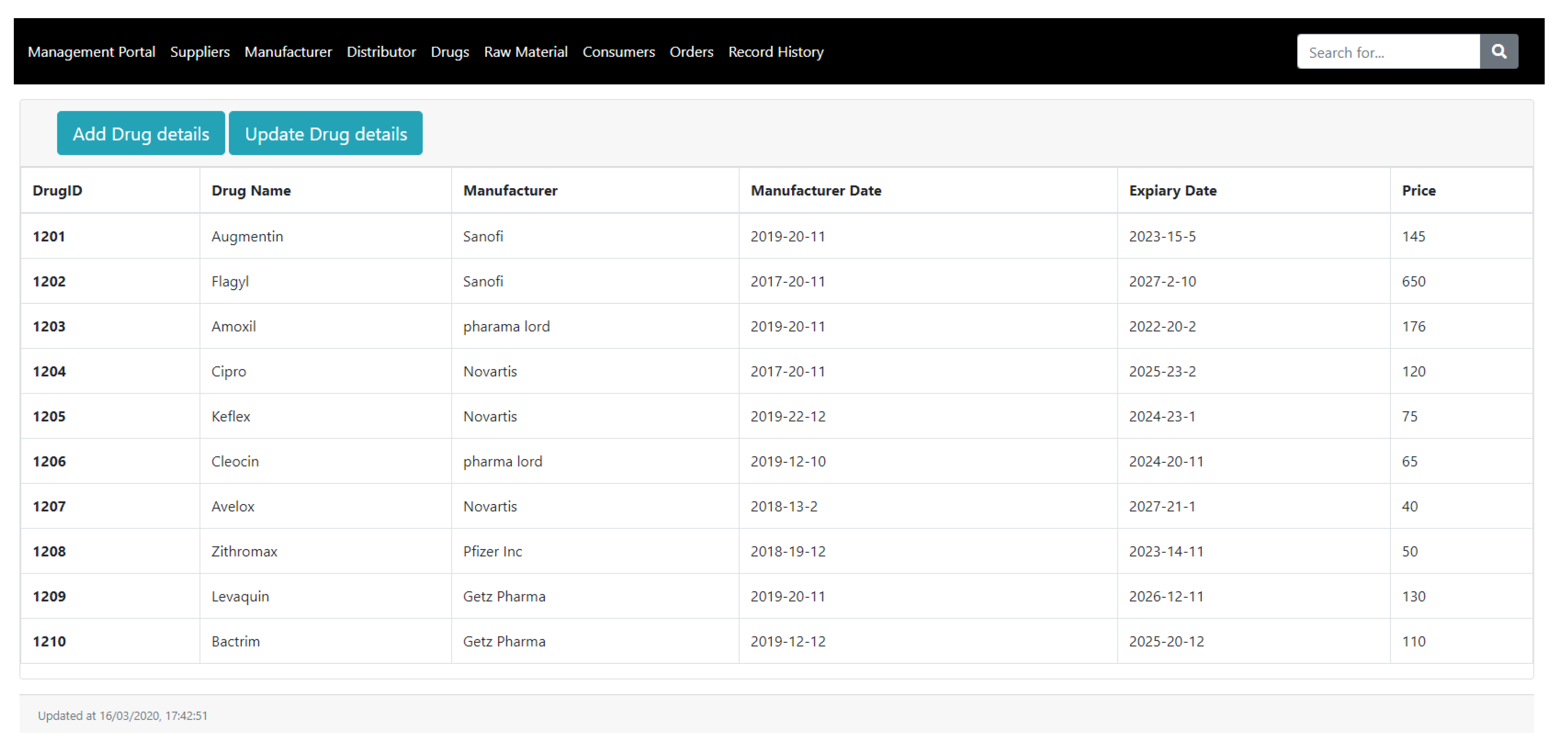
Several conclusions emerged from testing the proposed machine learning-based DSCMR system. In the drug-management system, the client application mentioned earlier can communicate with the blockchain effectively. Once a user’s identity is validated by the peer nodes, they are able to start transactions. As shown in this figure, manufacturers can add, update, or delete drug details in the blockchain. Other participants such as doctors, hospitals, and pharmacies can view these records and make changes and updates to the drug information as needed, as seen here.
The REST server composer aids in communication between the client application and blockchain. Any requests to validate transactions are sent through the server, then stored in the blockchain. This process is demonstrated here.
As for the drug-recommendation system, four conditions were tested: acne, high blood pressure, anxiety, and alcohol dependence. Using the client application, the system worked to accurately suggest the best medicine for customers in a secure and transparent way. Patients could also track the drug source to determine whether it was real or fake.
The DSCMR system offers four main advantages in combating drug counterfeiting:
- It can recommend the top-rated and best medicine to customers.
- It allows patients to access the system directly through a client application, and pharmaceutical customers such as doctors by using their credentials.
- It can provide customers with a secure and transparent experience.
- Patients can check the entire source of their drug by scanning a barcode.
Whether it’s doctors, pharmacists, hospitals, or manufacturers, everyone involved in the chain will be able to track the relevant drug along the supply chain. This helps to prevent the entry of fake drugs into the chain, and reduces the problem of counterfeit drugs.
Daniel Browning is business development coordinator at Do Supply Inc.