
Biden Confronts Decades of Union Decline in Bid to Boost Pay
President Joe Biden’s strategy of bolstering labor unions as a way to enhance American workers’ pay is running up against a half century of setbacks for organizing workers.
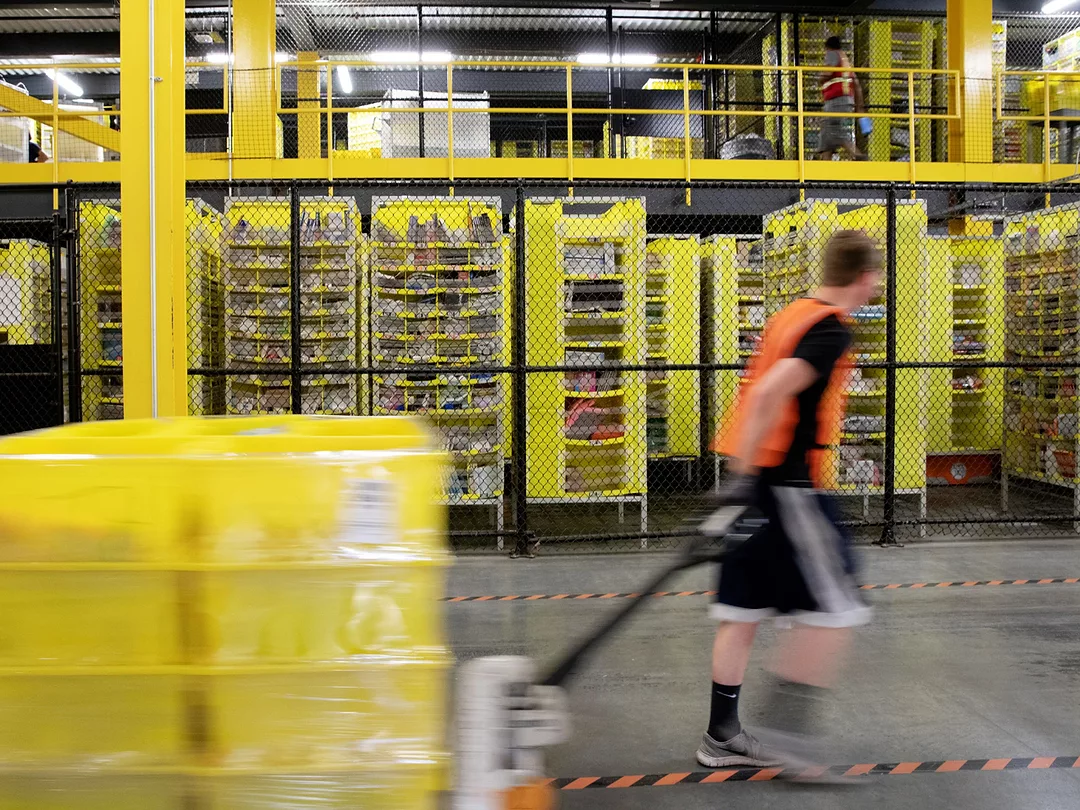
In a high-profile move this month, Amazon.com Inc. workers at a Bessemer, Alabama, warehouse voted against joining a retail union, despite a pro-labor video message to the distribution workers from Biden.
Labor union membership has slumped to 10.8% of wage-and-salary employees in 2020 from almost a third of workers in 1960. The globalization of supply chains, technological advancements that allow companies to replace labor, legal barriers to organizing and the shrinking share of factory workers — traditionally easier to organize — in the workforce have all taken a toll.
Creating “good-paying, union jobs” is a centerpiece of Biden’s $2.25 trillion infrastructure-focused economic plan, which also calls for new laws to encourage unions. “Even in the face of automation and globalization, America can and must retain well-paid union jobs and create more of them all across the country,” according to a White House summary.
Wage growth was relatively subdued for most of the 2010s expansion. With unemployment still elevated in the wake of the pandemic, boosting productivity and generating a tight labor market may provide a more viable path to raising pay than unionizing.
“It will be very hard to resuscitate unions and collective bargaining in their current form,” said Harry Holzer, a Georgetown University professor and former U.S. Labor Department chief economist during the Clinton administration. “While I am sympathetic to strengthening unions, I am very pessimistic.”
Biden is pushing to pass the Protecting the Right to Organize (PRO) bill, which is intended to boost union membership after decades of decline. While the House approved the measure in March, it faces long odds in the Senate, where it will need the support of at least 10 Republicans.
Lost Wages
That proposal would abolish state “right-to-work” laws that ban mandatory collection of dues or fees as a condition of employment, penalize employers that retaliate among union drives and extend federal labor rights to many workers currently classified as independent contractors, among other measures.
While the White House continues to push the bill as a priority, the administration has other tools, such as directing federal spending to American-made goods.
“The president is going to be looking for more ways and more opportunities to strengthen worker organizing and empower workers because he thinks it’s absolutely critical to his economic agenda, to American democracy and to countering corporate abuse and the power of Wall Street in policy making,” said Seth Harris, deputy assistant to the president and a labor adviser.
Tim Schlittner, a spokesperson for the AFL-CIO, said that while the union is strongly advocating for the PRO Act, the infrastructure proposal would “still be very good for working people” without the measure.
Declining unionization translates to a loss of $1.56 per hour worked, the equivalent of $3,250 for a full-time, full-year worker, according to an estimate by the left-leaning Economic Policy Institute.
Celine McNicholas, EPI’s director of government affairs and labor counsel, said that tying federal contract dollars to union jobs wouldn’t be sufficient for creating a workforce with strong union density.
“It will make a difference, but you absolutely need meaningful labor-law reform, not nibbling around the edges and offering piecemeal” measures, she said. “The system is fundamentally broken and requires fundamental reform.”
Campaign Fizzles
American companies have mostly resisted unions, as Amazon has. Manufacturers have built factories in other countries to help neutralize U.S. unions.
But even industries where work can’t be moved abroad — like warehousing, trucking and retail — have seen steady erosion in unions and the rise of nonunion employers. In the Amazon defeat, organized labor failed to win the hearts and minds of workers despite a pandemic that put a spotlight on front-line worker safety.
Falling unionization has contributed to rising inequality among American workers, and just stabilizing the trend would make a difference, said Mark Zandi, chief economist for Moody’s Analytics.
“Unionization has steadily declined over the past several decades, and arresting its decline won’t be easy or immediate,” he said. “But if we are going to address the income and wealth inequities, it is important for policy to be a tailwind to unionization and not a headwind.”
While unions may be a factor in pay, prospects for a tighter labor market offer the promise of raising incomes. Biden has touted his economic proposals as helping to return the U.S. to full employment relatively quickly.
Pay for hourly workers and minorities accelerated in 2019 as the U.S. unemployment rate fell to the lowest level in half a century. Economists are forecasting the jobless rate will drop to 3.8% by 2023, creating more bidding by employers for hard-to-hire workers.
In addition, economists say raising productivity will be a significant factor in long-term compensation trends.
Increased union organizing “is unlikely to contribute to an increase in wage growth in the long run,” said Bart Hobijn, an Arizona State University economist who formerly worked at the Federal Reserve Bank of San Francisco. “What drives wage growth in the long run are technology and globalization as well as education and infrastructure investment.”
While many economists say there’s a clear link between pay and productivity over the long term, there have also been decades when productivity has been strong and wages have lagged. A 2017 paper co-written by former Treasury Secretary Lawrence Summers, who also served as an Obama White House adviser, found that productivity growth was helpful to the pay of middle-income Americans but not enough alone to raise living standards substantially.
Popular Stories





SupplyChainBrain 2026 ESG Guide: ESG — The Supply Chain’s Biggest Secret
VIEW THE LATEST ISSUECase Studies


Visit Our Sponsors |
|
|
|
|
|
|
|
|
|
|
|
|
|
|
|
|
|
|
|
|
|
|
| |
|
|
|
|
|
|
|
|
|
|
|
|
|
|
|