• Advertise
  • Contact Us
  • Supplier Directory
  • SCB YouTube
  • About Us
  • Login
  • Subscribe
  • Logout
  • My Profile
  • LOGISTICS
    • Air Cargo
    • All Logistics
    • Facility Location Planning
    • Freight Forwarding/Customs Brokerage
    • Global Gateways
    • Global Logistics
    • Last Mile Delivery
    • Logistics Outsourcing
    • LTL/Truckload Services
    • Ocean Transportation
    • Parcel & Express
    • Rail & Intermodal
    • Reverse Logistics
    • Service Parts Management
    • Transportation & Distribution
  • TECHNOLOGY
    • All Technology
    • Artificial Intelligence
    • Cloud & On-Demand Systems
    • Data Management (Big Data/IoT/Blockchain)
    • ERP & Enterprise Systems
    • Forecasting & Demand Planning
    • Global Trade Management
    • Inventory Planning/ Optimization
    • Product Lifecycle Management
    • Robotics
    • Sales & Operations Planning
    • SC Finance & Revenue Management
    • SC Planning & Optimization
    • Supply Chain Visibility
    • Transportation Management
  • GENERAL SCM
    • Business Strategy Alignment
    • Customer Relationship Management
    • Education & Professional Development
    • Global Supply Chain Management
    • Global Trade & Economics
    • Green Energy
    • HR & Labor Management
    • Quality & Metrics
    • Regulation & Compliance
    • Sourcing/Procurement/SRM
    • SC Security & Risk Mgmt
    • Supply Chains in Crisis
    • Sustainability & Corporate Social Responsibility
  • WAREHOUSING
    • All Warehouse Services
    • Conveyors & Sortation
    • Lift Trucks & AGVs
    • Order Management & Fulfillment
    • Packaging
    • RFID, Barcode, Mobility & Voice
    • Warehouse Automation
    • Warehouse Management Systems
  • INDUSTRIES
    • Aerospace & Defense
    • Apparel
    • Automotive
    • Chemicals & Energy
    • Consumer Packaged Goods
    • E-Commerce/Omni-Channel
    • Food & Beverage
    • Healthcare
    • High-Tech/Electronics
    • Industrial Manufacturing
    • Pharmaceutical/Biotech
    • Retail
  • THINK TANK
  • WEBINARS
    • On-Demand Webinars
    • Upcoming Webinars
    • Webinar Library
  • PODCASTS
  • WHITEPAPERS
  • VIDEOS
Home » Factories Minus People: It’s Dark in There
SCB FEATURE

Factories Minus People: It’s Dark in There
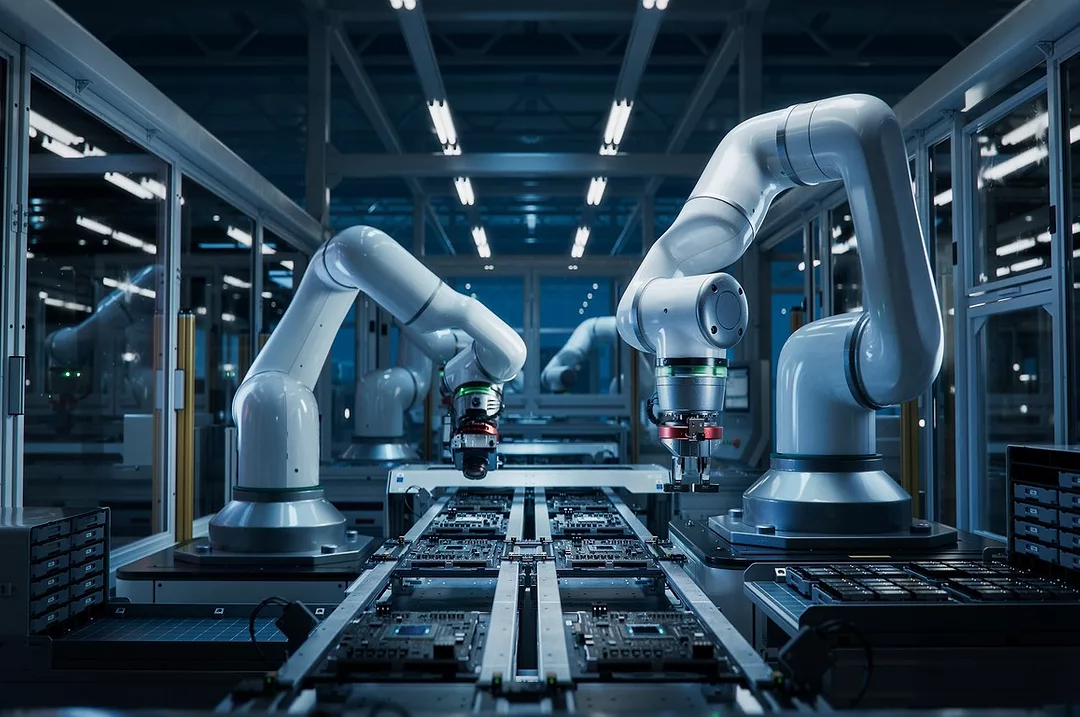
Robot Arms on Fully Automated PCB Assembly Line Inside Modern Electronics Factory

Photo: iStock/SweetBunFactory

April 6, 2026
Robert J. Bowman, SupplyChainBrain

It might seem like something out of science fiction, but there are a number of places around the world where it’s already a reality: factories operating 24/7 without any humans on the plant floor.

The “dark” or “lights-out” factory — robots don’t need to “see,” so illumination is minimal to non-existent — makes sense in a limited number of operations today. At the moment, it’s best suited for handing certain e-commerce orders, grocery items and industrial spare parts. The technology involved is typically a combination of automated storage and retrieval systems (AS/RS), autonomous mobile robots (AMRs) and conveyors — all controlled by artificial intelligence and sensors tied to the internet of things. Human presence is limited to people sitting at terminals and overseeing the operation — or coming in and repairing the machines when they go down.

With all the hype attending robots and AI, coupled with the difficulty of finding enough people who actually want to work in a factory today, one might assume that dark plants are popping up everywhere. But that’s not exactly the case.

The concept is gaining traction, especially in the U.S., but has yet to take over the world of production and material handling, says Vijay Narayan, business unit head of manufacturing, logistics, energy and utilities with Cognizant, an information consulting and outsourcing company.

Narayan cites the recent announcement by Hyundai Motor Group of a $26 billion investment in industrial production in the U.S., and Ford Motor Company promising to spend $5 billion on plants in Kentucky and Michigan, as evidence that manufacturers are ramping up automation in the factory. It only makes sense that similar technology would migrate to the warehouse.

The latest push was triggered in part by COVID-19, which took humans out of the workplace, and caused many to consider whether they ever wanted to come back. Factory work, of course, isn’t something that can be done by workers from home, but the general image of a production center as a place of drudgery has contributed to the difficulty of finding enough labor to staff it. Add to that the cost of hiring those who are willing to take on the job, and you have a solid case for more “lights-out” automation. It’s no surprise that many of the dark factories that exist today are in countries where labor costs are highest.

Narayan has spent some 30 years in the manufacturing sector, but says the last two to three have been “very different” when it comes to accessing a pool of skilled human labor. Hence the age of “smart” manufacturing, a sector that’s expected to grow in value by as much as 8% annually in the U.S. over the next five years, reaching $40 billion by 2030, and close to $200 billion globally.

That said, Narayan expects manufacturers to maintain a hybrid model of human and robots over the next eight to 10 years. “In the U.S,” he says, “it’s going to be tough to make it completely dark.”

He sees an adoption curve similar to that of self-driving cars, which continue to present hurdles when solving the most difficult use cases, even though the basic technology already exists.

The decision by a factory or warehouse to go “dark” must be based on a careful assessment of return on investment, taken on a case-by-case basis, Narayan says. Facilities looking to go all-out on automation face the possibility at some point of diminishing returns.

“The technology is there,” he says, “but do you really want to get there?” Getting to between, say, 75% and 98% automated might yield big efficiencies, but there remain tasks where human effort is still more efficient and economical than deploying a pricey army of robots.

The best candidates for going completely dark in manufacturing and material handling are those in which production is “more continuous, very mechanical,” Narayan says, citing process and metal industries as examples. Automotive is also “very amenable” to smart manufacturing and dark factories — no surprise, given that it was among the first industries to embrace mass automation in the early years of the 20th century.

Many of the dark facilities of the future will likely be greenfield projects, rather than existing factories swapping out their old equipment and systems. “It’s easier when you’re trying out things that are completely new,” Narayan says. “The ROI becomes that much easier.”

Eventually, near-total automation will become the key to survival of many factories and warehouses, Narayan believes. He predicts that dark facilities will be prevalent by the middle of the next decade. “By 2033 to 2038,” he says, “we’ll see a significant number of factories 95% automated.”

    RELATED CONTENT

    RELATED VIDEOS

    Artificial Intelligence Robotics HR & Labor Management Warehouse Automation Industrial Manufacturing
    • Related Articles

      Opinion: When Factories Have a Choice Between Robots and People, It's Best to Start With People

      Big Data Grows in Importance, But There Aren't Enough Qualified People to Fill Analytics Jobs

      Supply Chains Crave Digitization — But Not the People to Make It Happen

    • Related Directories

      ProcureAbility

    Robert J. Bowman, SupplyChainBrain

    Watch: How eGourmet Solutions Scaled Order Management to Meet Rapid Growth

    More from this author

    Subscribe to our Daily Newsletter!

    Timely, incisive articles delivered directly to your inbox.

    Featured Product

    Popular Stories

    • A pair of hands reaches towards a cluster of icons showing global logistics network distribution and transportation

      CSCMP's State of Logistics Report: Get Used to the Fog

      Logistics
    • Ebook_TransformingSupplyChain_thumbnail.jpg

      Transforming Your Supply Chain From Cost Center to Growth Driver

      Forecasting & Demand Planning
    • TWO WORKERS DISCUSS DATA SHOWN ON COMPUTER SCREENS

      Gartner: Gap in SC AI Talent Cannot Be Closed by Hiring Alone

      Artificial Intelligence
    • GOVERNANCE SCRUTINY RISK MANAGEMENT ASSESSMENT iStock-champpixs-1465316262.jpg

      Supply Chain Resilience Is Now a Board Governance Imperative

      Supply Chain Finance & Revenue Management
    • 015_bringing_the_loading_dock_up_to_speed_v1 (540p).png

      Watch: Bringing the Loading Dock Up to Speed

      HR & Labor Management

    Digital Edition

    2026 esg cover main scb q2 2026 cover

    SupplyChainBrain 2026 ESG Guide: ESG — The Supply Chain’s Biggest Secret

    VIEW THE LATEST ISSUE

    Case Studies

    • Recycled Tagging Fasteners: Small Changes Make a Big Impact

    • A GRAPHIC SHOWING MULTIPLE FORMS OF SHIPPING, WITH A HUMAN STANDING AT THE CENTER, TOUCHING A SYMBOLIC MAP OF THE WORLD

      Enhancing High-Value Electronics Shipment Security with Tive's Real-Time Tracking

    • A GRAPHIC OF INTERLACING HONEYCOMBED ELEMENTS REPRESENTING GLOBAL BUSINESS TRANSACTIONS

      Moving Robots Site-to-Site

    • JLL Finds Perfect Warehouse Location, Leading to $15M Grant for Startup

    • Robots Speed Fulfillment to Help Apparel Company Scale for Growth

    Visit Our Sponsors

    4flow Arkieva Blue Yonder
    Carton Cloud CoEnterprise Dassault
    Duravant E2Open General Logistics Systems
    Hy-Tek iGPS Korber
    Lyngsoe Procurability Quinyx
    SAP Sikick Systech
    S&P Global Mobility TADA TransImpact
    US Bank Werner Enterprises WSI
    • More From SCB
      • Featured Content
      • Video Library
      • Think Tank Blog
      • SupplyChainBrain Podcast
      • Whitepapers
      • On-Demand Webinars
      • Upcoming Webinars
    • Digital Offerings
      • Digital Issue
      • Subscribe
      • Manage Email Preferences
      • Newsletters
    • Resources
      • Events Calendar
      • 2026 Event Coverage
      • SCB's Great Supply Chain Partners
      • Supplier Directory
      • Case Study Showcase
      • Supply Chain Innovation Awards
      • 100 Great Partners Form
    • SCB Corporate
      • Advertise on SCB.COM
      • About Us
      • Privacy Policy
      • Contact Us
      • Data Sharing Opt-Out

    All content copyright ©2026 Keller International Publishing Corp All rights reserved. No reproduction, transmission or display is permitted without the written permissions of Keller International Publishing Corp

    Design, CMS, Hosting & Web Development :: ePublishing